How Much Does Memory Care Cost? Prices by State, Plus What Families Pay Over Assisted Living
Published on October 17, 2026

Memory care typically costs $6,252 a month in the United States, and the middle half of communities charge between $5,300 and $7,316. At communities that offer both levels of care, memory care runs about $1,595 a month more than assisted living in the same building. Those are the published rates, and the real bill is usually higher once care-level and medication charges are added.
That is the short answer. The long answer is the one families need, because the number on the brochure is rarely the number on the invoice. This guide sets out the national prices by service, the state and regional figures, what memory care adds over assisted living and why, the charges that grow the bill after move-in, how memory care compares with in-home care and nursing homes, and how families pay. It ends with every city page on this site.
A word on where the numbers come from. Prices in this guide come from the published price lists of more than 600 memory care and senior living communities listed in this directory, collected in September 2026. We show the median (the middle price) so one very cheap or very expensive one does not skew it. “Middle half” means the range between the cheapest quarter and the most expensive quarter of communities. Only prices a community itself labelled memory care are counted as memory care, and the same goes for assisted living and independent living. Prices change, so treat these as a guide, not a quote.
What Memory Care Costs Per Month
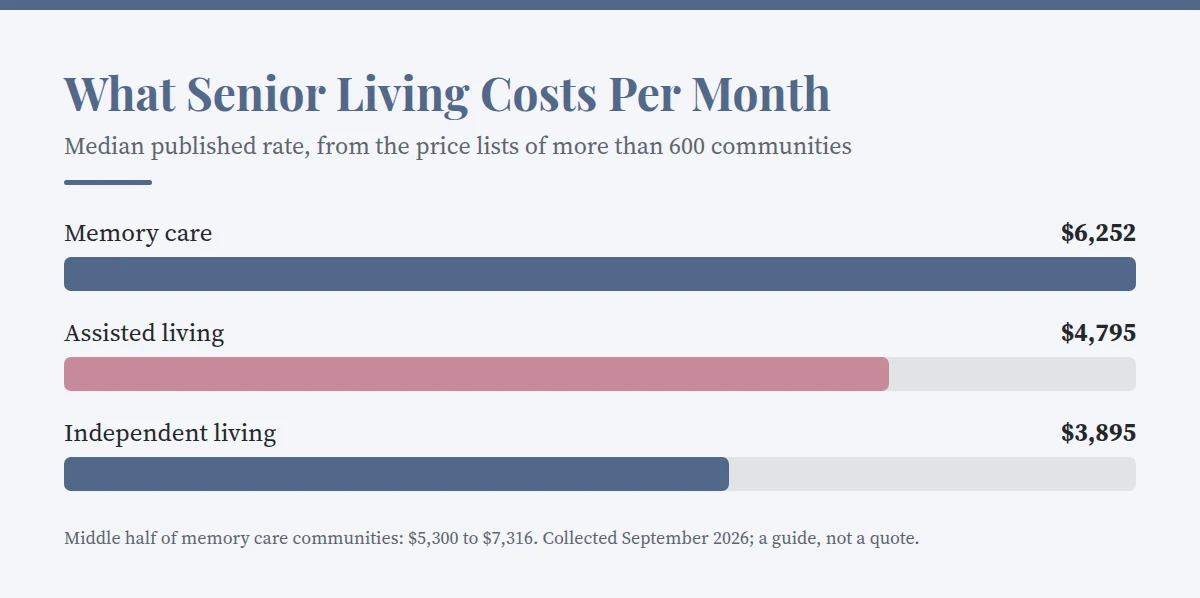
Table 1. National prices by service, from the price lists communities publish themselves.
| Service | Typical price (median) | Middle half of communities |
|---|---|---|
| Memory care, per month | $6,252 | $5,300 to $7,316 |
| Assisted living, per month | $4,795 | $3,995 to $5,534 |
| Independent living, per month | $3,895 | $3,156 to $4,609 |
| Second-person fee, per month | $950 | $908 to $1,154 |
| Community fee (one time, at move-in) | $2,500 | $1,500 to $4,500 |
| Respite (short) stay, per day | $288 | $186 to $388 |
| Security deposit | $862 | $500 to $1,338 |
The memory care rate is a monthly charge that includes the room, meals and the community’s dementia care program. In practice that means a private or shared apartment inside a secured unit, three meals a day plus snacks, housekeeping and laundry, a planned daily program, and staff on the unit around the clock. Fees in the table are one-time unless the row says per month or per day.
Two things drive the spread between $5,300 and $7,316. The first is the room. A shared companion suite is priced below a private studio, and a one-bedroom with its own bathroom costs more again. The second is the care. Some communities quote an all-inclusive rate that covers whatever help a resident needs; most quote a base rate for the room and meals and then add a care charge set by an assessment. A community whose published figure looks cheap may simply be publishing the base rate.
Beyond those two, the price reflects what sits behind the door: whether the unit is a fully secured wing or a few rooms at the end of a hallway, how many staff are on the floor overnight, the age of the building, and the local cost of labor and real estate, which is why the next two tables split the figure by state and region. And the most important sentence in this guide is the one in the method note: most communities add care-level or medication charges on top, so a family’s real bill is often higher than the listed rate.
Memory Care Prices by State and Region
A state figure is only worth printing when enough communities in that state publish a memory care price. At the moment one state clears that bar on its own.
Table 2. Memory care, per month, by state (states with 15 or more priced communities).
| State | Memory care, per month (median) | Middle half |
|---|---|---|
| Texas | $5,550 | $4,995 to $6,635 |
Texas is the only state with enough priced memory care communities for a figure of its own, and its median sits below the national one. For every other state with city pages on this site, the communities are grouped by region, so the figure below is a combined median for the states listed in that row.
Table 3. States with fewer priced communities, grouped by region (memory care, per month).
| Region | States with fewer than 15 priced communities | Memory care, per month, median (combined) |
|---|---|---|
| Midwest (other states) | Illinois, Indiana, Kansas, Michigan, Minnesota, Missouri, Nebraska, Wisconsin | $6,570 |
| South (other states) | Florida, Georgia, Kentucky, Maryland, North Carolina, Oklahoma, Tennessee, Virginia | $6,372 |
| West (other states) | Arizona, California, Colorado, Nevada, New Mexico, Oregon, Washington | $6,125 |
New Jersey and Pennsylvania have too few priced communities to show a figure; for those two states, use the national table above. No city has 10 or more priced communities for this figure yet, so there is no city table; for a city, use its state or region figure. A city median built on a handful of price lists would swing with every new listing, and city figures will follow as more communities publish their prices.
How to use these three tables together: find your state or region, then check the national middle half. A quote inside the middle half is ordinary. A quote above $7,316 should come with a visible reason, such as a one-bedroom unit, a new building, or an all-inclusive care rate. A quote below $5,300 deserves a question about what the base rate leaves out.
What Families Pay Over Assisted Living, and Why
Table 4. Memory care compared with assisted living at the same community, per month (communities that publish both prices).
| Comparison | Typical difference (median) | Middle half of communities |
|---|---|---|
| Memory care compared with assisted living at the same community, per month | $1,595 more | $869 to $2,303 more |
This is the fairest comparison in the guide. Each community’s own two prices are compared, so differences between towns and operators cancel out: this row compares the memory care wing with the assisted living wing down the hall, where Table 1 compares different buildings in different places. Families pay about $1,595 a month more for memory care, and at the middle half of communities the premium runs from $869 to $2,303.
That premium buys four things.
A secured setting, staffed around the clock. A memory care unit is built so that a person who cannot find the way back can wander safely. Doors to the outside are alarmed or delay-release, courtyards are enclosed, and the floor plan loops rather than dead-ends. The Alzheimer’s Association notes that a special care unit may or may not be locked, so ask. Delaware’s dementia care law requires every staff member on a secured memory care unit to be trained in preventing and responding to a resident’s unauthorized exit. Security is a cost whether the unit is full or half empty, because the staff have to be awake and present inside it all night regardless.
Dementia-specific staff training. Many states set training floors for secured units that do not apply to general assisted living. In Texas, a certified Alzheimer’s facility must give all staff four hours of dementia-specific orientation before they take on any job duties, follow it with 16 hours of supervised on-the-job training for attendants, and attendants then complete 12 hours of in-service education on Alzheimer’s every year. Kentucky requires eight hours of dementia-specific orientation within the first 30 days for everyone working on a secured unit, 16 hours of specialized dementia training for direct care staff, and eight hours a year after that. Delaware sets four hours initially and four hours a year for direct care staff, and two hours initially and two a year for everyone else. Training costs money and keeping trained staff costs more, and both show up in the rate.
More hands per resident. Federal survey data on residential care communities as a whole found that about two in five residents have a diagnosis of Alzheimer’s disease or another dementia and that 62 percent need help with three or more activities of daily living. A memory care unit concentrates the residents who need the most help, and the help is slower: a person in the middle stages of dementia needs cueing through each step of bathing, dressing and eating rather than a hand with one of them. Delaware’s law requires a written staffing plan for the secured unit that meets each resident’s scheduled needs, and state inspectors check that the plan is staffed.
A structured day. Good memory care runs a program, not an activity calendar, because unstructured hours are when distress and wandering peak. Delaware’s staffing plan must detail the staffing for activity services inside the secured unit, and that is the right question anywhere: who runs the program, how many hours a day, and what happens on weekends.
If the premium is out of reach, the alternative most families land on is general assisted living with a dementia diagnosis in the file. Nearly half of assisted living residents now live with dementia, and the care they get varies enormously. Before choosing that path, read what families should demand when memory care is not an option, because the questions in it are the difference between a bargain and a bad placement.
The Charges That Grow the Bill After Move-In
The listed rate is a floor. These are the charges that stack on top of it, and the figures given are the only ones in this directory’s data; for the rest, ask for the community’s fee schedule in writing.

Care levels or points. Most communities assess each resident on move-in and assign a care level, or a point total, with a monthly charge attached. Dementia progresses, so levels rise, and the admission agreement almost always gives the community the right to reassess and re-price. Ask what the scale looks like, what your parent’s assessed level would be today, and what would move them up a level. The National Institute on Aging’s advice to families is to ask what the fee includes, what would cost extra, and whether the dementia unit’s prices differ from the rest of the building.
Medication management. Storing, dispensing and documenting medications is usually a separate charge, priced either as a tier or by the number of medication passes a day. A resident on several daily medications can sit in the top tier from day one.
Incontinence care and supplies. Incontinence care is often its own add-on, and supplies are frequently billed separately or expected from the family. Ask which.
The community fee. This is a one-time charge at move-in, with a median of $2,500 and a middle half of $1,500 to $4,500. It is usually described as covering move-in preparation and the initial assessment, and it is usually not refundable. It is separate from the security deposit, which has a median of $862 and a middle half of $500 to $1,338, and which should be refundable subject to the agreement. Get both facts in writing, because the refund rules are what your family will be reading when the apartment is cleared out. The guide to what happens after a loved one with dementia dies covers the memory care refund and how to chase it.
The second-person fee. When two people share one apartment, typically a spouse or partner, the community charges a second-person fee of $950 a month at the median, with a middle half of $908 to $1,154. It covers the second resident’s meals and services, not a second room.
Respite stays. A short stay in memory care, used for a caregiver’s break or as a trial before a permanent move, has a median price of $288 a day and a middle half of $186 to $388. Many communities fold a respite stay’s community fee into the daily rate or waive it; ask.
Rate increases. Expect two kinds: an annual increase on the base rate and a care-level increase whenever a reassessment moves your parent up. Many states require advance written notice for the first kind. Arizona, for example, requires at least 30 days’ written notice before any increase in a fee or charge, except when a resident’s need for services changes as documented in the service plan. That exception appears in other states’ rules too, and it is the one that matters in memory care, because care-level increases are the ones a dementia diagnosis makes likely. Minnesota’s Office of Ombudsman for Long-Term Care reported in March 2026 that fees and rent were rising at an incredibly fast pace, often without explanation, that facilities were not sharing fee schedules, and that the issue made up roughly a tenth of its casework over three years. Ask any community for its last three years of increases. The admission agreement guide walks through the clauses that govern reassessment and re-pricing, and the long-term care ombudsman is the free advocate to call when a fee dispute goes nowhere.
Memory Care Compared With In-Home Care and Nursing Homes
Memory care sits between two other options, and families often compare it with both. The honest comparison is about what each buys rather than a single price, because the other two are priced on different units entirely.
In-home care is priced by the hour, so the cost depends on how many hours someone needs. A few hours of help a day, layered on top of a family caregiver, can cost well below a memory care rate. Around-the-clock coverage at home means paying for three shifts of every day, and at that point the hourly model typically costs more than a community, which spreads its overnight staff across many residents. An NIA-funded study of the seven years before death found that people with dementia living in the community and their families paid 64 percent of the total cost of care themselves, compared with 43 percent for those living in a nursing home, largely because of unpaid family hours and out-of-pocket spending. The in-home memory care guide covers when home care fits, how to hire, and the signs that the hours have outgrown the house. If the plan involves a parent moving in with you, the multigenerational caregiving guide does the math on the whole household, including the income a working caregiver gives up.

Nursing homes (skilled nursing facilities) are a medical setting, with licensed nurses on duty around the clock and physicians overseeing care. The National Institute on Aging’s description is that nursing homes focus more on medical care than assisted living or board and care homes do. Memory care is not a nursing home, and a resident whose needs become medical, such as wound care, tube feeding or two-person transfers, may be asked to move. The difference that matters most to families is who pays. Medicaid covers nursing facility care for every eligible person aged 21 or older, states cannot put that benefit on a waiting list, and the rate covers room and board. No equivalent exists for memory care. Medicare, for its part, pays for a nursing home only as short-term skilled care after a qualifying three-day inpatient hospital stay, for up to 100 days in a benefit period, with a daily charge from day 21. Observation status in the hospital does not count toward the three days, a detail that catches many families.
Hospice is not a setting but a service, and it is the exception to the pattern. Medicare’s hospice benefit pays for the clinical care, medications and equipment related to end-stage dementia wherever the person lives, including a memory care apartment, but it does not pay the community’s room and board, so the monthly rate continues. The guide to hospice care for end-stage dementia explains when a person qualifies and how the two bills fit together.
How Families Pay for Memory Care
Most families pay privately, and most of the rest pay privately for a while first. The Alzheimer’s Association puts it plainly: Medicaid pays for long-term care for people who have used up most of their own money. These are the sources, in the order families usually reach for them. Decisions about any of them belong with an elder law attorney or a certified financial planner, because a misstep in one program can cost eligibility in another.
Private funds. Savings, pensions, Social Security, the sale or rental of a home, and sometimes a reverse mortgage, an annuity or the cash value of a life insurance policy. One piece of relief families miss: the IRS treats qualified long-term care services for a chronically ill person as a medical expense. A person counts as chronically ill when a licensed practitioner certifies that they cannot perform at least two activities of daily living without substantial help, or that they need substantial supervision to be protected from threats to health and safety because of severe cognitive impairment. Meals and lodging in a home can count when a principal reason for being there is to get medical care. Whether and how much that helps depends on the rest of the tax return, so take the question to a tax professional before counting on it.
Long-term care insurance. A policy bought years earlier is the most underused asset in dementia care, usually because nobody files. Benefits start when a trigger is met, and most policies pay when the insured needs help with two or more of six activities of daily living or has a cognitive impairment; an assessment by the insurer’s nurse or social worker confirms it. Then an elimination period runs, typically 30, 60 or 90 days, during which the family pays for care before the policy does. Most policies then reimburse costs up to a daily limit until a lifetime maximum is reached. Policies generally cover care in an assisted living facility as well as at home or in a nursing home, but the exact settings depend on the policy, so read it, or have the agent read it to you, before the move.
Veterans benefits. Aid and Attendance is an addition to the VA pension for a veteran or surviving spouse who needs another person’s help with daily activities like bathing, feeding and dressing, or who is in a nursing home because of the loss of mental or physical abilities. It is income and asset tested, and dementia very often meets the care test. Assisted living and memory care communities are not run, staffed or paid for by the VA, though the VA inspects and approves the ones it refers veterans to, and VA benefits can help pay for extra services such as visits from a VA clinician. State Veterans Homes, which some states run with memory care wings, receive VA payments that help defray the cost of care. The veterans and dementia guide covers eligibility, the forms, and how to layer VA benefits with Medicare and Medicaid.
Medicaid. Medicaid is the largest payer of long-term care in the country, and it is also the hardest to use for memory care. Three facts explain why. First, eligibility is strict on both income and assets, and a transfer of money to qualify can trigger a penalty, so planning belongs with an elder law attorney. Second, whether Medicaid pays for anything inside an assisted living or memory care community depends on the state; the federal Administration for Community Living’s plain statement is that some states cover assisted living services while others do not, and that Medicaid will not pay for rent, mortgage, utilities or food. The vehicle is usually a home and community-based services waiver, which lets a state pay for services for people who would otherwise need institutional care, but federal rules exclude the cost of room and board from waiver funding except for short respite stays in an approved facility. So even in a waiver state, the family or the resident’s own income still covers the room and the meals. Third, a community has to accept Medicaid, and many take few or no Medicaid residents; in federal survey data only about 17 percent of residential care residents were Medicaid beneficiaries. Ask every community what happens when private funds run out, and get the answer in the admission agreement. After a Medicaid beneficiary dies, the state can seek repayment from the estate, which the after-death guide explains before it becomes a surprise.
Medicare. Medicare does not pay for memory care. Its own long-term care page says it does not pay for long-term care, which it also calls custodial care, whether in a nursing home, in an assisted living facility or at home. It continues to pay for the things it always paid for, which are doctors, hospital stays, short-term skilled nursing after a hospital admission, skilled home health visits and hospice. A memory care resident keeps all of that. What Medicare never covers is the monthly rate.
Free help with the financial plan. The Alzheimer’s Association’s 24/7 Helpline offers a free care consultation that can walk a family through the payment options and local programs, and a geriatric care manager or hospital social worker can tell you what the local Medicaid waiver actually covers. Make sure the person signing the agreement has the authority to do it: the advance directives and power of attorney guide covers the documents a community will ask for and the responsible-party clause that can make an adult child personally liable for the bill.
How to Read a Community’s Price Sheet
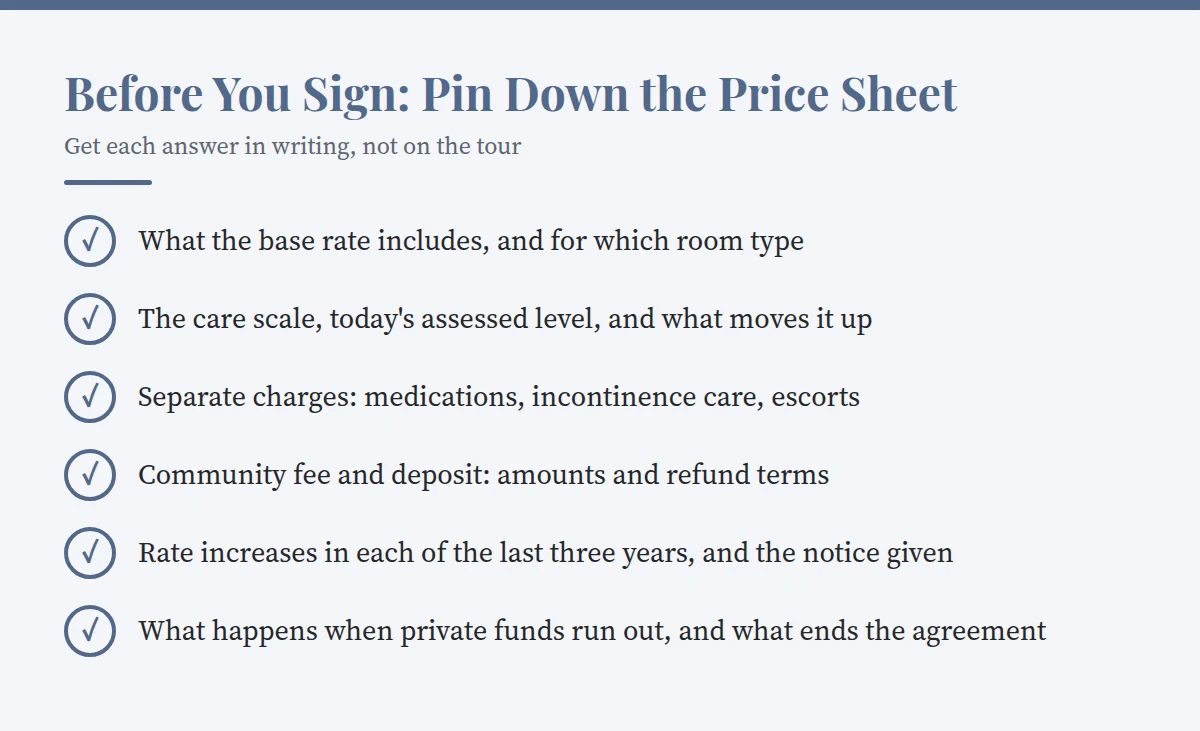
Every community will hand you a rate sheet. Read it as a set of questions.
- What does the base rate include? Room, meals, housekeeping, laundry, utilities, cable, transportation, and a named number of hours of care, or none. Ask which room type the published figure is for.
- What is the care scale and where would my parent land today? Ask for the assessment to be done before you sign, not after move-in, and ask what would move the level up.
- Which items are separate charges? Medication management, incontinence care and supplies, escorts to meals, two-person assistance, hospice coordination, and anything described as “enhanced”.
- What are the one-time charges? The community fee, the security deposit, and whether either is refundable, in what circumstances, and within how many days.
- What is the second-person fee, and what is the respite rate? Even if neither applies today, the respite rate tells you what a trial stay would cost.
- What were the rate increases in each of the last three years, and how much notice is given? Ask for the figures in writing, and ask separately about care-level increases.
- What happens when private funds run out? Whether the community accepts Medicaid, whether a waiver bed exists, and how long a resident must pay privately first.
- What ends the agreement? The discharge triggers, especially the clause about needs exceeding the licensed level of care, and the notice period.
The answers belong in the admission agreement, which is a legal contract and should be read as one. The clause-by-clause guide to the memory care admission agreement covers arbitration, responsible-party liability and discharge triggers, which are the three places a price sheet cannot warn you about.
Questions to Ask on a Tour
The price sheet answers what you pay. The tour answers what you get for it. Alongside the key questions for choosing a memory care facility, ask these with the rate in mind:
- How many care staff are on the unit on the day shift, the evening shift and overnight, and how many residents live there?
- Is the unit secured, and how: delayed-egress doors, an enclosed courtyard, an alarmed perimeter, or a locked wing?
- What dementia-specific training do direct care staff complete before they work alone, and how many hours a year after that? Is it required by the state?
- Who runs the daily program, how many hours a day does it run, and what happens on weekends?
- How is mealtime handled for residents who need prompting or finger foods? Memory care dining is where staffing shortages show first.
- Every community says it is person-centered. These five principles turn the claim into questions a tour can test.
- Who owns the building and who operates it? Ownership shapes staffing and rate decisions, and a tour is the time to ask.
One more thing about how you found the community. If a free placement advisor sent you, the community will pay a referral fee when your parent moves in, and the list you were given contains only the communities that pay. That does not make the advice bad, but it does mean you should read how referral agencies get paid before treating the shortlist as the whole market, and ask the community directly whether its rate or community fee differs for families who come on their own.
Find Memory Care Near You
The figures above are a guide; the communities below are where the real quotes come from. Every city page on this site is listed here by state, more than 400 cities in all. Open your city, request the rate sheet from each community that fits, and bring the questions in the previous section.
- Alabama: Birmingham, Jacksonville, Opelika
- Arizona: Anthem, Chandler, Gilbert, Glendale, Goodyear, Green Valley, Litchfield Park, Mesa, Oro Valley, Peoria, Phoenix, Scottsdale, Sun City West, Sun City, Surprise, Tucson
- Arkansas: Fayetteville
- California: Alameda, Albany, Alhambra, Antelope, Belmont, Berkeley, Beverly Hills, Burbank, Burlingame, Campbell, Cardiff, Carlsbad, Carmichael, Castro Valley, Citrus Heights, Clovis, Culver City, Daly City, Danville, El Cerrito, Elk Grove, Encinitas, Escondido, Fair Oaks, Fremont, Fresno, Hayward, La Mesa, Lemon Grove, Los Altos, Los Angeles, Los Gatos, Menlo Park, Millbrae, Milpitas, Morgan Hill, Mountain View, National City, Oakland, Palo Alto, Pasadena, Pleasant Hill, Pleasanton, Rancho Cordova, Redondo Beach, Redwood City, Rialto, Roseville, Sacramento, San Diego, San Francisco, San Jose, San Leandro, San Mateo, San Rafael, Santa Clara, Santa Cruz, Santa Monica, South San Francisco, Sunnyvale, Torrance, Tustin, Vallejo, Walnut Creek, West Hollywood, West Sacramento, Yuba City
- Colorado: Arvada, Aurora, Centennial, Colorado Springs, Denver, Englewood, Federal Heights, Golden, Greeley, Greenwood Village, Highlands Ranch, Lakewood, Littleton, Monument, Thornton, Westminster, Wheat Ridge
- Florida: Aventura, Brandon, Coral Gables, Cutler Bay, Hialeah, Homestead, Jacksonville Beach, Jacksonville, Lutz, Miami, New Port Richey, North Palm Beach, Orange City, Orlando, Palm Harbor, Pembroke Pines, Plant City, Port Charlotte, Riverview, Tampa, Tavares, Wesley Chapel, Winter Park
- Georgia: Acworth, Alpharetta, Atlanta, Brookhaven, Canton, Columbus, Cumming, Dallas, Decatur, Douglasville, Grayson, Hiram, Johns Creek, Kennesaw, Lithia Springs, Marietta, Powder Springs, Rome, Roswell, Sandy Springs, Smyrna, Tucker, Villa Rica, White, Woodstock
- Illinois: Bloomingdale, Blue Island, Bolingbrook, Chicago, Deerfield, Glen Ellyn, Glenview, Homer Glen, La Grange, Lincolnwood, Morton Grove, Northbrook, Oak Lawn, Oak Park, Orland Park, Palos Heights, Park Ridge, Schaumburg, South Barrington, St. Charles, Vernon Hills, Washington
- Indiana: Avon, Carmel, Fishers, Franklin, Greenwood, Indianapolis, Jeffersonville, Merrillville, Noblesville, Portage, Westfield, Zionsville
- Kansas: Columbus, Kansas City, Mission, Olathe, Overland Park, Prairie Village
- Kentucky: Frankfort, Lexington, Louisville, Lyndon, Masonic Home, Prospect
- Louisiana: Hammond
- Maryland: Annapolis, Baltimore, Bethesda, Edgewater, Severna Park, Westminster
- Massachusetts: Boston, Lexington, Newton
- Michigan: Ann Arbor, Auburn Hills, Bloomfield Hills, Chelsea, Chesterfield, Clinton Township, Dearborn Heights, Dearborn, Detroit, Dundee, Farmington Hills, Fraser, Grosse Pointe Woods, Lansing, Livonia, Macomb, Monroe, Northville, Oak Park, Oakland Township, Plymouth, Rochester Hills, Rochester, Royal Oak, Shelby Township, Southfield, St. Clair Shores, Sterling Heights, Troy, Utica, Village of Clarkston, Warren, Washington, West Bloomfield Township
- Minnesota: Arden Hills, Bloomington, Brooklyn Center, Burnsville, Champlin, Chanhassen, Columbia Heights, Coon Rapids, Corcoran, Cottage Grove, Detroit Lakes, Eagan, Eden Prairie, Edina, Excelsior, Fridley, Golden Valley, Hastings, Hopkins, Inver Grove Heights, Lake Elmo, Lakeville, Maple Grove, Maplewood, Mendota Heights, Minetonka Mls, Minneapolis, Minnetonka, New Brighton, New Hope, Oakdale, Plymouth, Prior Lake, Richfield, Robbinsdale, Roseville, Savage, Shakopee, Spring Lake Park, Spring Park, St. Louis Park, St. Paul, Wayzata, West St. Paul, Woodbury
- Missouri: Kansas City, Springfield
- Nebraska: Bellevue, Columbus, Elkhorn, La Vista, Omaha, Papillion
- Nevada: Henderson, Las Vegas, North Las Vegas
- New Jersey: Cherry Hill Township, Cinnaminson, Collingswood, Evesham, Florence, Haddonfield, Marlton, Moorestown, Mt Laurel Township, Voorhees Township, Westampton Township, Williamstown
- New Mexico: Albuquerque, Bernalillo, Rio Rancho
- New York: Brooklyn, Elmhurst, Long Beach, New York
- North Carolina: Apex, Cary, Chapel Hill, Charlotte, Durham, Garner, Jacksonville, Knightdale, Mint Hill, Mooresville, Moyock, Pineville, Raleigh, Wake Forest, Zebulon
- Ohio: Columbus
- Oklahoma: Bethany, Edmond, Midwest City, Mustang, Norman, Oklahoma City, Tulsa
- Oregon: Central Point, Portland, Tigard
- Pennsylvania: Dresher, Philadelphia
- Tennessee: Bartlett, Brentwood, Franklin, Hendersonville, Memphis, Mount Juliet, Nashville
- Texas: Allen, Arlington, Austin, Beaumont, Burleson, Carrollton, Cedar Park, Colleyville, Columbus, Converse, Cypress, Dallas, El Paso, Flower Mound, Fort Worth, Garland, Haltom City, Houston, Irving, Katy, Keller, Kingwood, Lakeway, Live Oak, Magnolia, Mesquite, Murphy, New Braunfels, North Richland Hills, Pasadena, Pearland, Pflugerville, Plano, Richardson, Rockwall, Round Rock, Rowlett, Sachse, Saginaw, San Antonio, Shavano Park, Spring, Sugar Land, The Woodlands, Tomball, West Lake Hills, Willow Park
- Virginia: Chesapeake, Hampton, Norfolk, Portsmouth, Suffolk, Virginia Beach
- Washington: Bellevue, Burien, Edmonds, Kent, Kirkland, Renton, Seattle, Tukwila
- Wisconsin: Bayside, Brookfield, Brown Deer, Columbus, Cudahy, Elm Grove, Franklin, Greenfield, Menomonee Falls, Mequon, Milwaukee, New Berlin, Oak Creek, Pewaukee, River Falls, South Milwaukee, Sussex, Waukesha, Wauwatosa, West Allis, West Bend
Frequently Asked Questions About Memory Care Costs
How much does memory care cost per month? The typical published rate is $6,252 a month, and the middle half of communities charge between $5,300 and $7,316. That rate covers the room, meals and the dementia care program; care-level and medication charges usually come on top, so budget above the listed figure.
How much more does memory care cost than assisted living? At communities that publish both prices, memory care costs $1,595 a month more than assisted living in the same building at the median, and the middle half of communities charge $869 to $2,303 more. Nationally the medians are $6,252 for memory care and $4,795 for assisted living, but the same-community comparison is the fair one because it cancels out location and operator.
Which state has the lowest memory care prices? Texas is the only state with enough priced communities for a figure of its own, at a median of $5,550 a month, and it sits below the combined medians for the other Southern states ($6,372), the West ($6,125) and the Midwest ($6,570). A full state ranking is not possible yet, because most states have too few published memory care prices to report separately.
Does Medicare pay for memory care? No. Medicare does not pay for long-term care, which it also calls custodial care, in any setting. It continues to cover doctors, hospital stays, short-term skilled nursing after a qualifying hospital stay, skilled home health and hospice, but never the community’s monthly rate.
Will Medicaid pay for memory care? Sometimes, for the care but not the room. Some states use Medicaid waivers to pay for services inside assisted living and memory care communities, others do not, and federal rules exclude room and board from waiver funding, so the family or the resident’s income still pays for the apartment and meals. Medicaid does cover nursing facility care for everyone who is eligible, including room and board, which is one reason a person who outlives their savings may end up in a nursing home rather than memory care.
What is a community fee, and do I get it back? The community fee is a one-time charge at move-in, with a median of $2,500 and a middle half of $1,500 to $4,500, and it is usually not refundable. It is separate from the security deposit, which has a median of $862 and a middle half of $500 to $1,338 and should be refundable subject to the agreement. Get the refund terms for both in writing.
How much does a short respite stay in memory care cost? The median published respite rate is $288 a day, and the middle half of communities charge $186 to $388 a day. A respite stay is the most reliable way to test a community before committing to a monthly rate, and it is what a family caregiver should use for a real break.
Sources
- Centers for Medicare & Medicaid Services on what Medicare does not pay for in long-term care
- Centers for Medicare & Medicaid Services for the three-day stay and 100-day limits on skilled nursing coverage
- Medicaid.gov on nursing facility services as a required benefit with no waiting lists
- Medicaid.gov with how 1915(c) home and community-based services waivers work
- Legal Information Institute for the federal rule excluding room and board from waiver funding
- Administration for Community Living on which Medicaid long-term care services states cover
- Administration for Community Living with benefit triggers and elimination periods in long-term care insurance
- National Institute on Aging on the kinds of residential long-term care and who pays for each
- National Institute on Aging for the cost questions to ask a facility with an Alzheimer’s unit
- Kelley and colleagues on the share of dementia care costs families bear at home versus in a nursing home
- U.S. Department of Veterans Affairs for who qualifies for Aid and Attendance
- U.S. Department of Veterans Affairs on which long-term care settings VA pays for
- Internal Revenue Service with the medical expense rules for qualified long-term care services
- Melekin, Sengupta and Caffrey for federal survey findings on dementia, Medicaid and care needs among residential care residents
- Legal Information Institute on Texas training rules for certified Alzheimer’s assisted living facilities
- Delaware General Assembly with the staffing plan and training rules for secured memory care units
- Kentucky General Assembly on training hours for staff of a secured dementia care unit
- Legal Information Institute for Arizona’s notice rule for assisted living fee increases
- Minnesota Office of Ombudsman for Long-Term Care on the rise in assisted living fee and rent complaints
- Alzheimer’s Association with what special care units are and what to ask about them
- Alzheimer’s Association on how Medicaid fits into paying for dementia care
Further reading
- 44 Percent of Assisted Living Residents Now Have Dementia: What Families Should Demand When Memory Care Isn’t an Option
- Before You Sign: What Is Really in the Memory Care Admission Agreement
- Veterans and Dementia: A Complete Guide to VA Benefits, Eligibility, and Care
- In-Home Memory Care: When to Consider It and How to Get Started
- Choosing the Right Memory Care Facility: Key Questions to Ask
- Free Memory Care Placement Services: How Referral Agencies Get Paid and What That Means for Your Search
- Who Actually Owns the Memory Care Community: Private Equity, REITs, Chains, and Nonprofits
- Hospice Care for End-Stage Dementia: When and How to Bring It In