After a Loved One With Dementia Dies: The Complete Guide to Grief, Paperwork, and Medicaid Estate Recovery
Published on October 2, 2026

The call tends to come at an hour nobody would choose. A hospice nurse, or the night supervisor at the memory care community, tells you your father died a little after three, and asks whether you want to come in before anyone calls the funeral home.
What follows is disorienting in a way that people who have not lived it rarely understand. You have been mourning him for years, one lost ability at a time. Now the death you were braced for has arrived, and instead of room to feel it, you are handed a to-do list: forms, phone calls, a room to empty, accounts to close. For families who relied on Medicaid to pay for long-term care, a letter from the state may follow months later, asking about his estate.
This guide follows that first year in roughly the order it unfolds: the first hours, the notifications, closing out the memory care account, probate, the estate recovery claim, and the grief that often waits until the paperwork is done. Laws differ from state to state and nothing here is legal advice, so treat it as a map to bring to an elder law attorney, not a substitute for one.
The First Hours: Fewer Decisions Than It Feels Like
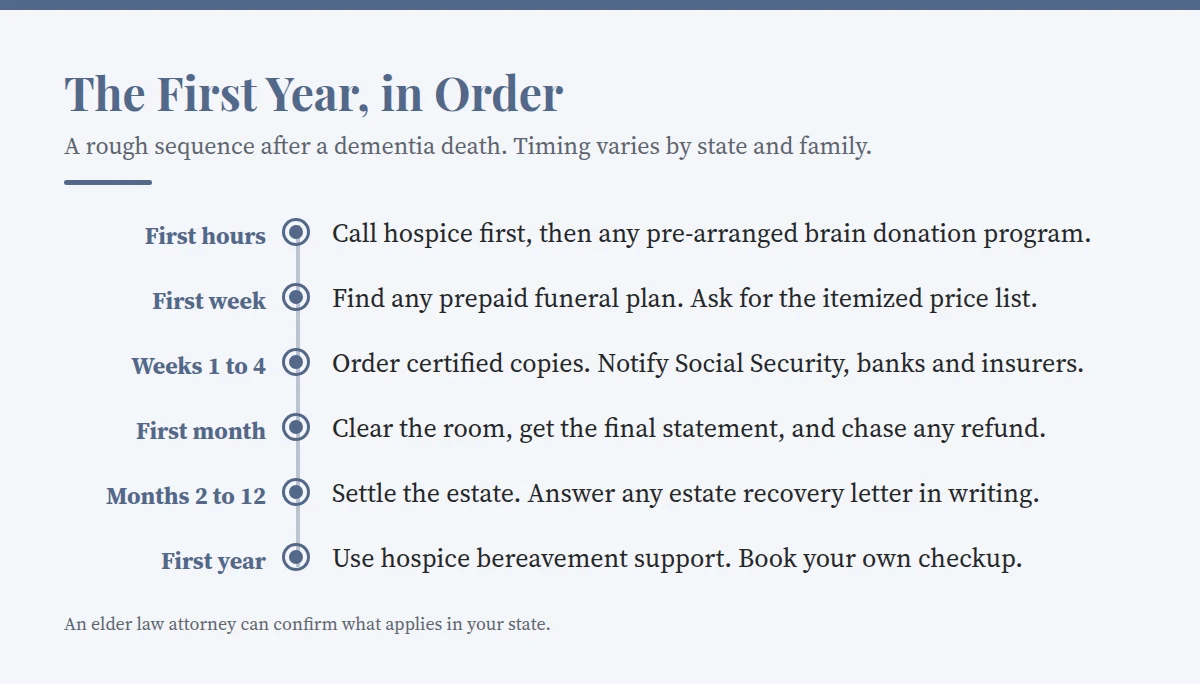
The National Institute on Aging puts it plainly: if someone dies at home, there is no need to move the body right away. If hospice was involved, a plan for this moment is likely in place already, so call the hospice number first. A doctor or hospice nurse formally pronounces the death and completes the forms behind the death certificate. In a memory care community, ask the nurse on duty what has been done and who has been called.
One call is specific to dementia. If your family arranged a brain donation, that program’s number belongs near the top of the list. The Alzheimer’s Association notes that these arrangements generally have to be made well before death, and the NIA points out that a brain autopsy allows a definitive diagnosis of Alzheimer’s, an answer some relatives want for their own medical history.
Before you sit down with a funeral director, find two things: any prepaid funeral or burial contract, and any written wishes about burial or cremation. Medicaid lets people keep a burial space and a small burial fund without losing eligibility, so if your loved one went through a Medicaid application, check whether something was set aside then. It is easy to pay twice in a fog.
Federal law gives you real leverage in that meeting. Under the FTC’s Funeral Rule, the funeral home must hand you an itemized General Price List to keep and must quote prices over the phone if you ask. You can buy only the goods and services you want, and the home cannot refuse a casket or urn you bought elsewhere or charge a fee to handle it. No state law requires routine embalming for every death.
The First Weeks: Death Certificates and Notifications
Banks, insurers, pension plans and government agencies will mostly want a certified copy of the death certificate, not a photocopy. Copies come from the vital records office in the state where the death occurred, and many funeral homes will order them for you. Order more than seems reasonable.
Before the certificate is finalized, it is fair to ask the physician what will be listed as the cause of death. Alzheimer’s is badly undercounted: researchers at Rush University estimated that about 503,400 deaths of Americans 75 and older in 2010 were attributable to Alzheimer’s dementia, while death certificates that year recorded fewer than 84,000 Alzheimer’s deaths. An accurate certificate becomes part of your family’s medical history.
Funeral homes generally report the death to Social Security, which notifies Medicare, so give them your loved one’s Social Security number. If benefits were being paid, the payment for the month of death has to go back. Social Security pays a month behind, so if your mother died in July, the payment that arrives in August is returned, even though it lands after the death. A surviving spouse may qualify for a one-time $255 death payment, which must be claimed within two years.

After that, work down the rest of the list:
- Pensions and annuities, including any survivor options.
- Life insurance, which needs a death certificate and the policy number.
- The VA, if your loved one served. Our guide to VA benefits for veterans with dementia covers what a surviving spouse may still be able to claim.
- Banks and credit card companies.
- Equifax, Experian and TransUnion. The NIA recommends sending each a copy of the death certificate to help prevent identity theft.
- A long-term care insurance policy, if there was one. File any final claim for care through the date of death.
Closing the Memory Care Account and Getting Money Back
Pull out the admission agreement before you call the business office, because it decides most of what happens next. Look for four things: how much notice the community requires after a death, whether charges stop on the date of death or continue while belongings remain in the room, which deposits and fees are refundable, and how quickly refunds go out. Our clause-by-clause guide to the memory care admission agreement walks through how those sections are usually worded.
Some states write the answers into law. In California, an assisted living community cannot require advance notice to end the agreement after a resident dies, and it must give the family written notice of its termination and refund policies within three days of learning of the death. Fees stop accruing once all of the resident’s belongings are out of the unit, and anything paid in advance must be refunded within 15 days after that. The community also cannot block authorized family members from removing belongings during reasonable hours. Other states set different rules, so ask your state’s assisted living licensing agency what applies where you are.
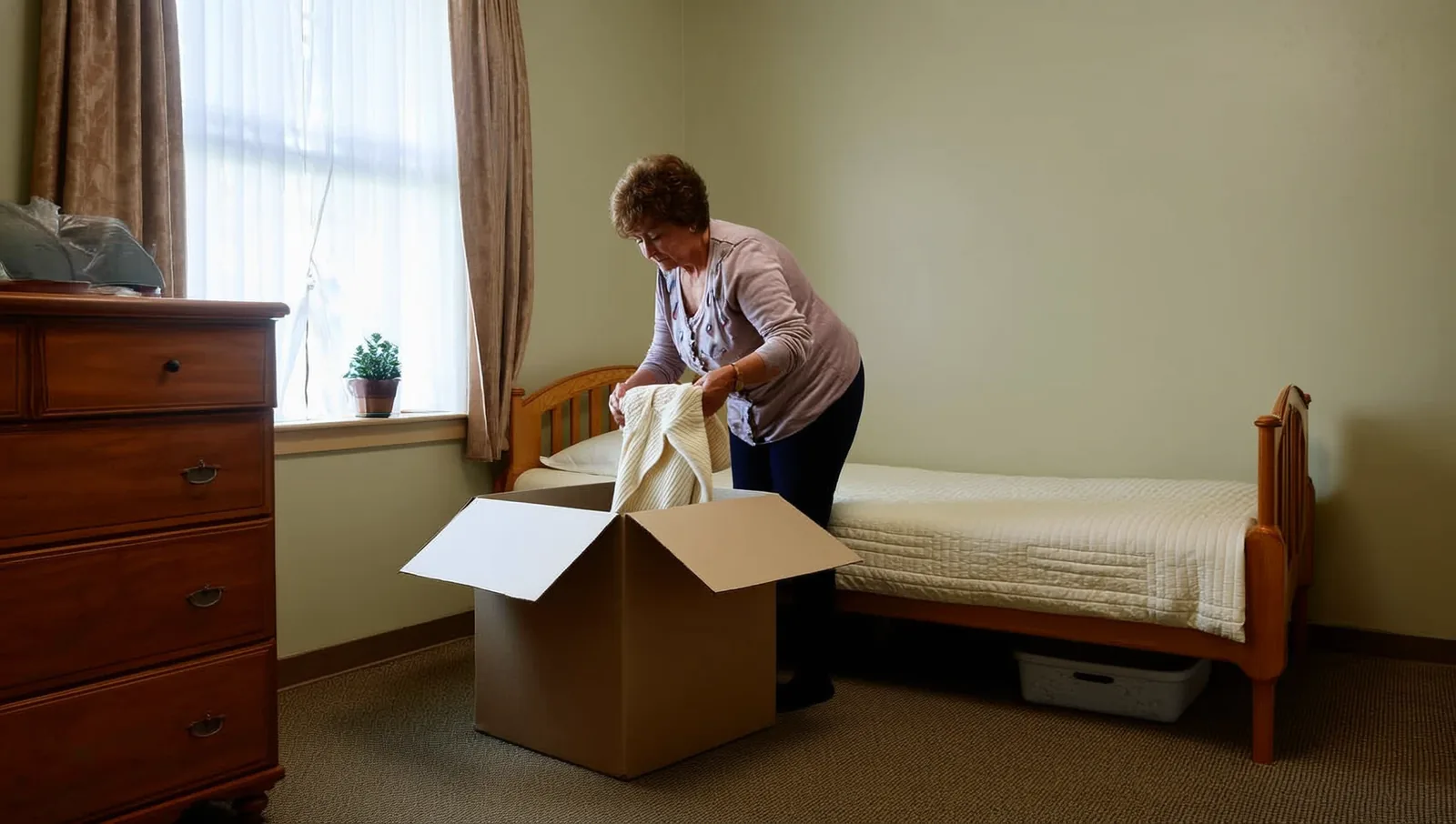
If your loved one lived in a nursing home rather than assisted living, a federal rule covers any money the facility held for the resident. Within 30 days of the death, the facility must turn over the remaining funds, with a final accounting, to whoever is administering the estate.
If charges run until the room is empty, clear it quickly. Ask for a final itemized statement, check it against what was paid in advance, and get any refund promise in writing. And if you signed the admission agreement as the responsible party, the final bill should be paid from your parent’s money or estate, not your own, unless you personally guaranteed it.
Probate in Plain Language
The power of attorney you may have relied on for years ended at the moment of death. The Consumer Financial Protection Bureau is blunt about it: even if you could easily pay some of the outstanding bills, an agent no longer has the authority to do so. Authority passes to the executor named in the will, or to an administrator the probate court appoints when there is no will.
Not everything goes through probate. Accounts with a named beneficiary, property owned jointly with survivorship rights and assets in a living trust generally pass straight to whoever is named. What remains in your loved one’s name alone is the probate estate, and most states offer a simpler process for small estates.
The executor’s work runs in a rough order: list what the person owned, notify creditors as state law requires, pay valid debts, file the final income tax return, and only then distribute what is left. The IRS wants that return prepared as it would have been during life, reporting income up to the date of death, with any refund claimed on Form 1310.
Family members generally do not inherit debts. The Federal Trade Commission explains that a person’s debts are paid from their estate, and if the estate cannot cover them, they usually go unpaid. The exceptions are narrow: you cosigned, you are a spouse in a community property state, or you are an executor who did not follow the state’s probate rules. That last one is the reason not to hand out inheritances quickly.
If there is a house, a history of Medicaid, or siblings who disagree, pay for an hour with an elder law attorney before anyone signs or sells anything. The Alzheimer’s Association points families to the National Academy of Elder Law Attorneys’ online directory, the Eldercare Locator (800.677.1116), and LawHelp.org for free or reduced-cost legal aid.
The Medicaid Estate Recovery Letter
For families who used Medicaid for long-term care, a letter may arrive soon after the death, or once probate opens, from the state Medicaid agency or its contractor, claiming part of the estate for the cost of care. It blindsides people because the warning came years earlier in an application packet, often signed in the middle of a crisis. MACPAC, the commission that advises Congress on Medicaid, found that states do give notice at application, but the information often lacks detail and awareness remains low.
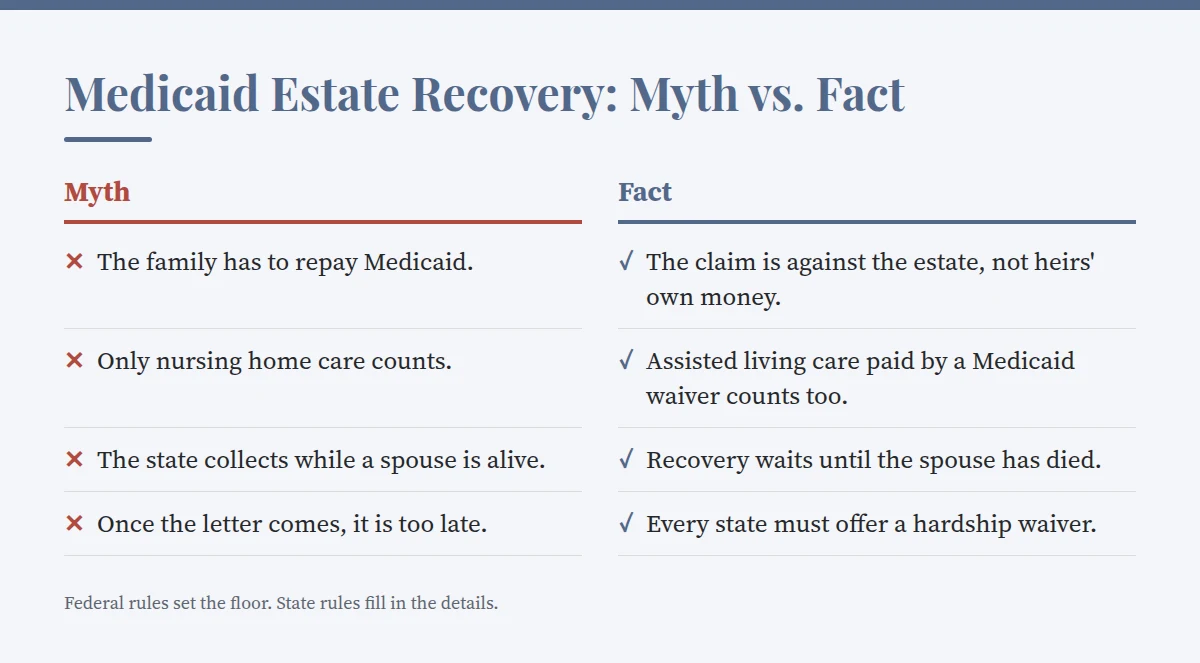
What the law requires. Since 1993, federal law has required every state to seek repayment from the estates of Medicaid enrollees who were 55 or older when they received long-term care: nursing facility services, home and community-based services, and related hospital and prescription drug costs. States may also recover for other Medicaid services, except Medicare cost-sharing paid through the Medicare Savings Programs. People of any age who were permanently living in a nursing home are covered as well.
The point memory care families miss is that home and community-based services are on that mandatory list. That is how Medicaid pays for care in assisted living, through waiver programs that can cover services but never room and board. A parent who never set foot in a nursing home can still leave an estate recovery claim behind.
How much is at stake. States collect only from the estate, and only up to what Medicaid paid. MACPAC found that states collected about $733.4 million in fiscal year 2019, roughly 0.55 percent of Medicaid’s fee-for-service long-term care spending. Because Medicaid requires people to spend down to qualify, the estates actually pursued tend to be modest, and the family home is often most of what remains. Three-quarters of Medicaid decedents had a net worth under $48,500.
Who is protected. Recovery cannot happen while a spouse survives, or while there is a surviving child under 21 or a blind or disabled child of any age. For a spouse, that postpones the claim rather than cancelling it: the law allows recovery after the spouse’s death.
One more protection fits many dementia families. If the state placed a lien on the home of a parent who moved permanently into a nursing home, it cannot recover from the house while a son or daughter lives there who lived with the parent for at least two years beforehand, gave care that kept them out of an institution, and has lived there ever since. A sibling who lived there for at least a year before the move is protected the same way. Ask whether your state goes further.
Hardship waivers. Every state must have a way to waive recovery when it would cause undue hardship, but each state defines hardship for itself. MACPAC urged Congress to set minimum standards, such as protecting a family’s sole income-producing asset and homes of modest value, and to make estate recovery optional. Federal law still requires it.
The estate may be bigger than you expect. At minimum, states recover from the probate estate. Federal law lets them reach further, into assets that passed outside probate, such as jointly held property, life estates and living trusts. Whether your state does is a first question for an attorney.
When the letter comes:
- Do not ignore it, and do not pay it on reflex.
- Ask for an itemized statement of what Medicaid paid, with dates of service.
- Check whether a spouse, a young or disabled child, or a caregiving son or daughter changes the picture.
- Ask in writing how to apply for a hardship waiver, and by what date.
- If you are the executor, hold off on distributions until the claim is resolved.
The Grief That Comes After Years of Goodbyes
If you spent years mourning someone who was still alive, our guide to ambiguous loss explains why that grief never had a clear shape. The death closes that chapter and often opens a different one.
For many caregivers the death brings real relief. In a study of 217 family caregivers of people with dementia, published in the New England Journal of Medicine in 2003, caregivers showed high levels of depressive symptoms while providing care. Within three months of the death those symptoms had fallen significantly, and within a year they were well below caregiving levels. Seventy-two percent said the death was a relief to them, and more than 90 percent believed it was a relief to the person who died. Relief is not a betrayal. It is what the end of a grueling stretch feels like, and it rarely arrives alone.
Resilience is not universal, though. Analyzing the same caregivers, the researchers found that 20 percent developed complicated grief, along with high levels of depressive symptoms, after the death. Those most at risk had been more depressed and more burdened before the loss and were caring for someone more severely impaired. Less intuitively, caregivers who reported more positive experiences of caregiving were also at higher risk. When a role has organized your days for years, losing it is a second loss stacked on the first.
Feeling unprepared is common even after years of warning. In a related study, 23 percent of bereaved dementia caregivers said they had not been prepared for the death at all, and they reported more depression, anxiety and complicated grief afterward.
When grief does not ease. Prolonged grief disorder entered the psychiatric diagnostic manual in 2022. In adults, the American Psychiatric Association describes intense longing for the person who died, or preoccupation with thoughts of them, persisting at least a year after the loss, along with symptoms such as feeling as though part of yourself has died, intense loneliness, or a sense that life is meaningless. The APA estimates that 4 to 15 percent of bereaved adults experience it, and effective treatments exist. Only a clinician can make that diagnosis, so if the description sounds familiar a year on, say it out loud at your next appointment.
Where to find support. If hospice cared for your loved one, its bereavement program is open to the family for up to a year after the death, a Medicare requirement. Call them. Our guide to hospice care in end-stage dementia covers what else the benefit includes. The Alzheimer’s Association’s 24/7 Helpline (800.272.3900) can connect you with local support. If you are thinking about harming yourself, call or text 988 at any hour.
When the Caregiving Ends: Learning to Live Again
Caregiving does not taper off. One day you are on call around the clock, and the next there is nowhere you have to be. When nurse researchers at the University of Massachusetts Dartmouth interviewed former dementia caregivers, a pattern emerged: sleep problems that persisted, for some as long as 10 years; health problems that surfaced after caregiving ended; and a slow process the caregivers described as learning to live again, held back by uncertainty and a reluctance to give up a role they had identified with for years. It was a small study of eight people, but the shape will be familiar to many readers.

A few places to start:
- Book your own checkup. The appointments you postponed can come first now, and lingering sleep trouble is worth raising too.
- Hold off on irreversible decisions, especially selling the family home while probate or an estate recovery claim is unresolved.
- Take stock of the money. If you cut back on work to give care, as our guide to working while caring for a parent with dementia describes, a certified financial planner can help you measure the gap in savings and retirement.
- Rebuild one connection at a time. A standing weekly commitment, like a walk, a class or a shared meal, is easier to keep than a vague plan to reconnect.
- Let what you learned shape what comes next, without rushing it. Some former caregivers eventually volunteer or mentor families who are just starting out. Others want a long break from anything to do with dementia. Either is fine.
What This Comes Down To
The first year after a dementia death asks two things that pull against each other: to grieve, and to administer. Do the administration in order, and lean on the people whose job it is to know it: the hospice social worker, the funeral director, an elder law attorney. Let the grief arrive on its own schedule, which may be later than everyone else’s. You spent years looking after someone. This year, part of the work is letting other people look after you.
Further reading (sources)
- National Institute on Aging on what to do in the hours and weeks after someone dies
- Alzheimer’s Association for arranging brain autopsy and donation in advance
- Federal Trade Commission with your rights under the Funeral Rule
- USA.gov on ordering certified copies of a death certificate
- USA.gov for the agencies to notify when someone dies
- James and colleagues on how death certificates undercount Alzheimer’s deaths
- Social Security Administration with reporting a death, returning benefits and the death payment
- California Legislature on refunds and notice when an assisted living resident dies
- Code of Federal Regulations for returning a nursing home resident’s funds after death
- Consumer Financial Protection Bureau on when an agent’s authority under a power of attorney ends
- IRS with filing the final income tax return of someone who has died
- Federal Trade Commission on who pays a deceased relative’s debts
- Alzheimer’s Association for finding an elder law attorney and free legal aid
- Medicaid.gov with federal estate recovery rules and who is protected
- U.S. Code for the estate recovery statute, including the caregiving child protection
- MACPAC on estate recovery collections, notice and recommended reforms
- HHS Office of the Assistant Secretary for Planning and Evaluation with how Medicaid pays for services in assisted living
- Schulz and colleagues on caregiver depression and relief before and after a dementia death
- Schulz, Boerner and colleagues for predictors of complicated grief in dementia caregivers
- Hebert and colleagues with feeling unprepared for the death after years of caregiving
- American Psychiatric Association on prolonged grief disorder
- Code of Federal Regulations for the hospice bereavement requirement
- Corey and McCurry on what former dementia caregivers experience after caregiving ends