The Long-Term Care Ombudsman: The Free Advocate Every Memory Care Resident Already Has
Published on September 14, 2026

You have raised the same concern three times now. Your mother’s call light goes unanswered for thirty or forty minutes. You mentioned it to the aide, then to the nurse on the unit, then in a careful email to the executive director that got a warm reply and no change at all. You are at the point where families either give up or start looking for a lawyer.
There is a step in between, and hardly anyone uses it. Somewhere in your state is a person whose entire job is to advocate for your mother. They can walk into that building unannounced tomorrow, speak with her privately, and press the administrator for an answer. The service costs nothing. You do not need a lawyer, a diagnosis, or proof of anything. Most families have never heard of it.
What an Ombudsman Actually Is
The Long-Term Care Ombudsman Program is federal, authorized under Title VII of the Older Americans Act. It started as a small demonstration project in 1972 and now operates in all fifty states plus the District of Columbia, Puerto Rico, and Guam. Each state has an Office of the State Long-Term Care Ombudsman headed by a full-time director, with local ombudsmen based in Area Agencies on Aging or contracted nonprofits.
The name is the first barrier. It sounds Scandinavian and bureaucratic, and many families assume it applies only to nursing homes. It does not. The program covers nursing homes, assisted living, board and care homes, and residential care communities. Memory care units sit inside licensed assisted living in most states, which puts your mother squarely inside the program’s mandate.
The scale is larger than the obscurity suggests. In fiscal year 2023 the program handled 202,894 complaints, provided information and assistance more than half a million times, and worked with over 1,500 full-time-equivalent staff plus 3,443 trained volunteers. Seventy-one percent of complaints were resolved or partially resolved to the complainant’s satisfaction.
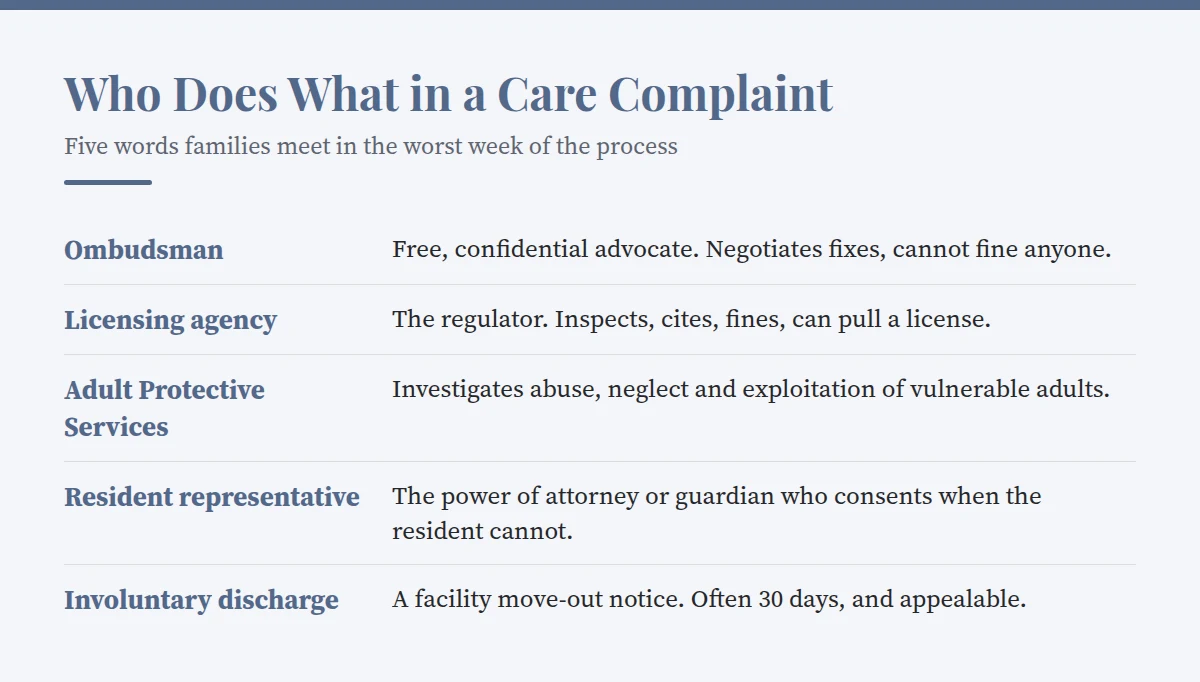
One thing to hold onto before anything else: an ombudsman is an advocate, not a regulator. That single distinction explains most of what follows.
What They Can Do, and What They Cannot
Ombudsmen have real legal authority, and it is worth knowing exactly where it stops.
They can enter any licensed long-term care facility, including unannounced, and federal law gives them immediate, private, and unimpeded access to residents. An administrator cannot turn an ombudsman away or insist on sitting in on the conversation. They can interview your mother alone, review her records with appropriate consent, observe the unit at whatever hour they choose, and take a complaint directly to the administrator and negotiate a fix. They can sit beside you in a care plan meeting as a second set of ears. They can explain the resident rights that apply in your specific state, help you respond to a discharge notice, and refer you to legal aid, the licensing agency, or Adult Protective Services. They also track patterns across a building over time, which means your one complaint may be the twelfth of its kind.

They cannot fine a community, cite a deficiency, suspend admissions, or revoke a license. They cannot order a staffing change. They cannot officially substantiate abuse, which is the job of the investigating agency. They cannot give you legal advice or represent you in court. And with limited exceptions, they cannot act on your complaint against the resident’s wishes.
That last point catches families off guard often enough to deserve its own section.
The Consent Rule That Surprises Families
The ombudsman works for the resident, not for you. The model is called resident-directed advocacy, and it is the program’s organizing principle. When someone other than the resident files a complaint, the ombudsman is required to determine what the resident actually wants and follow that direction. If your mother tells the ombudsman she does not want a fuss made, the ombudsman follows her.
Confidentiality runs equally deep. A resident’s identity and the substance of their complaint cannot be disclosed without informed consent, and that confidentiality generally takes precedence over state mandatory reporting laws. This is deliberate rather than accidental. It is what makes residents willing to speak honestly to someone who walks into their room.

Dementia complicates this, and the rules anticipate it. When a resident cannot communicate informed consent, the ombudsman may rely on the consent of a resident representative, meaning a power of attorney, guardian, or the family member acting in that role, unless there is reasonable cause to believe that person is not acting in the resident’s best interest. When a resident cannot communicate consent, has no legal representative at all, and the ombudsman has reason to suspect abuse, gross neglect, or exploitation, separate procedures let them proceed and access records anyway. Nobody is left unprotected because they cannot speak.
The practical takeaway is to have your authority documented before you need it, and to make sure the community’s file lists the correct resident representative. It is one more argument for putting the legal documents in place early rather than in the middle of a crisis.
Expect one more thing. A resident with moderate dementia may tell the ombudsman something very different from what she told you, or may say nothing useful at all. Trained ombudsmen work with this every day, and it does not disqualify her account or yours.
Three Doors, and They Are Not Interchangeable
Most families lose weeks because they knock on the wrong one.
The long-term care ombudsman is the advocate. Free, confidential, independent, and resident-directed, with no enforcement power. This is the right first call for care quality, dignity, staff conduct, call light response, activities, meals, roommate conflict, disagreement about a care plan, a discharge notice, and anything at all where you feel unheard. Start here for most concerns.
The state licensing or survey agency is the regulator. It inspects, cites deficiencies, imposes plans of correction, levies fines, and can suspend admissions or pull a license. For nursing homes it also acts as the CMS-contracted survey agency enforcing the federal rules. Complaints get investigated on a timeline driven by severity, and the file on a given building is public.
There is a nuance here that matters enormously for memory care. Memory care inside assisted living is regulated by state law, not the federal nursing home rulebook, so it does not appear on Medicare’s Care Compare and carries no federal star rating. Your state’s licensing file is the closest equivalent, and its depth varies dramatically from state to state. What you can reasonably demand also depends on your state’s specific rules, which is part of why families in general assisted living have to advocate harder.
Adult Protective Services investigates abuse, neglect, and exploitation of vulnerable adults and can substantiate findings and refer cases for prosecution. In some states APS covers facility residents directly; in others those cases route to licensing instead. One phone call will tell you which applies where you live.
There is a fourth door, and it is 911. A suspected assault, a serious injury, or a resident who has walked out of the building is not a complaint pipeline matter.
These doors are not mutually exclusive. For suspected abuse or neglect, file with APS and the licensing agency at the same time and tell the ombudsman as well. The Alzheimer’s Association Helpline (800-272-3900) and the Eldercare Locator (800-677-1116) will both route you correctly if you are unsure. You do not have to prove anything first. Deciding whether abuse occurred is the investigator’s job, not yours.
Work the Building First, Usually
An ombudsman call lands much harder when the community has already been given a documented chance to fix things.
Start with the direct care staff or med tech on the unit, because a surprising share of problems stop there. Move to the memory care director or charge nurse and ask for a specific fix attached to a name and a date. Request a care plan meeting in writing, since you are entitled to participate in one. Then go to the executive director in writing, because email creates a record that a hallway conversation never does. Regional or corporate leadership is the last rung.
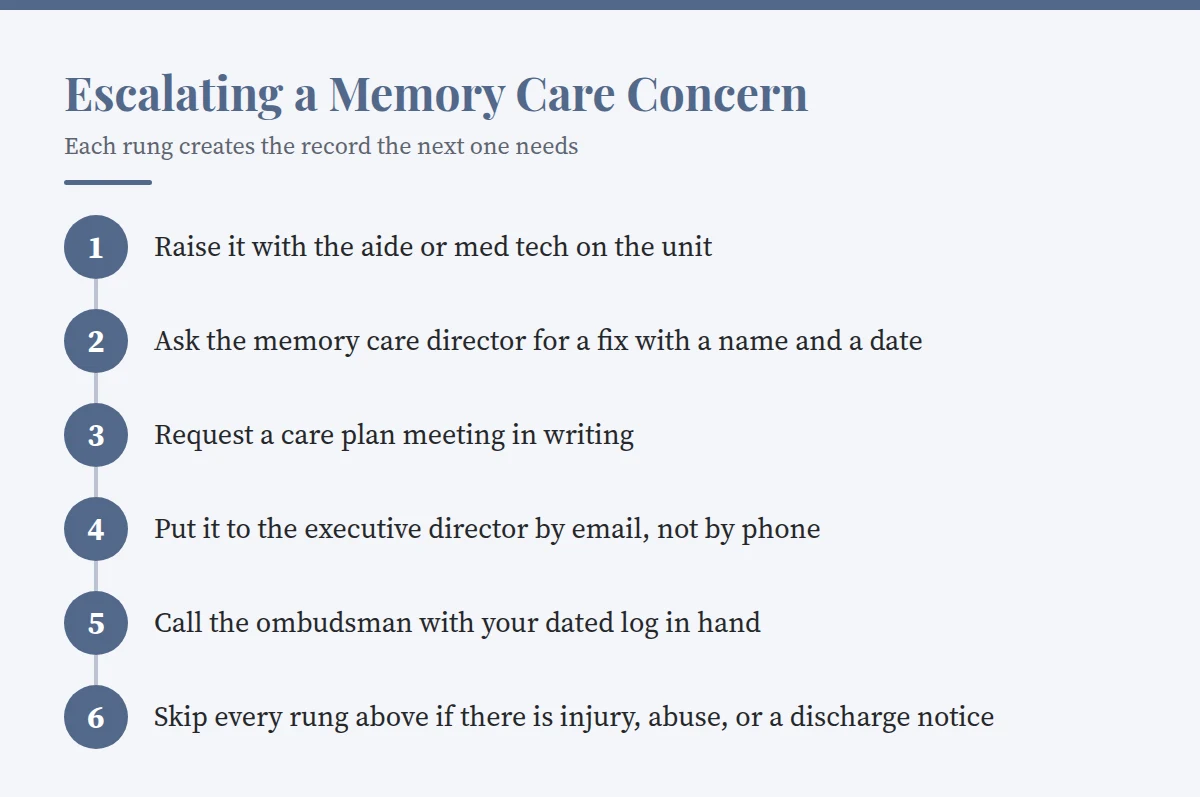
Through all of it, keep a log: date, time, what you observed, who you told, what they committed to, and what actually happened. Five dated entries turn an ombudsman conversation from “a daughter is unhappy” into “here is a pattern this building has been told about five times.”
Skip the ladder entirely when the concern is urgent. An injury, a suspected assault, an unexplained bruise, an elopement, rapid unexplained weight loss, or a discharge notice with a clock running all justify going straight outside.
One honest caveat before you build a case. Some of what reads as neglect is the disease itself: refusing a shower, pushing food away, agitation that arrives every afternoon at four, an accusation that staff have been stealing. It is worth ruling out whether a perception or pain problem is driving the behavior first. A good ombudsman will raise the question anyway, and you will be more credible for having asked it yourself.
What Actually Happens When You Call
Intake is usually a phone call. You give your name, the facility, and the concern. You can raise an issue anonymously, though consent-based advocacy generally needs the resident identified.
From there the ombudsman confirms consent, visits the community (often without warning), speaks with your mother privately, may review records, observes the unit, talks with staff, and brings the issue to the administrator. Almost every resolution is negotiated rather than ordered. That can sound toothless, and it is frequently more effective than it sounds, because the ombudsman is in that building regularly, knows the administrator by name, and will be back next month.
Timelines vary. A simple issue can close within days. A contested discharge can run for weeks. And the honest statistic is the one quoted above: 71 percent of complaints end up resolved or partially resolved to the complainant’s satisfaction. The word “partially” is doing real work there. Outcomes are often genuine but incomplete.
If you are worried about retaliation against your mother, say so during intake. Retaliation is prohibited and is a complaint category in its own right, and ombudsmen navigate this constantly, including keeping your name out of the conversation where they can.
The Discharge Notice Is the Emergency Nobody Treats as One
Involuntary discharge is the most common complaint category the program handles, in both nursing homes and assisted living. In memory care it typically arrives as “we can no longer meet her needs,” often following behavioral changes, a fall, or a hospital stay.
The notice is usually written and usually gives 30 days, though state law varies from around two weeks to 90 days, with shorter windows allowed only in genuine emergencies. It generally must state the reason and, in most states, your appeal rights and the ombudsman’s contact information.
Call the ombudsman the day it arrives. Do not sleep on it, because the notice period is the entire window. A community’s assertion that it cannot meet a resident’s needs is a claim, and claims can be challenged, particularly when the real driver is a staffing shortage, a change in who is paying, or a family that complains. Ombudsmen handle more of these cases than any other kind and know your state’s appeal route. It is also the moment to ask honestly whether the next building would be a better fit, with the questions that cut through marketing language in hand.
How to Find Yours
- Eldercare Locator, 800-677-1116 on weekdays, or eldercare.acl.gov
- National Consumer Voice for Quality Long-Term Care, which publishes a state-by-state directory at theconsumervoice.org/get-help
- Posted inside the community. Contact information is required to be displayed. If you cannot find it anywhere, that is a small tell in itself.
- Alzheimer’s Association Helpline, 800-272-3900, staffed 24 hours
- Your Area Agency on Aging, which houses the local program in many states
The best use of an ombudsman may come before any crisis. They know the complaint history of buildings in your county and earn nothing from where your mother lands, which makes them one of the very few disinterested voices in a field crowded with advisors paid by the communities they recommend. They will not rank facilities or tell you to avoid one. They will tell you what kinds of complaints they see and what to ask about on a tour.
Expect an Advocate Who Is Stretched Thin
This is the part the brochures leave out. In 2016 the average ombudsman was responsible for roughly 350 beds. By 2024 that figure had climbed to 603, a 72 percent increase. Volunteer hours fell by more than half over the same period, from over 600,000 to under 300,000. Ombudsmen visited 60 percent of nursing homes quarterly but only 24 percent of assisted living communities, which is exactly where most memory care sits.

So the program is real and it works, and the person who answers the phone may be covering forty buildings. Be the complainant who is easy to help. Bring specific incidents with dates, what you have already tried inside the building, what resolution you actually want, and whether your mother can speak for herself. If you have not heard anything in a week, call back. A follow-up is not a nuisance. It is how an understaffed system gets worked properly.
An ombudsman will not fix everything, and some problems come down to a building that is short-staffed in ways no advocate can negotiate away. But families who never make the call are giving up an advocate they already have, one who is funded, trained, and legally entitled to walk through that door. Family members file about one in four complaints the program receives each year. On a question this consequential, it is worth being one of them.
Sources
- Administration for Community Living on what the ombudsman program does and how large it has grown
- ACL with the plain-language answers to what an ombudsman can and cannot do
- National Consumer Voice for Quality Long-Term Care for the state-by-state directory and help line
- National Ombudsman Resource Center covering what ombudsmen do and the consent rules they work under
- AARP Public Policy Institute on the caseload and volunteer trends squeezing the program
- eCFR for the federal rule on consent, confidentiality, and facility access
- Alzheimer’s Association with how to recognize and report abuse of someone with dementia
- National Ombudsman Resource Center on transfer and discharge advocacy
- Eldercare Locator for the national number that routes you to local agencies
Further reading
- Choosing the Right Memory Care Facility: Key Questions to Ask
- 44 Percent of Assisted Living Residents Now Have Dementia: What Families Should Demand When Memory Care Isn’t an Option
- Advance Directives and Power of Attorney: The Legal Documents Every Family Needs After a Dementia Diagnosis
- Free Memory Care Placement Services: How Referral Agencies Get Paid and What That Means for Your Search
- How Dementia Changes the Senses: Why Perception Explains So Much Behavior