Every Facility Says 'Person-Centered': The Five Principles From New Research and How to Test the Claim on a Tour
Published on October 9, 2026
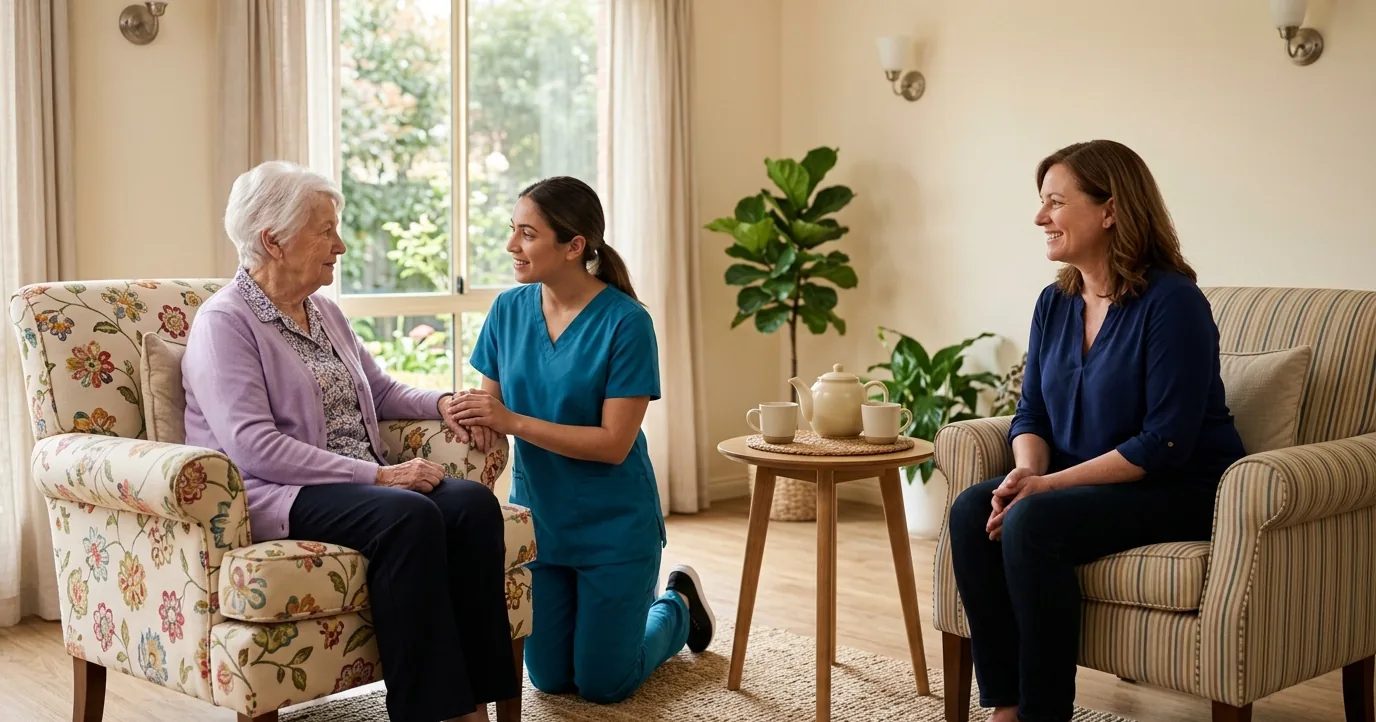
Somewhere on every memory care tour, the phrase arrives. It is in the brochure, on the framed mission statement by the front desk, and in the director’s voice as you walk the hallway: our care is person-centered. You nod, because it sounds right, and because by now you have heard it at every community on your list.
That sameness is the problem. A collection of dementia care research published in September 2026 found that “person-centered” has no agreed definition, even among the researchers who study it. When the team behind it surveyed Alzheimer’s associations around the world, one respondent said the term gets “used often to describe any care or support given to the person.” A community can say it in complete sincerity and still mean very little by it.
This guide turns that research into something you can use in a hallway. It covers the five principles the researchers distilled, what each one looks like on a real memory care floor, why even good communities struggle to deliver them, and the tour questions and red flags that separate a working practice from a marketing phrase.
What the New Research Found
The collection, titled “Reconstructing Person-Centeredness,” is a special supplement to the Journal of Applied Gerontology. It came out of LINC-AD, a national research network convened by the Alzheimer’s Association and funded by the National Institute on Aging. The guest editors were Sam Fazio and Lauren Stratton of the Alzheimer’s Association and Sheryl Zimmerman of the University of North Carolina at Chapel Hill. Across ten papers and an opening editorial, the authors asked what person-centered care actually means, why it is so hard to deliver, and how anyone could measure it.
Three findings matter most for families.
Nobody agrees on what it means. A scoping review of US dementia research found 71 studies that defined person-centered care, and their definitions varied widely. The most common ingredients were the person’s needs and preferences (in 59 percent of definitions), relationships (52 percent), and personhood, the idea that someone with dementia keeps their full standing and dignity as a person (48 percent). The reviewers also set aside more than 150 other articles that put the term in their titles or abstracts without ever defining it. If researchers can use the phrase without saying what they mean by it, so can a sales brochure.
Most of the world falls short of it. The international survey went to member associations of Alzheimer’s Disease International, the global federation of national dementia organizations, and drew answers from 59 people representing 39 countries. Respondents from 15 of those countries, higher and lower income alike, said quality dementia care was scarce or missing where they live. Out of their descriptions of good care came five shared principles, which the next section walks through.
It is never finished. A third paper drew on meetings with 116 people, from long-term care leaders and direct care workers to advocates and people living with dementia. It concluded that complete person-centeredness can never be reached, because it keeps colliding with other legitimate goals: safety, budgets, and the needs of everyone else who lives in the building. As the authors put it, person-centeredness is “a dynamic and continuously negotiated process.” That sounds abstract, but it hands you a practical test. A community doing this work can tell you where the tradeoffs bite. A community that claims there are none is reciting.
The Five Principles, and What Each Looks Like on the Floor
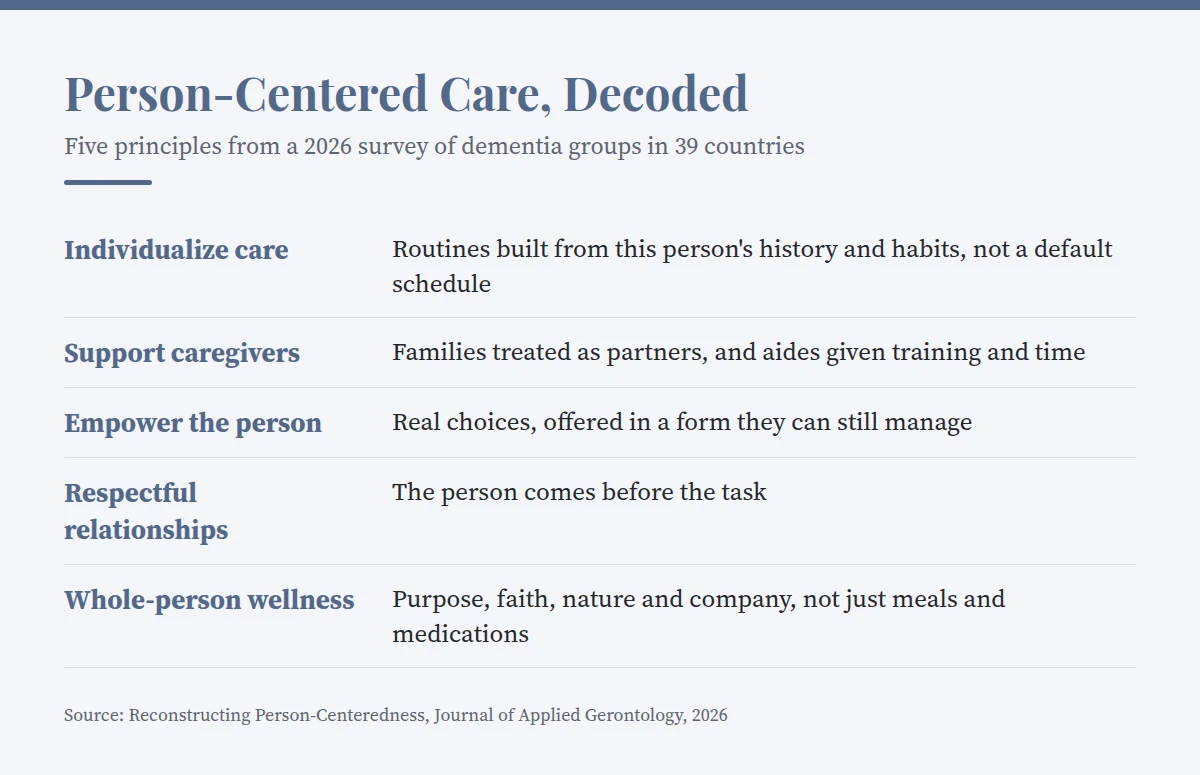
The survey’s five principles are not a checklist for facilities to adopt word for word. They are the common ground that emerged when dementia organizations in very different countries described good care. For a family, they work as five lenses. Hold each one up during a visit and ask what you would expect to see if the community meant it.
1. Individualize Care
Respondents from 21 countries described this principle. It means care built from who the person is (their personality, life history, culture, and habits) and revisited as the disease changes them, rather than one routine applied to everyone with the same diagnosis.
On the floor, it looks like a retired baker who wakes at 4:30 being given coffee and a quiet job folding napkins instead of being steered back to bed. It looks like a shower schedule that follows a lifelong preference for evenings. And it looks like a care plan written in sentences about one person, not a page of checked boxes.
The research is pointed about that last part. In one of the supplement’s discussion groups, a participant described computer-generated “cookie-cutter care plans,” built from drop-down menus, as about as far from person-centeredness as care can get. The same paper walks through an illustrative case: a man with moderate Alzheimer’s grows agitated whenever staff come to brush his teeth, a task that care planning software added from his diagnosis list. His aide, whose annual review counts completed tasks, starts to feel like giving up on him. Knowing a resident’s favorite song is a start. Letting what you learn reshape the day is the principle.
2. Support and Acknowledge Caregivers
Respondents from 22 countries named this principle, more than any other. It has two halves, and memory care depends on both.
The first half is you. Respondents stressed bringing family caregivers into formal care settings respectfully and on purpose, so that care keeps lining up with what the person and the people closest to them want. You are not a visitor to be managed. You are the best source of information the staff will ever have.
The second half is the paid staff. The supplement’s paper on the care workforce found that person-centered care is rarely treated as the standard. A nursing assistant in its discussion groups described aides who bought hair rollers so that residents who could not afford the beauty shop could still have their hair set every week. That is the principle at work, and the researchers’ point is that it happened because aides went out of their way, not because the system expected it. On a tour, look for signs that the community makes this kind of care part of the job: dementia training, enough time on each shift, and consistent assignment, meaning the same aides work with the same residents most days. The workforce paper names consistent assignment as one of the conditions that can help relationships form in residential care.
3. Empower the Individual
Respondents from 16 countries described person-centered care as honoring the agency of the person with dementia: involving them in decisions about their own care, respecting their choices, and adapting information and surroundings so they can keep doing what they still can.
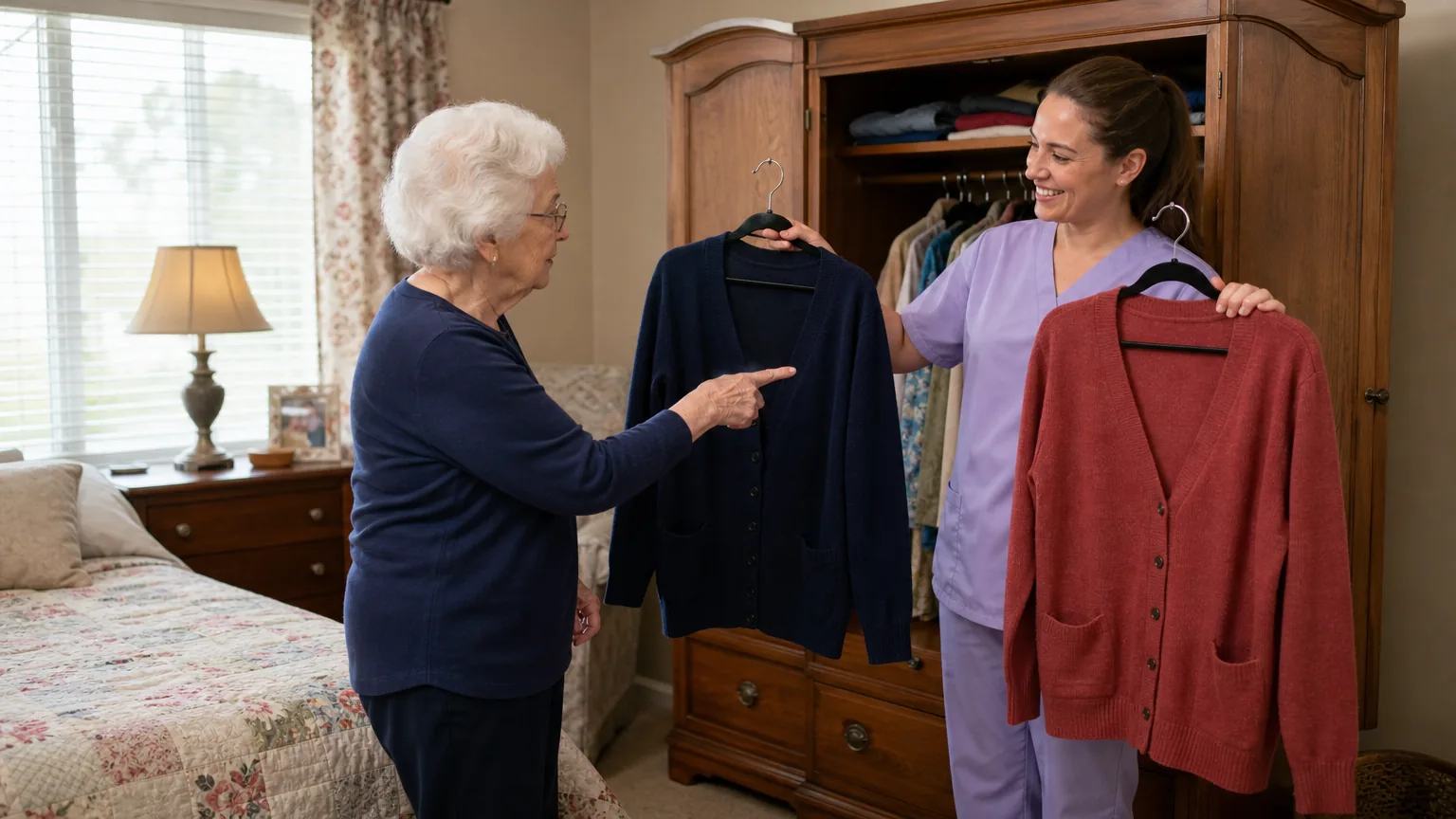
On the floor, that looks like an aide holding up two shirts and waiting for a choice, rather than dressing a resident in whatever is on top of the pile. It looks like handing over the washcloth so a resident can wash their own face, even though it takes longer. It looks like residents setting tables, watering plants, or sorting the mail because it is useful work.
Respondents were candid that this gets hard, for instance when someone refuses basic hygiene. A community that respects choice still has to handle that moment, and how it handles it tells you a great deal (the tour questions below include one for exactly this).
4. Cultivate Respectful Relationships
Respondents from 15 countries described this principle: care that honors the inherent worth of the person, puts the interaction ahead of the task, and meets people in their own reality instead of correcting it.
You can see it in small moments. An aide crouches to eye level and says what is about to happen before touching anyone. Staff talk with residents while helping them, not over their heads to each other. A woman waiting for her children to come home from school is asked about them, not told they are grown. The survey’s suggested practices also include avoiding labels, which gives you a simple listening test: staff who refer to residents as “feeders” or “wanderers” are describing tasks, not people.
5. Address Dimensions of Wellness
Respondents from 11 countries talked about wellbeing beyond the physical. The paper points to a seven-part model of wellness that runs from physical and emotional health to intellectual, social, spiritual, environmental, and vocational needs. Clean clothes, regular meals, and medications on time are the floor of good care, not the whole of it.
On the floor, read the activity calendar and then look around the room. Is there music from the residents’ own era, time outdoors, faith services in their own traditions, and tasks that feel like real work? Or is the day mostly television and bingo? Pay special attention to residents in later stages who no longer join groups, because they are the easiest people to leave in front of a screen. Our guide to meaningful activities at every stage shows what good engagement looks like.

Why Even Good Communities Fall Short
Before the tour questions, some realism, because it changes how you read the answers. The supplement names the barriers plainly: stigma, workforce challenges, limited resources, organizational structures, and regulation. Each one shows up on a memory care floor.
Stigma. Survey respondents described a common belief that people with dementia “can’t tell what they want or need.” Wherever that belief takes hold, staff stop asking and start deciding.
Staffing and time. Individualized care costs staff time. One participant laid out the arithmetic: an aide with seven residents who spends ninety minutes on one person’s individualized care leaves the other six waiting with their call lights on, which is not person-centered for them.
Safety rules. The paper on tensions tells of a resident whose favorite slippers were taken away after three falls. Staff made the resident safer and overrode the resident’s wishes in the same move. Another participant was candid about a tendency among staff: deciding that a resident has capacity when the resident agrees with staff, and lacks it when the resident does not.
Leadership in the building. In the workforce discussions, the general view was that person-centered practice depends less on corporate ownership than on leadership in the individual building. A licensed nursing home administrator said the director of nursing and the administrator set the quality, not the ownership type. (That is a useful counterweight if you have been digging into who owns and runs a community.) Staff also described the opposite case: an administrator who told everyone that quality came first, while a shower chair sat with a broken wheel for a month and the request for a new one was turned down as not in the budget.
None of this excuses a community. It tells you where to look. The research describes ways to negotiate these tensions, such as deciding together with the resident and family when wishes and safety pull in opposite directions, and sometimes writing down which risks everyone has agreed to accept. A community that can walk you through how it does that, with an example, is showing you the practice. If you are ever asked to sign a risk agreement, have an elder law attorney read it first.
Tour Questions That Separate a Practice From a Phrase
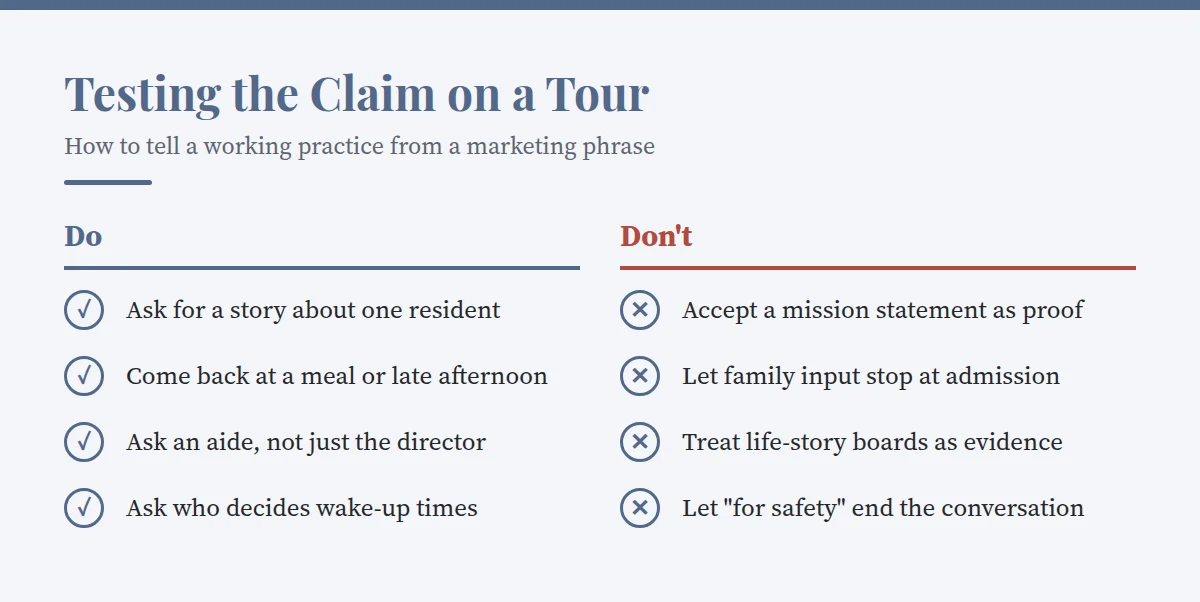
One rule covers all of these: ask for a story, not a policy. Anyone in sales can learn a policy. A specific story about a real resident (with the name left out) shows whether the practice exists.
- “Tell me about a resident whose daily routine you changed because of something you learned about them.” A real answer comes with details: what staff learned, who told them, and what changed. A general answer about “honoring preferences” is the phrase again.
- “Can I see the form you use to get to know a new resident, and who reads it?” Look for questions about lifelong routines, work, faith, comforts, and fears. Then ask whether the aides on the unit see the answers or whether they sit in a file.
- “What time do residents get up and go to bed, and who decides?” One schedule for the whole unit usually means the day is built around shift changes.
- “Do the same aides work with the same residents most days, including nights and weekends?” Consistent assignment is how staff learn a person well enough to notice distress early.
- “When a resident refuses a shower, what happens next?” Listen for curiosity (trying later, a different aide, a sponge bath, finding out why) rather than talk of compliance.
- “Tell me about a time a resident wanted to do something that carried a risk. How did you decide?” Every community faces safety versus freedom. You want an answer that involved the resident and the family, not one that ends at “for safety reasons.”
- “How are families involved in care planning, and how often do you meet?” Look for a real invitation, a regular schedule, and a way to raise concerns between meetings.
- “How long have the memory care director and the lead nurse been in their jobs?” So much depends on the people running the building that frequent turnover at the top is worth a follow-up question. Then ask how many aides have stayed more than a year.
Ask these alongside the core questions for any memory care tour, which cover staffing ratios, safety features, and costs.
What to Watch When Nobody Is Presenting
The scheduled tour is the most rehearsed hour of a community’s week. An assisted living staff member in one of the supplement’s discussion groups recalled the call that came before tours: “make sure nobody’s sleeping on the couch.” That staff member’s answer was to defend the resident who liked to nap there, but the instinct to tidy away real life is common. So visit a second time, unannounced if you can, at a meal, in the late afternoon, or on a weekend.
Signs the practice is real:
- Aides talk to residents while helping them, at eye level, and explain what they are about to do.
- Residents are doing different things at the same time, not all parked in one room facing one screen.
- Rooms look like the people who live in them, with their own furniture, photos, and objects.
- An aide, and not just the director, can tell you something specific about a resident’s preferences.
Red flags:
- Every answer is philosophy, and none is an example.
- “For safety” ends every conversation about choice.
- Everyone is up, dressed, and seated for breakfast at the same moment.
- Life-story boards and memory boxes line the hallway, but no aide can tell you what is in them. The research calls this superficial knowing: collecting facts about a person without letting them change the care.
- Family input is gathered at admission and never asked for again.
- The activity calendar is mostly passive: television, movies, bingo.
What PC-MET Is, and What It Is Not
The supplement’s most technical contribution is the Person-Centered Measure Evaluation Tool, or PC-MET, and it is worth knowing what it is before anyone mentions it on a tour.
PC-MET is a tool for researchers. It grades research measures (the questionnaires and rating scales that studies use to judge things like quality of life), not care communities. It scores a measure on six criteria: co-creation, accommodation, incorporation, biopsychosocial and cultural components, pragmatism, and systemic focus. In pilot testing, independent raters agreed with each other at a substantial level or better on all six. The Alzheimer’s Association says the work responds to a finding that many assessment tools described as person-centered do not adequately reflect the perspectives of people living with dementia and their care partners.
So no memory care community can be “PC-MET certified,” and you cannot score a building with it. If a sales director brings it up, ask what exactly they mean. What PC-MET does signal is direction: the field wants person-centered care to become something that can be measured, not just promised. Until that happens, the measuring on a tour falls to you.
There is one more gap worth knowing about. Federal rules define person-centered care only for nursing homes that take Medicare or Medicaid, where it means treating the resident as “the locus of control” and supporting their choices and control over daily life. Much of memory care is licensed by states under assisted living rules, where that federal definition does not apply and state requirements vary. In an assisted living memory care unit, the phrase answers to no federal definition at all.
After Move-In, Keep Testing
The tour is a snapshot. Person-centered care either survives the first months or it does not.
- Hand staff the person, not just the paperwork. Write a one-page summary of routines, comforts, triggers, and the names your loved one asks for, and give copies to the aides on the unit, not only to the admissions office.
- Go to every care plan meeting. Ask what has changed since the last one. A plan that stays the same while the disease moves on is not individualized.
- Vary your visits. Come at different times and notice whether the same aides keep turning up.
- Escalate in writing. Raise concerns with the memory care director first. If nothing changes, the long-term care ombudsman is a free advocate for residents. If what you see looks like neglect rather than a missed preference, our guide to recognizing and reporting abuse and neglect explains who to call.
The Question Behind the Phrase
Choosing memory care is among the hardest decisions a family makes, and a reassuring word in a brochure is meant to make it feel easier. Do not let it do that work for you. For the placement decision itself, bring in a geriatric care manager or a hospital social worker, someone who knows the local communities and earns nothing from where your loved one lands, and have an elder law attorney review the residency contract.
The supplement’s most memorable line did not come from a researcher. It came from a member of the Alzheimer’s Association’s Early-Stage Advisory Group, a panel of people living with early-stage dementia or mild cognitive impairment: “Person-centeredness means letting you into my world.” That is the real test on a tour. Not whether the staff can recite the phrase, but whether anyone there is asking to come in.
Further reading (sources)
- Alzheimer’s Association on the September 2026 announcement of the Reconstructing Person-Centeredness supplement
- Alzheimer’s Association for who serves on its Early-Stage Advisory Group
- Fazio and colleagues with the survey of dementia associations in 39 countries behind the five principles
- Efird-Green and colleagues on how US dementia studies define person-centeredness, when they define it at all
- Zimmerman and colleagues about six tensions that keep person-centered care from ever being finished
- Saavedra and colleagues on why care workers and leaders say person-centered care is rarely the standard
- Zimmerman, Port, Mast, Van Haitsma and Fazio for the PC-MET tool that grades research measures
- Legal Information Institute with the federal nursing home definition of person-centered care