Should Mom Move In With Us? The Complete Guide to Multigenerational Dementia Caregiving
Published on September 26, 2026
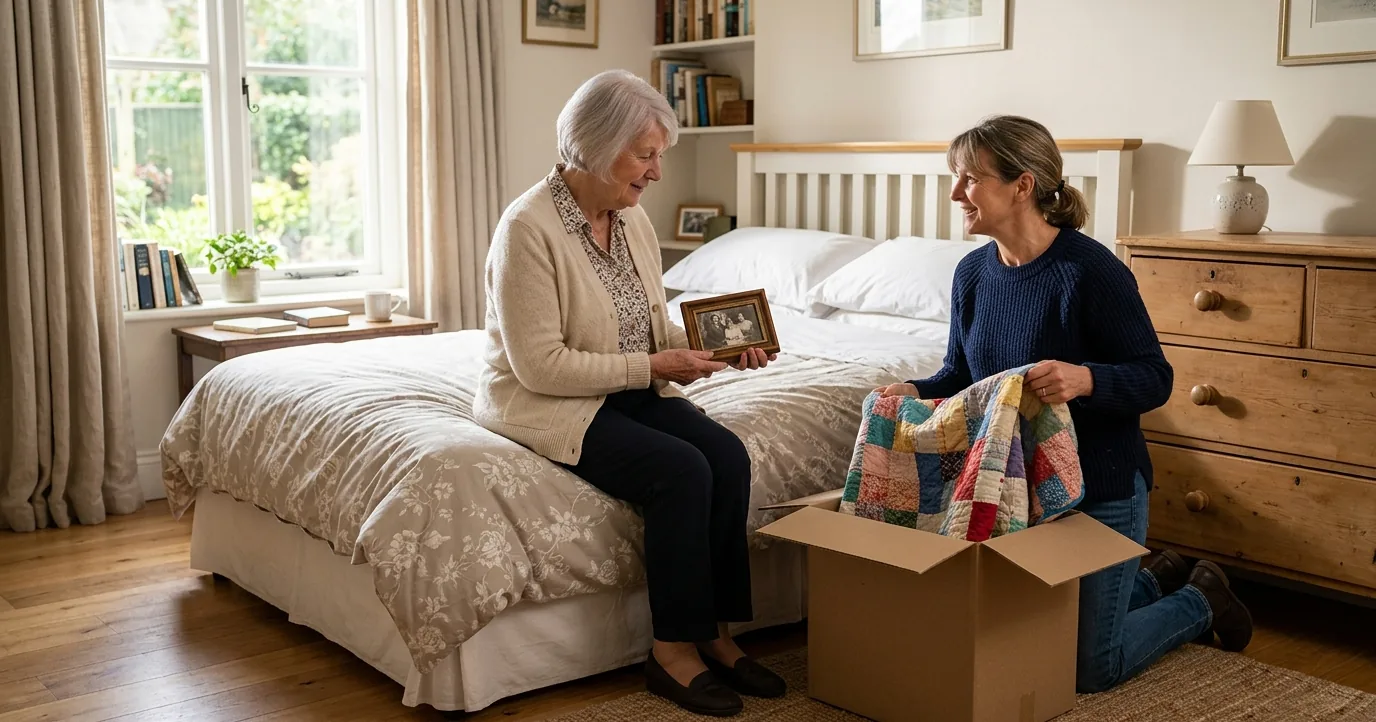
The idea usually arrives fully formed, often at a kitchen table the week after a fall or a frightening phone call. The spare room is right there. Mom can move in with us. It sounds like love, it sounds cheaper than memory care, and for plenty of families it turns out to be the right call for a good long stretch.
It is also one of the largest decisions a household can make, and it is often made in an afternoon. Forty percent of family caregivers in the United States now live with the person they care for, up from 34 percent in 2015, according to the 2025 Caregiving in the US survey from the National Alliance for Caregiving and AARP. This guide walks through the capacity question, the marriage, the house, the money, the children and the exit plan. Treat the answer as a decision you will revisit, not a promise you must keep forever, and bring in a geriatric care manager or social worker early. Their assessment of what your parent needs is worth more than any checklist, this one included.
A Decision, Not a Default
The same survey shows what the arrangement asks of you. Caregivers who live with the person they care for put in more hours and get less help doing it. Twenty-two percent of them provide 21 or more hours of care a week, against 12 percent of caregivers who live apart. Only 36 percent have unpaid help from family or friends, compared with 65 percent of those living elsewhere, and only 22 percent use paid help, compared with 39 percent. In plain terms, once a parent’s address is your address, siblings tend to step back and paid help tends not to arrive. Caregivers who share a home with the person they care for also rate their own health as fair or poor more often (26 percent, against one in five caregivers overall).
The survey found something else worth sitting with. More than half of caregivers (56 percent) said they had no choice about taking on the role. Compared with caregivers who felt they had a choice, they reported nearly twice as many poor mental health days a month (8 against 4.5), were almost three times as likely to feel isolated, and were less likely to find purpose in the work. That is the strongest argument for making this a real decision, made out loud by everyone who will live with it.
None of this means the answer is no. In a Pew Research Center survey of adults in multigenerational homes (for any reason, not dementia specifically), 54 percent found living with adult relatives rewarding all or most of the time. Twenty-three percent found it stressful that often, and adult children living with a parent said so more often than parents living with an adult child (31 percent against 18 percent). Both can be true in the same house, sometimes in the same week.
The Honest Capacity Assessment
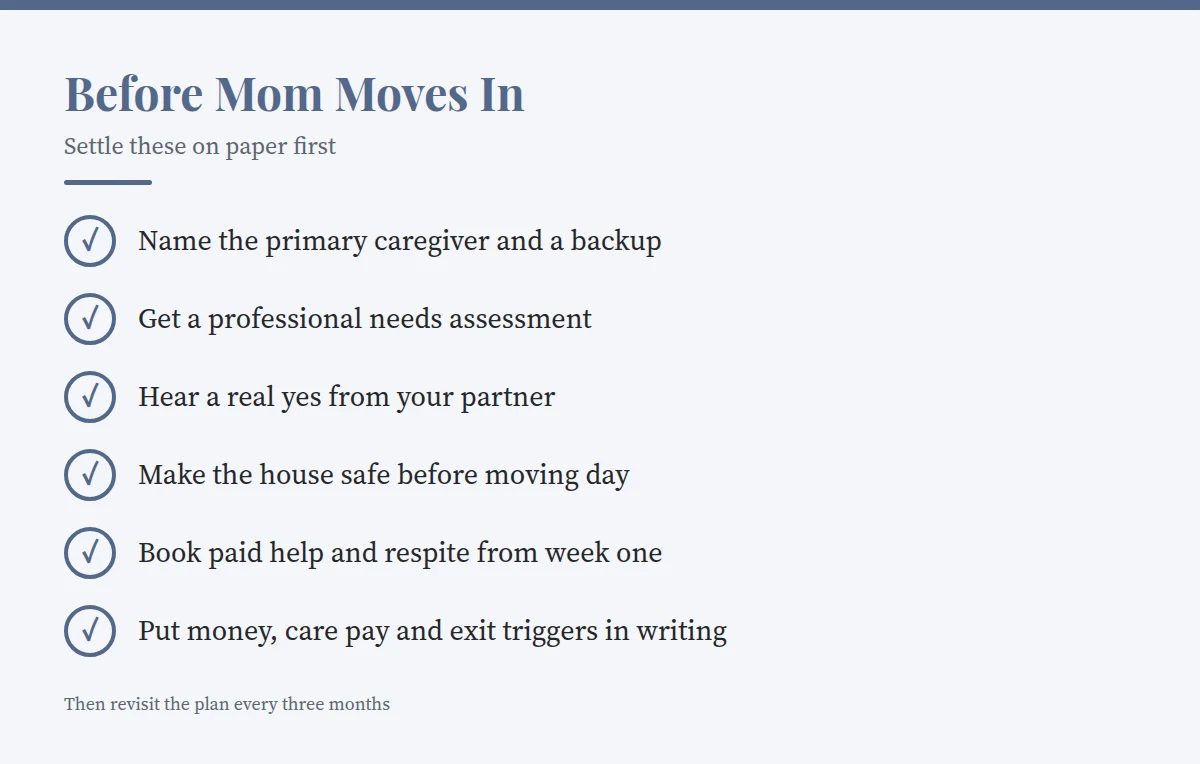
Before anyone packs a box, answer these questions on paper, ideally with a geriatric care manager or social worker who has assessed your parent.
- Who is the primary caregiver, by name? “We’ll all pitch in” usually means one person does most of it. Name that person, and a backup for the weeks they are sick or away.
- What will your parent need in eighteen months? Dementia is progressive. Plan for the supervision and nighttime help the next stage will bring, not only for the parent you see today.
- Who is home during the day? Working from home is not the same as being available. A parent who cannot safely be left alone needs someone present, family or paid, for every hour the house would otherwise be empty.
- Can your bodies do this? Helping someone stand, bathe and manage stairs is physical work, and so is broken sleep. Your health and your partner’s belong in the plan.
- What is the history between you? Dementia does not erase an old relationship, and it can strip away the restraint that kept friction manageable. A parent who was harsh or abusive is a legitimate reason to choose another setting. That is a boundary, not a failure.
- What does your parent want? Include them as far as their abilities allow. Moving in with you can mean leaving a neighborhood, friends, a congregation and familiar doctors, losses that deserve a plan of their own. Expect pushback too; one psychiatrist advises families raising these changes to be ready for opposition and even hurtful accusations.
If the legal documents are not in place yet, deal with them before the move. A durable power of attorney and a health care proxy are far easier to sign while your parent can still understand them, and you will need both for nearly everything below. Our guide to the legal documents every family needs after a diagnosis explains each one.
What It Does to a Marriage
Most advice on caring for a parent speaks to the caregiver. When the parent moves in, the person most affected and least consulted is often the caregiver’s partner.
Research on parent care in general (not dementia or shared homes specifically) suggests the strain builds with time. In a national study of 716 adult daughters and sons, people who had been caring for a parent longer reported less marital happiness, a stronger sense that roles in the marriage were unequal, and more hostility than people who had only recently started. Over time, caregiving daughters showed rising depressive symptoms while sons showed a decline. A separate study of 132 middle-aged couples found that when wives helped their own parents more often, husbands reported lower marital satisfaction if the husbands felt little obligation toward parents, or if the wives felt a great deal. Your partner’s sense of what adult children owe their parents matters as much as yours.
So the answer from your partner has to be a real yes, not a tired “fine.” Talk through what will change: evenings, privacy, weekends away, money, and who handles intimate care such as bathing (many in-laws should not take this on, and many parents would not want them to). Agree on protected time for the two of you, covered by paid help, and give each of you a standing right to call a review. A marriage that quietly breaks under the arrangement helps no one, least of all the parent.

Setting Up the House
The National Institute on Aging suggests going through the house room by room, correcting immediate dangers such as loose stair railings and poor lighting first, then working through the rest. Its home safety guidance for Alzheimer’s caregivers includes:
- Locking up or removing medicines, alcohol, cleaning products and laundry pods, along with guns and other weapons, knives and power tools.
- Setting the water heater to 120°F to prevent scalds, and adding safety knobs and an automatic shut-off switch to the stove.
- Installing grab bars in the tub or shower, in a color that contrasts with the wall, plus nonskid strips and a raised toilet seat with handrails.
- Putting nightlights in bedrooms, bathrooms and hallways, and marking the edges of steps with brightly colored tape.
- Using a room monitor, like the ones sold for babies, so you hear a fall or a call for help at night.
Add one choice of your own: a bedroom on the main floor, near a bathroom. Stairs only get harder, and a short, well-lit path to the toilet matters most at three in the morning.
Then plan for getting lost. The Alzheimer’s Association says six in 10 people living with dementia will wander at least once, and two of the warning signs it lists are appearing lost in a new or changed environment and wanting to “go home” even when already home. A new house is exactly that environment. For the first weeks, don’t leave your parent unsupervised while the surroundings are still unfamiliar. Place deadbolts high or low on exterior doors, out of the line of sight, add bells or a monitor that signals when a door opens, and keep coats, keys and wallets out of view, since they can prompt the urge to leave. Never lock a person in at home, the Association adds.
Make the room theirs. Their own chair, bedspread, photographs and lamp will settle a person faster than anything new. If modifications cost more than you can manage, NIA suggests asking your state housing finance agency or social services department about financial aid, and the Eldercare Locator (800-677-1116) can point you to local programs.
Build Paid Help In From Day One
Given how often caregivers who live with a parent go without help, the most protective step is to schedule help before you need it. In the Caregiving in the US survey, nearly four in 10 caregivers said respite would be helpful, yet only 13 percent used it.
A household that works usually layers several kinds of support: an adult day program a few days a week, an aide for the hours you work or for the late afternoon and early evening when many people with dementia grow restless, and planned respite so you can take a weekend or a real vacation. Our guide to bringing in-home memory care into the house covers hiring an aide and what it costs.

Ask about Medicare’s GUIDE Model as well. It pays participating dementia care programs to provide care navigation, a 24/7 support line, caregiver training, and up to $2,500 a year in respite for eligible patients, whether that respite happens at home, at an adult day center or in a facility. Not every area has a participating program, so ask your parent’s doctor whether one serves you.
The Money Conversation
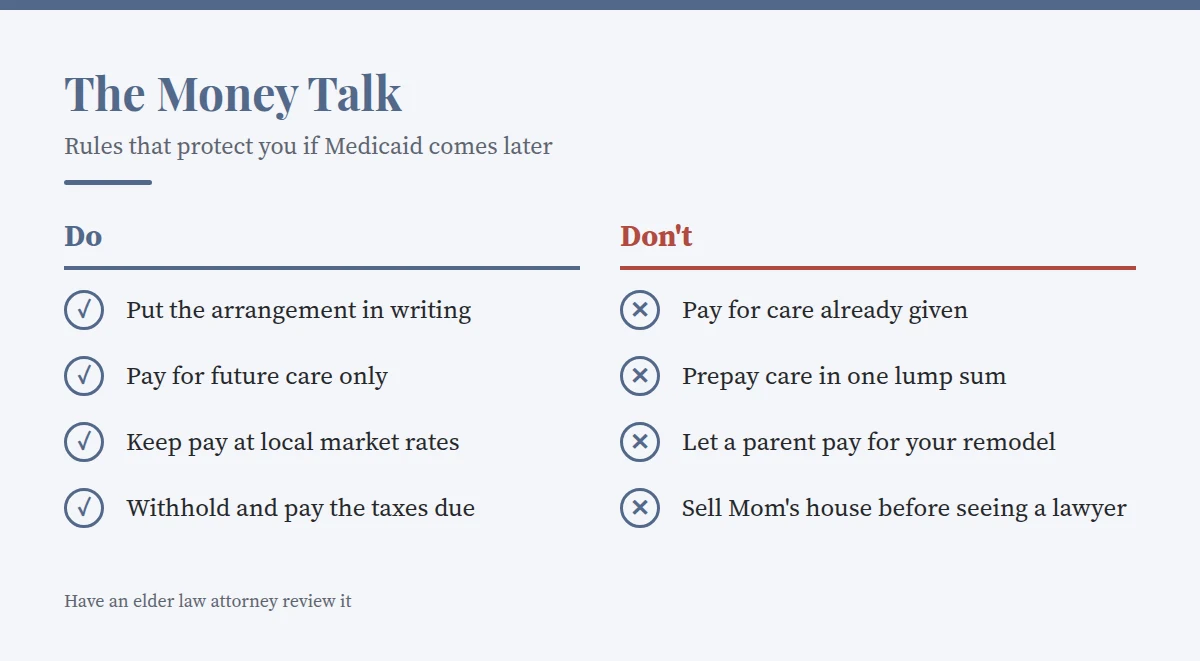
Money gets awkward fastest when it stays vague. Settle three things in writing before moving day, and have an elder law attorney review them.
What your parent contributes. Your parent’s own income should cover their share of the household. The Family Caregiver Alliance suggests that a care agreement spell out room and board when the person lives with the caregiver: a proportional share of utilities, mortgage, insurance and taxes. A written, fair arrangement protects you from sibling suspicion and your parent from being overcharged.
Whether the caregiver is paid. If you or your partner will give substantial hands-on care, a personal care agreement lets your parent pay you for it. The Alliance is specific about what makes one hold up. It covers future care only, never care already given. The pay is no more than a third party would charge in your area. It states the start date, the services, how often they happen and when payment is made. And it makes the caregiver an employee, which means withholding and paying taxes. Lump-sum prepayments are harder to defend. If you also hold your parent’s power of attorney, you would sit on both sides of the contract, one more reason to have a lawyer draft it.
How it will look to Medicaid. Under federal law, when someone applies for Medicaid long-term care, the state looks back 60 months for assets given away or sold for less than fair market value, and those transfers can bring a period of ineligibility. Casual payments to a caregiving child, or a parent paying for an addition to your house, can look like exactly that. A written agreement at fair value is how you show they were not.
One provision can change the whole plan. Federal law lets a parent transfer their home to an adult child without penalty if that child lived in the parent’s home for at least two years right before the parent entered a nursing facility, and provided care that kept the parent at home (the state decides whether the care qualifies). It applies when the child moves into the parent’s house, not the reverse. If staying in your parent’s home is realistic, ask an elder law attorney to compare “Mom moves in with us” with “we move in with Mom” before anyone sells a house.
Siblings belong in this conversation too. The one who hosts is contributing space, time and privacy, and the others can contribute money, respite weekends or the paperwork. Our guide for sandwich generation caregivers has a playbook for that family meeting.
Children in the House
Almost a third of family caregivers live with a child or grandchild under 18 while caring for an adult, the Caregiving in the US survey found. The Alzheimer’s Association notes that teenagers in these homes may not feel comfortable having friends over, may be embarrassed by how a grandparent acts, and may feel it is unfair to be handed new chores or unsure of their place in a changing family.
Explain what is happening in words that fit each child’s age, and keep explaining as the disease changes; this is an ongoing conversation, not a single talk. Protect what belongs to them: their room, their friends, their activities. Let them help in ways that build a relationship, like music, cards or cooking together, without making them the default sitter. A school counselor, therapist or pediatrician can help a child who is struggling. And make one rule firm from the start: if your parent’s agitation or aggression is frightening a child, the arrangement has to change.

There is an upside families rarely expect. Grandchildren who grow up with a grandparent at the dinner table get time with them that holiday visits never allowed.
Plan the Exit Before You Need It
This is the part families skip, and it protects everyone the most. A 2025 BMJ review that pooled 79 studies of nursing home admission found a median of 3.3 years from a dementia diagnosis to moving into a nursing home, and more than half of people had moved within five years. Individual timelines vary a great deal, but for most families, living together is a chapter rather than the whole story.
Write the exit into the plan on day one:
- Start with a trial. Agree on 90 days, then review every three months and after any fall, hospital stay or big change.
- List the triggers in advance. For example: your parent is unsafe during hours nobody can cover, you are up most nights, care now takes two people, agitation is frightening the children, your doctor is worried about your health, or the budget for paid help has run out.
- Learn the levels of care now. Assisted living provides housing, meals and help with daily tasks, but not necessarily a secured building or dementia-trained staff. Memory care adds a secured environment, staff trained in dementia, and activities built for people with cognitive decline. A skilled nursing facility provides round-the-clock nursing for significant medical needs. A geriatric care manager or social worker can tell you which level fits.
- Tour before a crisis. Bring our list of questions to ask memory care communities, and keep your parent’s financial records organized in case a Medicaid application follows.
- Ask what your parent would want while they can still tell you. A goals of care conversation covers the later decisions that no move-in plan can.
Be careful with one promise in particular. “We’ll never put you in a home” is said with love and can become a heavy weight years later. “We will always take care of you, and we will always make sure you are safe” is a promise you can keep in any setting. If the day comes, a move to memory care does not end your role. It changes it from doing the care to overseeing it.
A Decision You Get to Make Again
“Should Mom move in with us?” is not a question about how much you love her. It is a question about which arrangement keeps her safe and your household whole, and the honest answer can change with the seasons. If you say yes, say it deliberately: a partner who means it, paid help on the calendar, the money in writing and the exit sketched. Then ask again in three months. That is how families keep the promise that matters more than any address.
Further reading (sources)
- National Alliance for Caregiving and AARP on how many caregivers live with the person they care for, and how much help they get
- National Alliance for Caregiving and AARP with caregiver health findings, including for caregivers who felt they had no choice
- Pew Research Center for how adults in multigenerational homes rate the experience
- Bookwala on long-term parent care and marital quality in adult daughters and sons
- Polenick and colleagues with how spouses’ beliefs about helping parents shape marital satisfaction
- National Institute on Aging for room-by-room home safety tips for Alzheimer’s caregivers
- Alzheimer’s Association on wandering risk and how to prepare a home
- Alzheimer’s Association with what teenagers may feel when a family member has dementia
- Centers for Medicare & Medicaid Services on the GUIDE Model’s dementia care and respite benefit
- Family Caregiver Alliance for what a personal care agreement should contain
- Legal Information Institute with the federal Medicaid rules on asset transfers and the caregiver child exception
- Brück and colleagues in the BMJ on time from a dementia diagnosis to nursing home admission
- The Globe and Mail with a psychiatrist’s column on the demands and rewards of dementia care