Free Care Consultation From the Alzheimer's Association: What the 24/7 Helpline Actually Does and What the Evidence Says
Published on October 15, 2026
If you know the Alzheimer’s Association at all, you probably know it as a walk in the fall and a request for a donation. Its phone number, 800.272.3900, sits at the bottom of nearly every page of its website, and most families scroll straight past it, assuming it leads to a recorded menu or a fundraising pitch.
It leads to a person, at any hour of any day of the year. And if you ask for it, it leads to something more useful than a pamphlet: a free conversation of up to an hour with a master’s-level dementia specialist, built around one question (what should you do next?) and ending with a concrete plan for doing it. The Association calls this care consultation. It is one of the longest-studied forms of help for dementia families in the country, and hardly anyone outside the field knows it exists.
Here is what actually happens when you call, how to ask for a consultation and get the most from it, and what more than 20 years of research says it can and cannot do.
Two Kinds of Help Behind One Phone Number
The Helpline is free, confidential, and open to anyone: people living with dementia, caregivers, other relatives, and the public. You do not need a confirmed diagnosis, a referral, or a donation history. The phones are answered around the clock, 365 days a year, and help is available in more than 200 languages through bilingual staff or an interpreter service. If you are deaf, hard of hearing, or speech impaired, dial 711 to reach a relay operator.
The first person you reach is a Helpline agent, who handles the information side of things: explaining memory loss and the disease, sending literature, and pointing you to local support groups and education programs. Agents can also register you for those programs, in person or online. For a lot of calls, that is enough.
When it is not, the next step is a care consultant. The Association describes its care consultants as master’s-level dementia experts offering “individualized, solution-focused support,” and it is specific about how the conversation runs. Each consultation opens by clarifying what you hope to get out of it, and it closes with an action plan that you and the consultant build together. In a study of the service published in 2025, every consultation lasted up to an hour and ended with a plan of reasonable goals and next steps for the caregiver to take.
There are two other ways in. A live chat on the Helpline’s web page is typically staffed Monday through Saturday from 7 a.m. to 7 p.m. Central time, and an online form takes non-urgent questions, with a reply promised within 24 hours.
A few ground rules are worth knowing before you dial. Staff do not give medical advice, diagnoses, or treatment recommendations. Care consultants are mandated reporters, so if you describe abuse or neglect, they are required by law to report it to state authorities. And if the line is busy and you ask for a callback, it has to go to your own number. The Helpline will not call a sibling, a friend, or a doctor at your request, and the callback service is not available when an AI assistant places the call for you.
What a Care Consultation Covers
Callers bring almost everything. The topics the Association lists include what to do after a diagnosis, medications and treatment options, finding care providers, housing and moves into residential care, respite care and ways to pay for it, caregiver stress, understanding and responding to dementia-related behaviors, communication, safety, legal and financial planning, and local programs. If you do not know what to ask, the Association’s advice is to call anyway and let the conversation find the question.
The research behind the model describes the method more precisely. In the Cleveland study described below, care consultation was a telephone program in which Association staff worked with people living with dementia and their caregivers to identify strengths and resources in three places: the family, the health plan, and the community. That is a useful way to picture what a good consultation is doing underneath the conversation:
- The family. Who is doing what now, who could do more, and where the friction is. This is where a plan to split the load among siblings, or to bring a reluctant one in, takes shape.
- The health plan. What the person’s coverage already pays for that nobody has used yet, which doctor needs to hear about the new behavior, and what to ask at the next appointment.
- The community. Adult day programs, respite, the local Area Agency on Aging, support groups, legal help, and whatever the Association’s own chapter runs near you.
What you leave with is an action plan: a short list of specific steps, each of them yours to take. The plan only works if it survives the call, so write it down as you go and ask the consultant to read it back at the end. In a 2021 evaluation of Helpline consultations, 70 percent of callers had put action steps in place within a week and 80 percent within a month, and more than 80 percent rated the steps helpful.
How to Request One, and Make the Hour Count
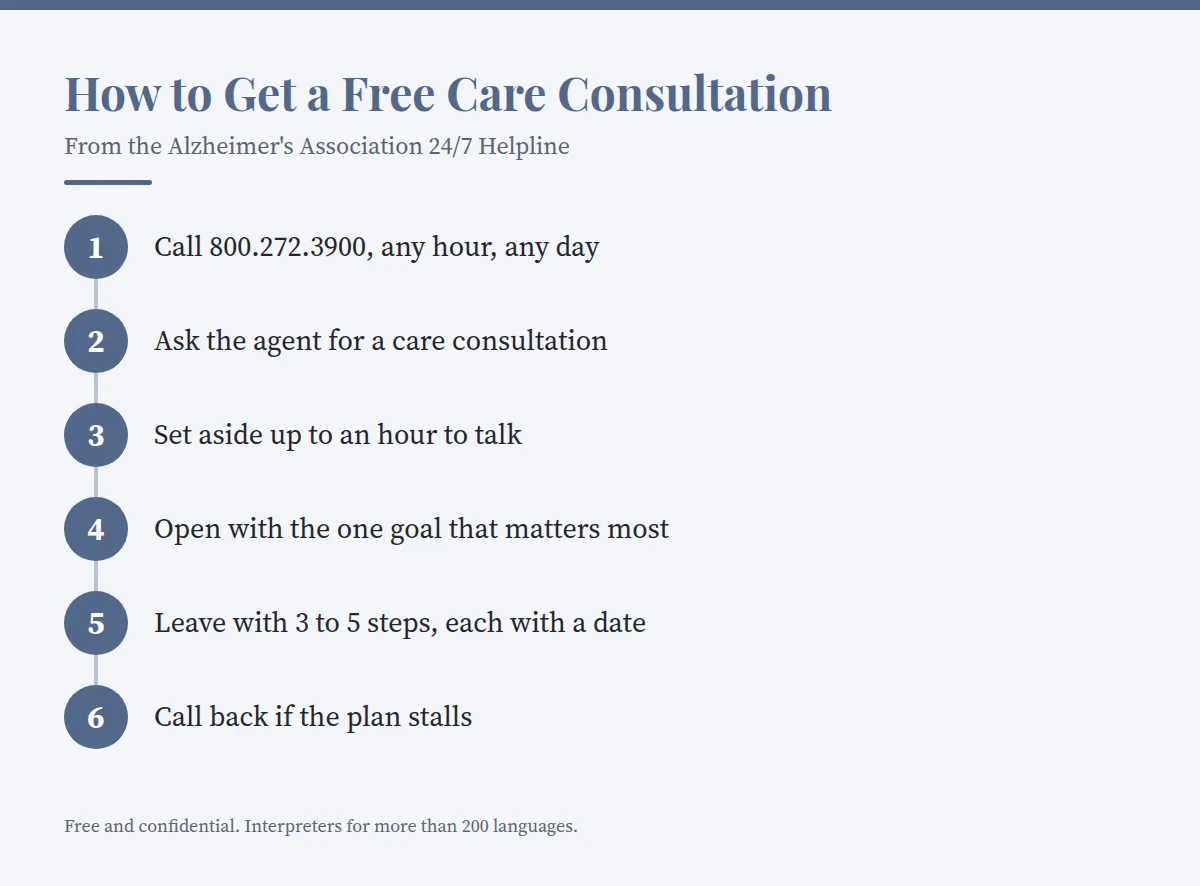
- Call 800.272.3900 and ask for a care consultation by name. The agent who answers can transfer you to a consultant or schedule the conversation for a better time.
- Choose an hour you can protect. Call from somewhere the person you care for cannot overhear, especially if the subject is driving, money, or a move.
- Have the basics within reach. The diagnosis or what the doctor suspects, the current medication list, the living situation, who helps and how often, the coverage in play (Medicare, Medicaid, a Medicare Advantage plan, long-term care insurance, VA benefits), and what you have already tried.
- Lead with your goal. The consultation starts there anyway. “I need to decide whether Dad can keep living alone” gets you further than a tour of everything that went wrong this month.
- Leave with three to five steps, each with a name and a date attached. Vague steps (“look into respite”) stall. Specific ones (“call the Area Agency on Aging on Thursday about respite funding”) get done.
- Call back when the plan stalls. One call is not the limit. In the 2025 study of 2,503 callers, the people who asked for a second or third consultation had started out struggling more than those who needed only one, and the second call still helped.
If several relatives share the care, each can call on their own. A sibling coordinating from another city can get a consultation and a plan built around the part of the job they can do from a distance.
What the Cleveland Demonstration Found
The strongest evidence for care consultation comes from testing it as a structured program, and its best-known early test was the Cleveland Alzheimer’s Managed Care Demonstration, a partnership between a large managed care health system and the Alzheimer’s Association chapter in Cleveland. Families were randomly assigned to care consultation on top of their usual health plan services or to the usual services alone, then followed for 12 months.
The caregiver results, published in 2003 and drawn from interviews with 157 family caregivers plus medical and administrative records, were real but selective. Care consultation reduced caregiver depression. It lowered some measures of health care use, though not all of them. Two other outcomes, care-related strain and satisfaction with the health plan, improved only in subgroups. The researchers had predicted in advance that the benefits would be larger for some families (those still waiting on a firm diagnosis, those facing more severe memory problems, those also using other Association services, and those where the caregiver was not a spouse), and for strain and satisfaction the results supported that kind of targeted effect.
A companion paper looked at the people living with dementia themselves. Those offered care consultation felt less embarrassed and isolated because of their memory problems and reported less difficulty coping. The strongest results came among people with more severe impairment, who had fewer physician visits, were less likely to have an emergency department visit or a hospital admission, were more satisfied with their health care, and had less depression and strain.
That pattern, with the benefits concentrated where situations are hardest, shows up again in later studies of the model, and it makes intuitive sense. A family with things in hand has less to gain from a plan. A family one bad night away from an emergency room visit that turns into a hospital stay has a great deal to gain.
What Came After: A VA Version and the Biggest Test Yet
The model was next adapted for veterans. Partners in Dementia Care paired VA medical centers with Alzheimer’s Association chapters, with care coordinators from both organizations working as one team by phone and email from a shared record. Among 486 caregivers of 508 veterans with dementia, the families who received it reported fewer unmet needs, less of three kinds of caregiver strain, less depression, and stronger support resources, with most of the gains visible by six months. Veterans with more cognitive impairment or behavioral symptoms also had fewer hospital admissions and emergency visits than comparable veterans in usual care, although they were no less likely to have at least one. One caution: this study compared matched communities rather than randomly assigning individual families.
A later real-world rollout of the same program in Ohio shows what the full version involves. Over 12 months, families averaged 14 phone contacts with their care consultant and worked through 12 action steps, and caregivers came out less isolated, more confident, and better connected to help. That study had no comparison group, but its results tracked the earlier trials.
Then came the largest test so far. D-CARE, published in JAMA in 2025, randomly assigned 2,176 people with dementia and their caregivers at four U.S. sites to one of three approaches for 18 months: care from a nurse practitioner or physician assistant dementia specialist working inside a health system, community-based care consultation using the Benjamin Rose Institute’s care consultation program (delivered by phone by social workers, nurses, or licensed therapists), or usual care. The usual care group was deliberately small, at 144 families, and the trial’s design included referral to the Alzheimer’s Association Helpline for them as needed.
The headline result was humbling. Neither program reduced the person’s behavioral symptoms or the caregiver’s strain compared with usual care, and neither changed the person’s thinking, daily function, or quality of life. What both did was leave caregivers more confident in handling the disease, an effect that appeared within six months and held for the rest of the study, and more satisfied with the care they received. Caregivers in the care consultation group also rated the quality of their care higher than those in usual care. The lead investigator noted that some benefits may not have been captured by the outcomes the trial chose to measure.
What the Helpline’s Own Studies Show
Every trial above tested care consultation as an ongoing program, with a consultant who keeps calling you back for months. A single Helpline consultation is a much lighter dose, and it has its own, smaller evidence base, produced by University of Pennsylvania nursing researchers working with Association staff.
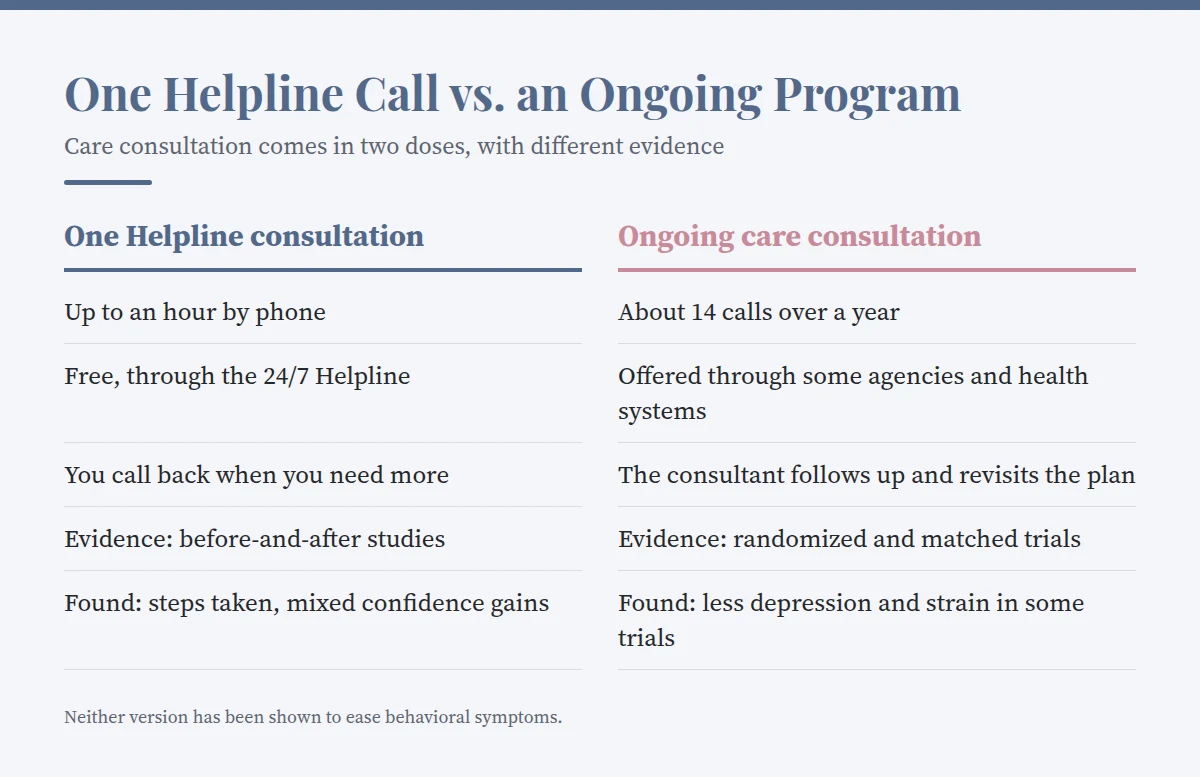
The earliest of these studies, published in 2021, randomly assigned 445 non-crisis callers to the standard Helpline consultation or the same consultation plus one extra booster call. The booster made no measurable difference. Across both groups, though, callers’ mental health scores and their confidence in managing their emotions improved within a week, and most callers acted on their plans. Because every participant received a consultation, the study cannot tell you how those callers would have fared without one, and the authors described it as a pilot.
The 2025 study of 2,503 callers found the same direction of change: small but statistically significant gains in callers’ confidence in handling stress and difficult emotions after one or two consultations. Callers started out below the national average on that measure, which says something about who picks up the phone.
The most recent evaluation, published in 2026, is the most sobering. Health systems in Illinois, Missouri, and Washington trained their staff to refer dementia caregivers to Association care consultants. Engagement was strong: 70 percent of caregivers completed action steps, 80 percent used community resources, and 90 percent understood their individual plans. But on average their confidence scores did not improve. Roughly as many caregivers got worse as got better, and the authors called for controlled trials to learn which caregivers benefit most.
Two caveats run through all of this. Association staff co-authored the Helpline studies, and in the largest one the callers were mostly white and well educated, so the results may not describe every family.
The Honest Bottom Line
Put together, the evidence supports a modest, specific claim. A care consultation is good at turning a shapeless, overwhelming situation into a few concrete steps that most people actually take, and at leaving caregivers somewhat steadier and more confident. Delivered as an ongoing program, it has reduced caregiver depression and strain in earlier trials and cut emergency visits and hospital admissions among people with more severe impairment. It has not been shown to ease behavioral symptoms or slow the disease, and in the biggest trial it did not reduce caregiver strain.
That is a fair return on a free phone call, but it is not a substitute for people who can see the situation for themselves. A consultant cannot assess your mother in her own kitchen, manage her care week to week, or make a medical judgment. For a placement decision, bring in a geriatric care manager or social worker who can visit and knows your local options. For symptoms and medications, go to the neurologist or geriatrician. For powers of attorney, Medicaid planning, and paying for long-term care, an elder law attorney or a certified financial planner is the right call.
What a consultation does well is help you work out which of those people you need first. It is also a useful counterweight if you have been relying on a free placement advisor, since those services are usually paid by the communities they recommend. If the problem is a memory care community that is not listening, a consultant can point you to your long-term care ombudsman, a free advocate with a legal right to walk into the building. And if one call is not enough and you want an ongoing program, look at Best Programs for Caregiving, the free national directory of tested caregiver programs. When we searched it earlier this month, it already listed a free national phone version of the same care consultation model, and the Association’s own Helpline care consultation is under consideration for listing.
Most families call only once a crisis has already arrived. A consultation does more good as a first step on an ordinary afternoon, well before the night that forces a decision. The number is 800.272.3900, and someone will answer.
Further reading (sources)
- Alzheimer’s Association on what to expect when you call the 24/7 Helpline
- Alzheimer’s Association with the programs it has put forward for Best Programs for Caregiving, including Helpline care consultation
- Bass and colleagues for caregiver outcomes after 12 months of the Cleveland demonstration
- Clark and colleagues on what the Cleveland demonstration did for people living with dementia
- Bass and colleagues with caregiver outcomes of Partners in Dementia Care in the VA
- Bass and colleagues on hospital admissions and emergency visits under Partners in Dementia Care
- Bass and colleagues describing a real-world Ohio rollout that averaged 14 calls a year
- Reuben and colleagues on how the D-CARE trial was designed
- Reuben and colleagues with the D-CARE results for behavioral symptoms and caregiver strain
- Reuben and colleagues for D-CARE findings on caregiver satisfaction and quality of care
- UCLA Health on the three D-CARE approaches and when caregiver confidence rose
- Hodgson and colleagues with the 2021 evaluation of Helpline care consultation
- Hodgson and colleagues on what second and third consultations added for 2,503 callers
- Hodgson and colleagues for the three-state program linking health systems to care consultants