Free Memory Care Placement Services: How Referral Agencies Get Paid and What That Means for Your Search
Published on September 12, 2026

You typed “memory care near me” into a search bar, filled in a form, and within a few hours somebody called. They were warm and knowledgeable. They asked good questions about your mother, they already knew which buildings had openings, and they told you the service costs you nothing.
All of that is true. You will not be billed. But free is doing a lot of work in that sentence, and understanding who does pay will make you better at using the help, not more suspicious of it.
Somebody Pays, and It Is Not You
A senior living referral agency, also called a placement agency or placement advisor, signs contracts with communities in a given market. The agency sends families to those communities. When a family actually moves in, the agency invoices the community.
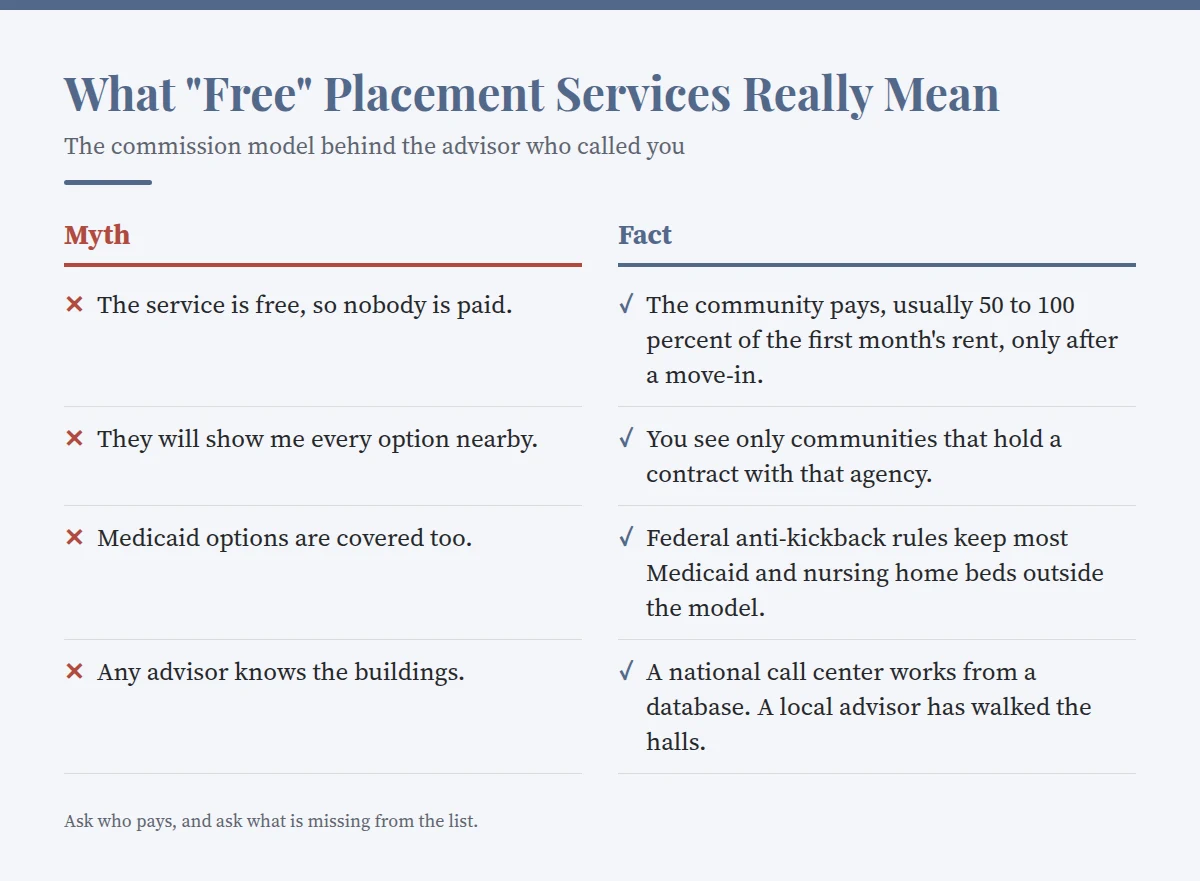
The standard fee is a share of the new resident’s first month of rent and care charges. Industry reporting generally puts it in the range of 50 to 100 percent of that first month, most commonly at the upper end, which works out to somewhere between roughly $3,500 and $12,000 per move-in depending on the market, the community, and the level of care. Memory care carries higher monthly rates than assisted living, which means a memory care placement is one of the more valuable transactions in the business.
Two details about that arrangement matter more than the number itself.
The first is that payment is triggered by a move-in, not by a conversation. An advisor who spends nine hours with your family and helps you conclude that your mother can safely stay home another year earns nothing for those nine hours. Most advisors will do it anyway. The incentive is still worth naming out loud.
The second is the clawback. Many contracts let the community recover some or all of the fee if the resident leaves within a minimum window, often 30 to 90 days. That clause quietly works in your favor. A placement that collapses in three weeks costs the advisor the commission, so a competent one has real reason to care whether the fit is right rather than merely fast.
You will not see a referral fee on your invoice. It sits in the community’s marketing budget, the same way a real estate commission sits inside a home’s sale price. It is fair to ask a community whether its rate or move-in fee differs if you come to them directly. Many will say no. The answer is still informative.
The List You Get Is a List of Partners
Here is the part that surprises families most: a referral agency can only show you communities that have a contract with it.
The big national platforms describe networks of roughly 14,000 to 15,000 providers nationwide, which sounds close to exhaustive. It is not. Whole categories of care routinely sit outside these networks.
Skilled nursing facilities. The federal Anti-Kickback Statute makes it a criminal offense to pay for referrals of services reimbursable by Medicare or Medicaid. Placement contracts are typically written with safeguards around this, including provisions that referred residents will not be paying for their initial stay through those programs. The practical result is that if your loved one needs a nursing home, the commission model largely does not reach that part of the market.
Medicaid beds and waiver placements. Same legal problem, plus thinner margins. This is the single biggest gap in the free advisor model, and it is invisible until you hit it. A family paying privately gets a robust list. A family whose mother will qualify for Medicaid in eighteen months gets a much shorter one.
Nonprofit, faith-based, and continuing care communities. Many run their own admissions and waitlists and have never needed to buy move-ins.
Small residential care homes. Adult family homes and board-and-care houses, which can be excellent for a person with dementia who does poorly in large groups, are inconsistently represented. Some contract with agencies. Many do not.
Communities that are full. A building with a waitlist has no reason to pay for leads, so it drops off the list precisely because it is in demand.
None of that is deception. It is simply the shape of the product. The output is a list of paying partners with current vacancies, which is a genuinely useful thing and is not the same thing as a survey of your market.
A Call Center and a Local Advisor Are Two Different Jobs
The phrase “free placement service” covers two businesses that barely resemble each other.
National platforms run large contact centers. The advisor who calls you may be several states away, working from a database and a screen. They are fast, they cover the whole country, and they can produce a shortlist within hours of your first form submission. The tradeoff is that your contact details often go out to several communities at once, which is why some families describe their phone ringing for a week. Ask directly how many communities will receive your information.
Local franchise and independent advisors are a different animal. Brands like CarePatrol, Oasis Senior Advisors, Assisted Living Locators, and Senior Care Authority operate as locally owned offices, alongside plenty of unaffiliated independents. A good one has walked every building in your county, knows which memory care director left in June, and will meet you in person and tour with you.
The value shows up in cases that a database cannot solve. One Clearwater, Florida franchise owner recently described a family whose father had already been placed in memory care and was deteriorating, with staff repeatedly calling relatives in to help with his daily care. She knew a dementia-specialty community nearby and he was admitted the next day. Within days he was outdoors and participating in activities again. That is local knowledge doing something a call center could not.

Neither model is better in the abstract. But you should know which one you are talking to, because it determines what you can reasonably expect from them.
What the Law Actually Requires
There is no federal license for senior placement agencies. Anyone can open one tomorrow. Regulation exists in a minority of states and varies widely, though the trend is toward more of it: industry trackers count roughly ten states with laws enacted, pending, or introduced.
Three examples show what protection looks like where it exists.
Washington has had the Elder and Vulnerable Adult Referral Agency Act on the books since January 2012. An agency must give each client a written disclosure statement before making any referral, get the client’s acknowledgment of it, and follow rules on recordkeeping, intake, and refunds.
Arizona requires disclosure at or before the referral covering any ownership, financial, business, management, or family relationship between the agency and the facility, the fact that the facility pays the agency a fee, and either the amount of that fee or a good faith estimate stated as a dollar range or a percentage of the first month’s charges. Written versions must be in fourteen-point type, and the agency has to request your acknowledgment.
Texas added a referral agency chapter to its Business and Commerce Code effective September 1, 2025. Agencies must disclose their services in writing, state who is responsible for the fee, tell you that you may stop using the agency at any time without penalty, and disclose the limits of the list they gave you. The law also requires criminal background checks and liability insurance, requires agencies to verify that a community is licensed, and bars them from referring you to any community in which they hold a financial interest or from serving as a client’s power of attorney.
That last prohibition is worth adopting as a personal rule no matter where you live. A placement advisor should never hold power of attorney, control funds, or sign admission paperwork for your family member. Those authorities belong with the people named in your family’s legal documents, full stop.
At the federal level, the Federal Trade Commission opened an advance notice of proposed rulemaking in March 2026 on unfair and deceptive fee practices in rental housing. It does not name senior living, but communities that charge monthly rent sit inside its scope, so a federal disclosure standard may eventually reach this corner of the industry.
Here is the useful part: even where none of these laws apply to you, nothing stops you from asking for everything they require. A good advisor will answer without flinching.
Seven Questions That Show You the Edges
Ask these on the first call, before you have invested any hope in a shortlist.

- Are you a national service or a local advisor, and have you personally been inside these communities? When? A specific month is a good answer. “Our team has vetted them” is not.
- How many licensed memory care communities are within twenty miles, and how many are in your network? The gap between those two numbers is the exact size of your blind spot.
- Who pays you, roughly how much for a placement like this, and when? In Arizona they must tell you. Everywhere else, ask anyway.
- Do you or your company have any ownership or corporate relationship with any community on this list?
- If Mom needs Medicaid in two years, which of these accept it and which would ask her to leave? This question exposes the network’s edge faster than any other, and it is the one families most regret not asking.
- What happens to your fee if she moves out in six weeks? You are asking whether a clawback exists. If it does, your interests and theirs are better aligned than you thought.
- How many communities will receive my contact information?
How to Use a Free Advisor Well
Treat the shortlist as a starting set, not the universe. Add two or three communities you found on your own, through your state’s licensing directory, your local Alzheimer’s Association chapter, or your Area Agency on Aging. If a community you found independently is also in the advisor’s network, you have just corroborated their coverage. If several are not, you have learned something.
Give the advisor a complete clinical picture rather than a polite one. Exit-seeking and wandering, sundowning, night waking, falls, continence, aggression during personal care, and any recent appetite or weight changes all change which buildings can actually accept and keep your mother. Vague inputs produce a generic list and, worse, a placement that fails a licensing assessment two weeks in.
Tour with your own questions, not theirs. An advisor’s tour is a good introduction and a poor evaluation. Walk each building again with the questions that cut through marketing language, and never sign anything on a first visit.

Notice what the list is made of. If every option is standard assisted living rather than a licensed memory care unit, ask why. Sometimes that reflects budget or availability honestly, and it changes what you will need to demand from a non-memory-care setting. Sometimes it simply reflects who pays commissions in your area.
And if staying home longer is genuinely on the table, say so. Some agencies earn fees on home care referrals too and will engage with the question. Others will not, because in-home memory care sits outside the part of the business that pays them.
The Sources With No Stake in Where She Lands
Pair the free advisor with at least one source that earns nothing from your decision.
Your state licensing agency publishes inspection reports and citation histories for licensed communities, free and public. Your long-term care ombudsman is a free advocate who knows the complaint patterns in local buildings and is nobody’s partner. The federal Eldercare Locator (800-677-1116) will connect you to your Area Agency on Aging, and the Alzheimer’s Association 24/7 Helpline (800-272-3900) will talk through options at any hour.
If the situation is complicated, and most dementia placements are, consider hiring a geriatric care manager, also called an Aging Life Care Professional. You pay them, typically somewhere around $100 to $250 an hour with an initial assessment running several hundred dollars or more, and that is precisely the point: nobody is paying them a commission on where your mother ends up. Some long-term care insurance policies include a care coordination benefit that will cover part of it. For a family weighing a move against staying home, or navigating a Medicaid spend-down, it is often the best money in the whole process. A hospital or clinic social worker can serve a similar independent role at no cost.
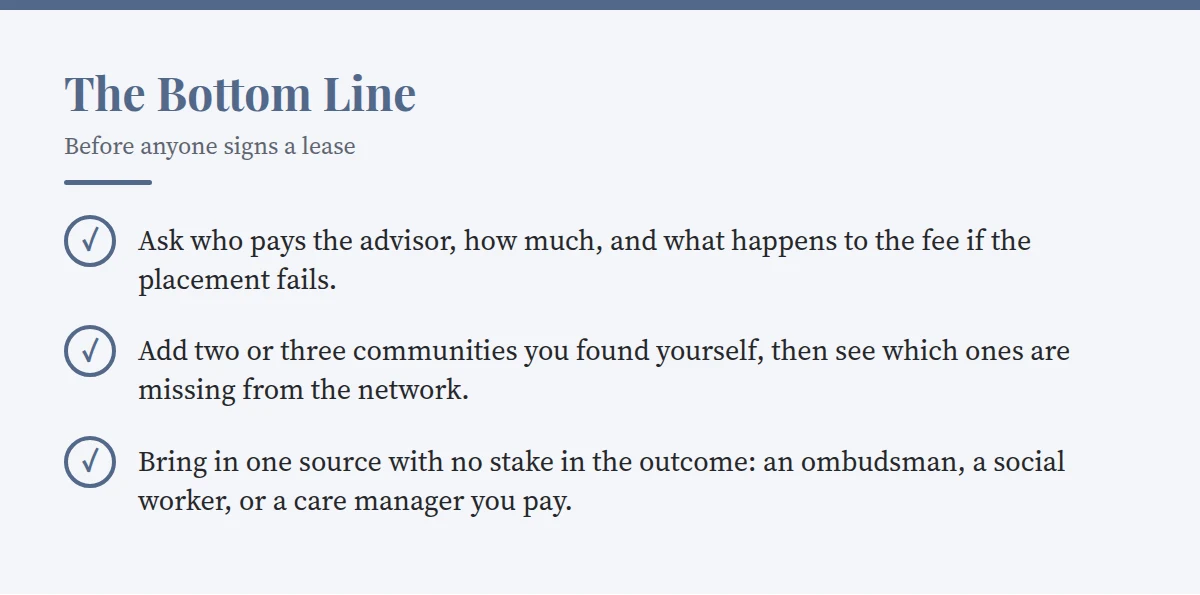
Free placement services are a legitimate and frequently excellent part of a memory care search. Use them for speed, for local knowledge, and for the doors they open in a week you do not have. Just remember what they are: a lead generation business with real expertise attached, not a fiduciary advisor. Ask who pays, ask what is missing, and bring one independent opinion to the table before anyone signs a lease.
Sources
- Washington State Legislature on the disclosure statement referral agencies must give before any referral
- Arizona State Legislature for the fee and relationship disclosures required of assisted living referral agencies
- Texas Legislature with the 2025 law setting disclosure, insurance, and conflict rules for referral agencies
- McKnight’s Long-Term Care News covering an OIG advisory opinion on paying referral fees for new residents
- Health Care Pulse explaining why placement agency contracts run into the anti-kickback statute
- Federal Trade Commission on the rulemaking that opened federal scrutiny of rental housing fee practices
- A Place for Mom, eldercare advisor service, the company’s own description of how its free advisor model and partner network work (named, deliberately not linked)
- St Pete Catalyst with a local placement advisor’s account of moving a family out of a failing memory care community
- Consumer Federation of California for the case that referral agencies need basic consumer protections
- Administration for Community Living for what an Ombudsman can and cannot do for a family
Further reading
- Choosing the Right Memory Care Facility: Key Questions to Ask
- 44 Percent of Assisted Living Residents Now Have Dementia: What Families Should Demand When Memory Care Isn’t an Option
- In-Home Memory Care: When to Consider It and How to Get Started
- Advance Directives and Power of Attorney: The Legal Documents Every Family Needs After a Dementia Diagnosis
- When a Loved One With Dementia Stops Eating: A Home Guide to Appetite, Weight Loss, and Swallowing