Sundowning, Aggression, and Other Behavioral Changes in Dementia: What They Mean and What Helps
Published on October 23, 2026
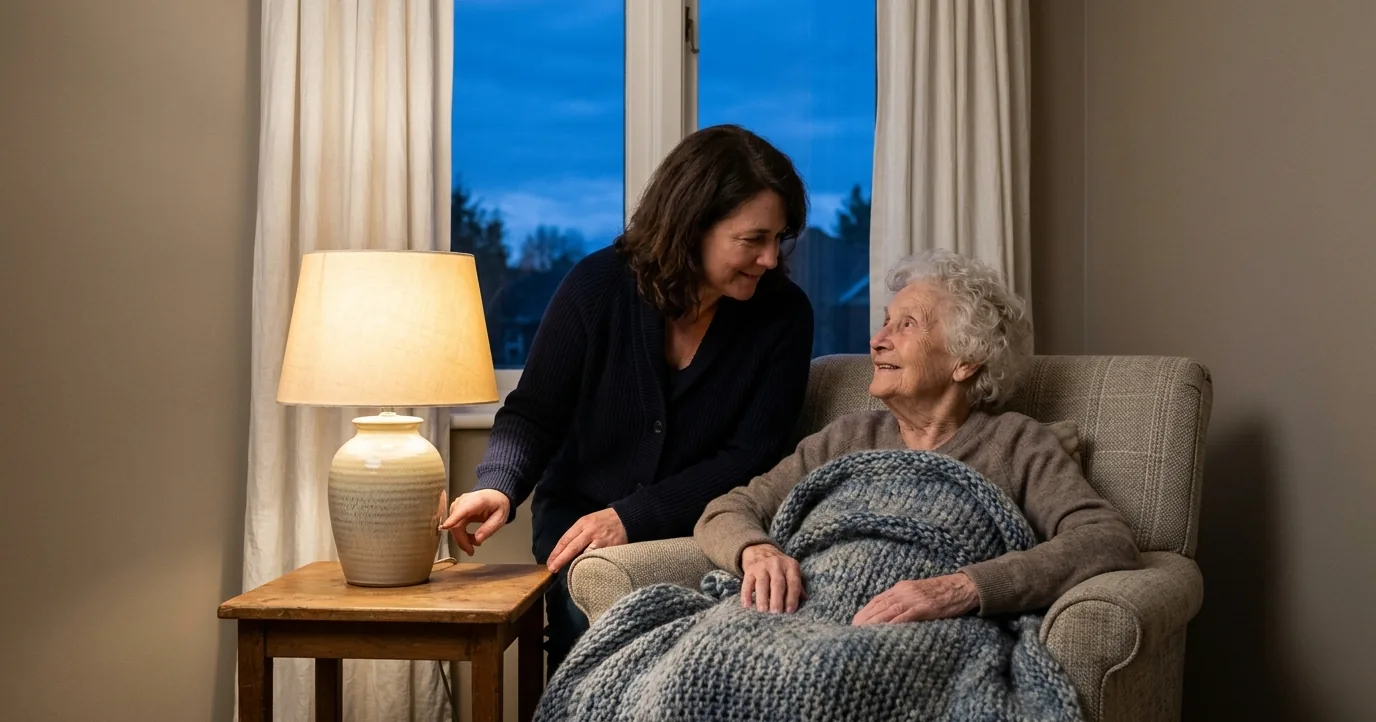
At about four o’clock every afternoon, your mother starts looking for her purse. She needs to get home, she says, and she is already home. By six she is pacing the hallway, and by eight she has accused you of hiding her car. This morning she was fine. Last Sunday she swung at your brother when he tried to help her out of the bath.
Nobody warns families that this part is coming, or that it is part of the disease at all. Clinicians call it behavioral and psychological symptoms of dementia, or BPSD: the agitation, aggression, late-day confusion, depression, suspicion and sleeplessness that travel alongside memory loss. A Utah study that followed 408 people for five years after they developed dementia found that 97 percent had at least one of these symptoms. If you are living through it, you are in the overwhelming majority.
This guide covers why these changes happen, how to track down a cause, how to calm a hard moment, how to plan a day around sundowning, and when a behavior change is really a medical problem. It leans on approaches that do not start with a prescription, because that is where the research says to start.
Behavior Is a Message
Start with what these behaviors are not. They are not a personality transplant, and they are rarely deliberate. The same study, run in Cache County, Utah, shows how ordinary they are. Over five years, 77 percent of participants had depression at some point, 71 percent had apathy and 62 percent had anxiety. At any single checkup, between 13 and 24 percent were agitated or aggressive.
Researchers sort the causes into a few families. Some come from the disease itself, which damages the brain circuits that regulate mood, impulse and sleep. Some are acute medical problems: pain, constipation, an infection, a side effect. Some are unmet needs, such as hunger, thirst, a full bladder, boredom or loneliness. Some come from the surroundings, like a loud room, a crowd, or shadows at dusk. And some come from the people giving care. A review in The BMJ by researchers Helen Kales, Laura Gitlin and Constantine Lyketsos notes that a caregiver’s own stress and depression can make behaviors worse without anyone intending it, as can a home with no predictable routine and nothing pleasant to do.
That last point is not an accusation. It is good news, because it is the part you control.
Under all of it sits one idea, known as the need-driven model of dementia behavior. A person who can no longer say “my knee hurts,” “I am frightened” or “I am bored out of my mind” still has the need. The behavior is how the need comes out.
The Four Steps Clinicians Use to Find the Cause
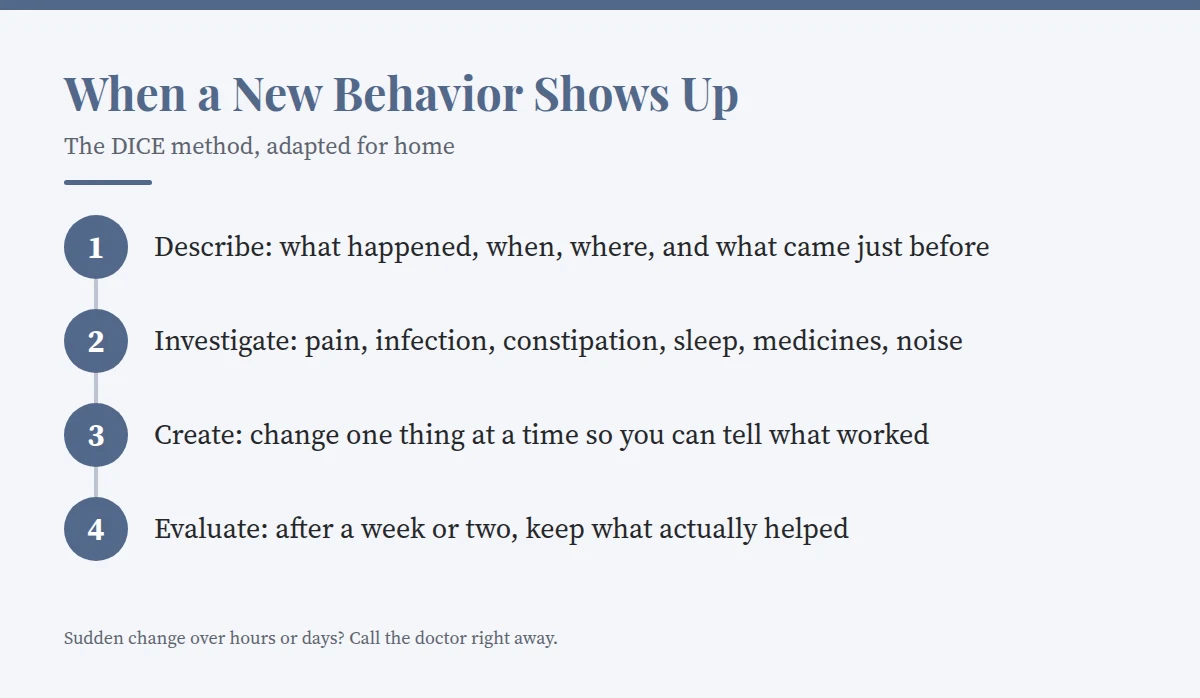
The same three researchers wrote up a method that an expert panel built for exactly this problem. It is called DICE, and although it was designed for clinicians, it works just as well at the kitchen table.
Describe. Write down exactly what happened, when, where, who was there, and what came just before and just after. “She got agitated” is not enough. “She pushed me away when I started undressing her for her shower at 7 p.m.” is. A week of notes usually shows a pattern that is invisible day to day.
Investigate. Look for causes you can change. Check the body first (pain, constipation, poor sleep, hunger, thirst, a new or changed medication, glasses and hearing aids), then the room, then the approach. Pain is easy to miss, because people with dementia stop reporting it in words. Our guide to how dementia changes the senses explains how to read pain in a face and a posture instead.
Create. Make a plan, and change one thing at a time so you can tell what worked. Move the shower to the morning. Turn the television off at dinner. Lay out clothes in the order they go on. Bring in the doctor if the cause looks medical.
Evaluate. After a week or two, ask whether the plan was actually carried out, whether the behavior improved, and whether your own distress is lower. If a medication was added along the way, the panel advises planning a trial of a lower dose or stopping it later rather than continuing it by default.
Nearly every major guideline puts non-drug approaches first, the BMJ review notes. The exception is an emergency in which someone is in imminent danger.
What Sets Off Agitation and Aggression
The National Institute on Aging describes agitation as restlessness and worry that a person cannot settle: pacing, sleeplessness, and sometimes lashing out with words or fists. Aggression can be verbal or physical, and it can arrive out of nowhere or build out of a frustrating situation.
Most of the time there is a reason. The NIA’s list of usual suspects includes pain, depression and stress; too little sleep; constipation; an abrupt change in a familiar routine, place or caregiver; grief over a lost freedom such as driving; noise, clutter and crowded rooms; loneliness; medication side effects and drug interactions; and being pressed into a task the disease has made too hard. Bathing is the classic example of that last one.
Notice how many of those involve care itself. A bath means being undressed and handled, sometimes by a person your loved one cannot quite place, in a room that may be cold, bright and echoing. To a brain that cannot follow what is happening, that can feel like an attack, and pushing back makes sense. The Alzheimer’s Association points to the communication side as well: too many questions at once, instructions with too many steps, and a caregiver whose own tension is easy to read.
How to Calm a Hard Moment
When an outburst has already started, the goal is not to win it or explain it. The goal is to lower the temperature. Guidance from the Alzheimer’s Association and the NIA overlaps heavily, and it comes down to a sequence.
- Stop the task. No shower or pill schedule is worth a fight. Set it aside and try again in twenty minutes, or tomorrow morning.
- Give space. Step back out of arm’s reach. Do not corner, crowd, hold or restrain the person, and avoid sudden movements they cannot see coming.
- Slow everything down. Lower your voice, soften your face, and breathe. If your own anger is rising, the NIA’s advice is literal: take a deep breath and count to ten.
- Answer the feeling. “I’m sorry this is upsetting. You’re safe. I’m staying right here.” Do not argue about the facts, and do not defend yourself.
- Offer a way out. A snack or a drink, a favorite song, a short walk, a simple job like folding towels, or a choice between two things.
- Take a break if it is safe. If your loved one is somewhere secure, step into another room for a few minutes. You need the reset as much as they do.

If anyone is in danger, get yourself and others to safety first, then call for help. When you call 911, tell the dispatcher and the responders that the person has dementia, so they understand the behavior is a symptom. Long before you need that call, lock away firearms, knives, car keys and anything else that could do harm.
Afterward, skip the debrief with your loved one. They may not remember the incident, and a lecture only revives the upset. Do write it down for your notes. Our guide to communicating with a loved one who has dementia has the words to use for accusations, suspicion and other hard conversations.
Sundowning: Why Late Afternoon Falls Apart
Sundowning is the name for confusion and agitation that build from late afternoon into the night. The Alzheimer’s Association describes it as a cluster of symptoms rather than a disease: trouble sleeping, anxiety, agitation, pacing, disorientation, and sometimes hallucinations. Nobody agrees on how common it is. A review of the research found estimates ranging from 2.4 to 66 percent, partly because there is still no agreed definition. Families living with it do not need a number to know it is real.
The likeliest explanation starts with the body clock. Dementia damages the suprachiasmatic nucleus, the small region of the brain that keeps sleep and waking on schedule, and the brain produces less melatonin, the hormone that signals night. Add the wear of a full day (a brain with dementia tires faster, so a busy morning can turn into an irritable evening), the shadows and dim corners of fading light, and a caregiver running low at the same hour. In care settings there is often one more trigger: staff shift changes around 3 p.m., which fill the halls with noise and bustle at exactly the wrong time.

Most of what helps works by shaping the whole day, not just the evening.
- Get daylight early. Time outdoors or beside a bright window, especially in the morning, gives a drifting body clock something to set itself by.
- Front-load the hard things. Schedule baths, appointments and outings for the morning or early afternoon, when your loved one is sharpest.
- Keep naps short. Long or late naps borrow from the night. If nighttime sleep is the problem, limit dozing during the day.
- Move the big meal to midday. A larger lunch and a lighter supper make evenings easier for many people.
- Cut late stimulants. Skip caffeine and alcohol later in the day. Nicotine disrupts sleep too.
- Turn the lights on before dusk. Bright, even light and drawn curtains keep shadows from turning into shapes.
- Quiet the evening. Turn off the news, because a frightening scene on television can feel real to someone who cannot separate it from the room. Keep the same calm routine every night: familiar music, a look through old photos, or a slow walk.
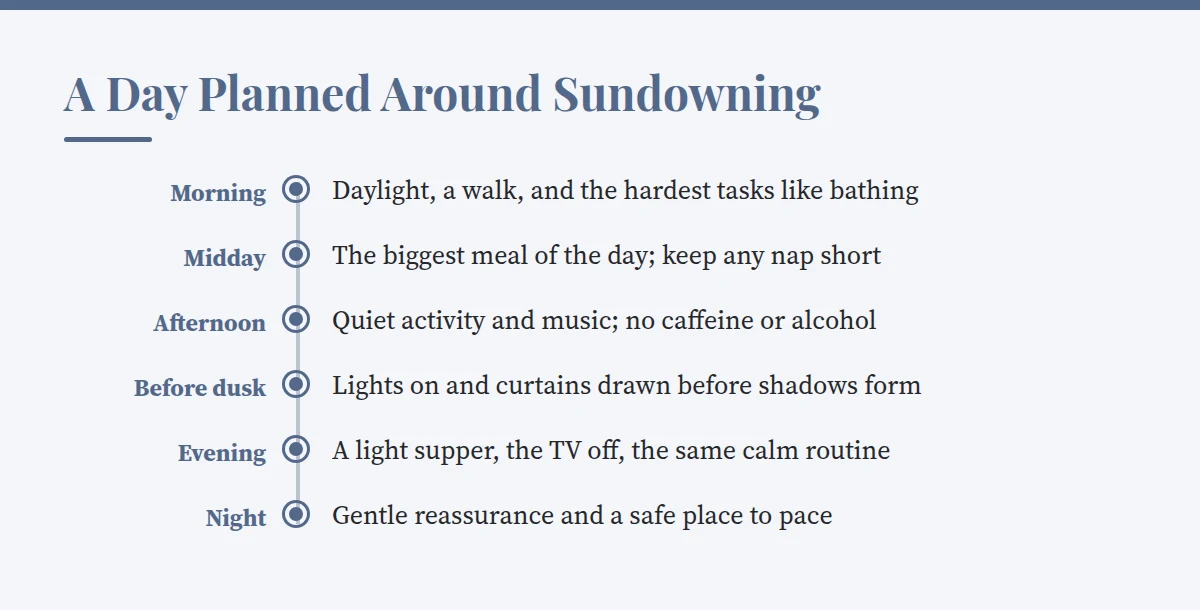
If your loved one wakes at night upset, approach calmly, check whether they need the bathroom, water or a blanket, and reassure them without arguing. Do not restrain someone who wants to walk. Let them pace in a safe space while you keep watch.
Bright light therapy and melatonin have both been studied for sundowning with modest results. Melatonin is a drug like any other, so raise both with the doctor before buying anything. Ask, too, whether current medications could be taken at different times of day, and whether something else is breaking up sleep. A urinary problem, restless legs or sleep apnea can all make nights worse.
The Quiet Symptoms: Depression, Apathy, and Anxiety
The behaviors that bring families to a doctor are the loud ones. The most common ones are quiet. In the Cache County study, depression, apathy and anxiety were the three symptoms people were most likely to develop, and apathy was consistently the most severe.
They are easy to miss because they disrupt nothing, and because they look like dementia itself. Losing interest in hobbies, pulling away from people and struggling to concentrate are signs of both. A panel of researchers working with the National Institute of Mental Health wrote provisional criteria for depression in Alzheimer’s that rely less on what the person can put into words. The core is a sad, hopeless or tearful mood, or a loss of pleasure in people and usual activities. Add at least two more signs over the same two weeks, such as withdrawal, changes in appetite or sleep, restlessness or slowing, irritability, fatigue, feelings of worthlessness or guilt, or thoughts of death.
Apathy is a different problem. It is a loss of drive and initiative, often without any sadness. A father who sits all afternoon unless someone starts an activity with him is not lazy, and he is not necessarily depressed, though the two often overlap. Both are worth raising with the doctor, and depression in particular responds to treatment. A geriatric psychiatrist is the specialist best placed to tell them apart.
Telling someone to cheer up does not work. Structure and small doses of pleasure do: a predictable routine, more of the people, places and activities they still enjoy, exercise (ideally in the morning), real ways to contribute to the household, and steady reassurance that they are loved and will not be left. Movement with an emotional and social side may do more than a workout. A 204-person trial of dance movement therapy found it eased depression and loneliness in mild dementia where a matched exercise class did not.

Anxiety often shows up sideways: the same question about an appointment asked twenty times, or a person who follows you from room to room and panics when you step out of sight. Calm, repeated reassurance and a predictable day help more than explanations do.
Suspicion, Delusions, and Hallucinations
False beliefs and false perceptions tend to grow as the disease advances. In Cache County, delusions affected 18 percent of people at the first visit and more than a third in later years, while hallucinations rose from 10 percent to around one in five. Delusions are often mundane. Someone stole my purse. That man is not my husband. Strangers come into the house at night.
Arguing never wins these, and a hallucination that frightens no one may not need any response at all. When one does cause fear, respond to the fear: reassure, stay close, and redirect.
One pattern deserves its own conversation with the doctor. Vivid, detailed visual hallucinations early in the illness, especially alongside movement problems or big swings from one day to the next, can point to Lewy body dementia. That matters for treatment, because the National Institute on Aging warns that antipsychotic drugs can be dangerous for people with Lewy body dementia, causing severe side effects and worsening movement symptoms.
When the Behavior Is Really a Medical Problem
Speed is the clue. Dementia changes people over months and years. A change that arrives over hours or days, in someone who was managing on Monday and is hallucinating or newly combative by Thursday, points to delirium or an acute illness until proven otherwise. Call the doctor right away. The Alzheimer’s Association and the NIA agree that a sudden change in behavior calls for a thorough medical exam.
Bring your notes to that appointment, along with every pill bottle in the house, over-the-counter products included. The American Geriatrics Society’s Beers Criteria, the standard list of medications older adults should generally avoid, flags several drug classes for people with dementia because of their effects on the brain. They include strongly anticholinergic drugs (a group that takes in diphenhydramine, the antihistamine in many nighttime sleep aids), benzodiazepines, and sleeping pills such as zolpidem. A pill added for sleep or a bladder problem can cause the very confusion it gets blamed on.
Infection is a common culprit, but a urine test can mislead. Many older adults carry bacteria in their urine without being sick. The Infectious Diseases Society of America’s guideline recommends that an older person with cognitive impairment, new confusion and bacteria in the urine, but no urinary symptoms, fever or other signs of infection, be checked for other causes and watched carefully rather than given antibiotics. If the only evidence is a positive urine test, it is fair to ask what else was ruled out.
Call 911 for a fall with an injury, signs of a stroke, or violence you cannot make safe. Call the doctor the same day for new confusion, a fever, or refusal to eat or drink. Behavior that has built slowly can wait for a scheduled visit, as long as you bring the notes.
What Medication Can and Cannot Do
Drugs have a place, but a later one than many families expect. In one large comparison, a 2019 network meta-analysis in the Annals of Internal Medicine pooled 163 randomized trials covering more than 23,000 people. Multidisciplinary care, massage and touch therapy, and music combined with massage and touch all beat usual care for aggression and agitation by a clinically meaningful margin. The authors concluded that non-drug interventions appeared more effective than medications. There is a caveat (almost half the studies were at high risk of bias from missing data), but the direction matches the major guidelines.
The risks are clearer. Of the drug options, antipsychotics have the strongest evidence, and the clearest downside. In a pooled analysis of 15 placebo-controlled trials, most lasting ten to twelve weeks, 3.5 percent of people with dementia given an atypical antipsychotic died, against 2.3 percent of those given a placebo. The FDA requires a boxed warning across the class: older adults with dementia-related psychosis who take antipsychotics face an increased risk of death.
Two medications now carry FDA approval specifically for agitation in Alzheimer’s dementia. Brexpiprazole (Rexulti), an antipsychotic, was approved in May 2023 on the strength of two 12-week trials, and it keeps the class warning. Dextromethorphan-bupropion (Auvelity), approved in April 2026, is the first option for this use that is not an antipsychotic. A 2025 expert panel writing for primary care doctors set the threshold plainly. Treatment always starts with individualized non-drug approaches, and medication comes into serious consideration when agitation becomes intense and disruptive, or when major safety concerns cannot be handled any other way.
If a doctor suggests a medication, these questions keep the plan honest:
- Which behavior is this meant to change, and how will we know if it has?
- What side effects should we watch for, and how soon could they show up?
- When will we review it, and when would we try lowering the dose or stopping?
- What should we keep doing, or start doing, alongside it?
A geriatrician, neurologist or geriatric psychiatrist is the right person to weigh those trade-offs for a specific person. Nothing in this guide substitutes for that judgment.
When Behaviors Change the Care Plan
Behavior is often what changes where a person lives. When the FDA approved the first drug for agitation, the director of its Division of Psychiatry called these symptoms “leading causes of assisted living or nursing home placement.” The expert panel behind DICE linked them to caregiver stress, depression and trouble holding a job, as well as earlier nursing home placement. If you are exhausted, that is not weakness. It is a predictable result of this stage of the disease.
Help comes in layers. Respite care, adult day programs and in-home aides can cover the hours that wear you down, and the Alzheimer’s Association’s 24/7 Helpline (800.272.3900) can point you to options near you. When someone is getting hurt, when nights without sleep have become normal, or when your loved one keeps trying to leave the house, it may be time to consider memory care: a secured form of assisted living with dementia-trained staff and a structured day. A skilled nursing facility is a different level again, with round-the-clock nursing for complex medical needs. What memory care costs varies widely by state, so start that research before a crisis forces the timeline.
On a tour, ask how staff are trained to handle agitation and aggression, what they try before calling a doctor, how they involve families, and when their shifts change. Then read the contract with behavior in mind, because a community can issue a discharge notice when it decides it can no longer manage a resident’s behavior. Our guide to the memory care admission agreement shows which clauses to read first, and an elder law attorney can review the document before you sign.
A geriatric care manager or a social worker can help you weigh these choices and spot options you might miss. You do not have to make this decision alone.
The Person Behind the Behavior
Every behavior in this guide is the disease speaking through a person who can no longer say what is wrong. Your job is not to stop the behavior at any cost. It is to get curious about it: what came just before, what hurts, what is too loud, too fast or too much. Most of the time the answer is something you can change. When it is not, it is something a doctor can help with.
Some days you will lose your temper, and so will they. Write it down, start again in the morning, and bring the notes to someone who can help.
Further reading (sources)
- Alzheimer’s Association on calming anxiety and agitation, and the two drugs approved to treat it
- Alzheimer’s Association for managing sleep problems and sundowning
- National Institute on Aging with the common causes of agitation and aggression, and ways to cope
- National Institute on Aging on why antipsychotics call for special caution in Lewy body dementia
- U.S. Food and Drug Administration announcing the first drug approved for agitation in Alzheimer’s dementia
- Steinberg and colleagues for five-year rates of behavioral symptoms in the Cache County Study
- Kales, Gitlin and Lyketsos on assessing and managing behavioral symptoms, including the DICE method
- The Detroit Expert Panel with recommendations for managing behavioral symptoms in clinical settings
- Khachiyants and colleagues for a review of what drives sundown syndrome and what treats it
- Olin and colleagues on provisional criteria for depression in Alzheimer’s disease
- Watt and colleagues with a network meta-analysis of treatments for aggression and agitation
- Schneider, Dagerman and Insel on death risk with atypical antipsychotics in dementia trials
- Grossberg and colleagues for an expert panel’s guide to treating agitation in Alzheimer’s dementia
- American Geriatrics Society with the 2023 Beers Criteria for medications older adults should avoid
- Infectious Diseases Society of America on when bacteria in the urine should not be treated