The Goals of Care Conversation: The Talk That Shapes Dementia End-of-Life Decisions
Published on September 19, 2026

The folder is in the filing cabinet where your father put it. Living will, durable power of attorney for health care, HIPAA release, all signed and witnessed four years ago at the elder law office downtown. You have a copy. So does his internist.
At 11 p.m. the memory care nurse calls. He has a fever, his breathing has changed, and she needs to know whether to send him to the emergency room. You open the folder on the kitchen counter and find language about terminal conditions and permanent unconsciousness, and nothing at all about pneumonia in a man who still smiles when he hears a hymn but has not known your name since spring.
That gap is not a drafting failure. It is what happens when a family signs the documents and never has the conversation the documents were supposed to record. The paperwork tells the hospital who decides. Only the conversation tells you what to decide.
The Folder Was Never the Plan
Start with how often these decisions land on somebody else. In a national study of adults over 60 who had died, 42.5 percent needed a treatment decision made in their final days, and of those, 70.3 percent had already lost the capacity to make it themselves. About two-thirds of that group had an advance directive on file. In dementia the proportion who cannot speak for themselves at the end is close to universal.
So the question is not whether a surrogate will decide. It is what that surrogate has to work with.
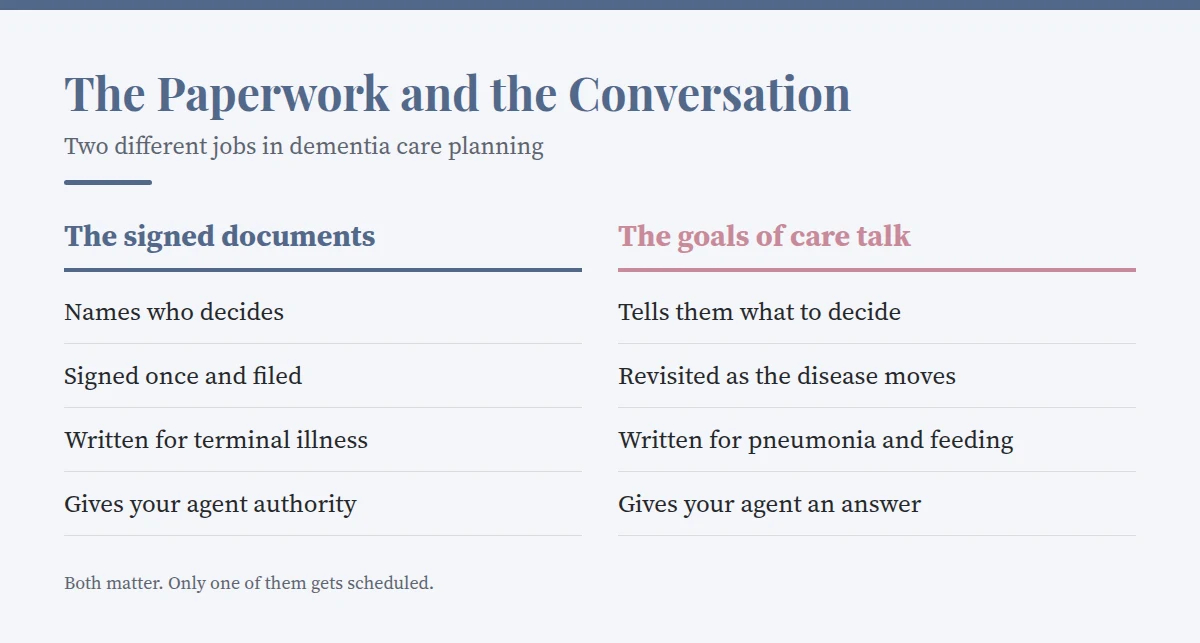
Researchers at the University of California, San Francisco put that question to 166 family caregivers after the person they cared for had died with dementia. Most of the people who died had advance directives and a named health care agent. What separated the families was whether they had also had an explicit goals of care conversation. Those who had one rated the advance directive as more useful, believed it had actually been followed, and were more likely to report that their person died in the place they had wanted to die.
Note what the same study did not find. Families who had the conversation disagreed about end-of-life care at about the same rate as families who had not. The talk makes the plan usable. It does not make your brother agree with you, and this article will come back to that.
One more finding is worth carrying. In a study that followed 323 nursing home residents with advanced dementia for up to 18 months, residents whose health care proxy understood the prognosis and the complications ahead were far less likely to undergo a burdensome intervention in their last three months, meaning a hospitalization, an emergency room trip, tube feeding, or intravenous therapy. The adjusted odds ratio was 0.12. Understanding what was coming changed what happened, more than any signature did.
What a Goals of Care Conversation Actually Is
It is a structured clinical conversation about what a person is living for, held before a crisis forces the question. It is not a form, not a checklist of procedures, and not the fifteen minutes at the end of a visit when a nurse asks whether you have an advance directive.
Palliative care clinicians are trained to run these using a talking map. The most widely taught is VitalTalk’s REMAP: reframe why the current plan no longer fits, expect emotion and respond to it, map what matters most to the person, align back what you heard, and only then propose a medical plan that serves it. Ariadne Labs teaches a parallel tool, the Serious Illness Conversation Guide, which opens by asking permission and by asking how much the person wants to know about what lies ahead.
The order matters more than it looks. Values first, treatments second. A conversation that opens with “do you want CPR” gets an answer about CPR. A conversation that opens with “what does a good day look like for you now” gets an answer you can apply to CPR, to a feeding tube, to a hospital transfer at 11 p.m., and to the three decisions nobody has thought of yet.
Who Should Run It
More than one person can, and the right answer depends on who your family already trusts.
The diagnosing neurologist or geriatrician. They have the prognosis and the credibility. The disadvantage is time: a memory clinic slot is often built around cognitive testing and medication, not a forty-minute values conversation. Ask for a separate appointment and say what it is for.
A palliative care team. This is the group trained specifically to do this, and the most common misunderstanding in memory care is that palliative care means hospice. It does not. Palliative care is specialty support for serious illness at any stage, delivered alongside every other treatment, in clinics and at home as well as in hospitals. A family can ask for a palliative care consult years before hospice is on the table.
Primary care, at the annual wellness visit. Medicare pays clinicians to do this. Advance care planning is a covered Part B service billed in 30-minute increments, and when it is delivered as part of the Medicare annual wellness visit, the deductible and coinsurance are waived. If a practice says there is no time for the conversation, there is a billing code that says otherwise.
A dementia care navigator. Since July 2024, Medicare’s GUIDE model has funded participating practices to assign each enrolled family a care navigator, along with a 24-hour support line and respite hours, at no added cost. Navigators are trained in assessment and care planning, and running a goals of care conversation is squarely inside the job. Ask whether any practice near you participates.
A clinical social worker or geriatric care manager, especially when siblings are far apart or the family has old fractures. They are often better at the room than the physician is, and they can convene people the doctor cannot.
When It Lands Best
Early. Earlier than feels necessary, and earlier than most families manage.
The window that matters is the one where the person with dementia can still participate in their own conversation. In the mild cognitive impairment stage and the first year or two after diagnosis, most people can describe what they value, name a proxy, and say what they would not want, even if they could not draft a legal document unaided. The Alzheimer’s Association is blunt about the reason: express your wishes while you can still make decisions for yourself, so that no one has to guess.
Three natural prompts, if you need one:
- The month the diagnosis is made, alongside the legal paperwork rather than after it
- A hospitalization, a fall, or a new diagnosis such as heart failure or cancer
- The move into memory care, when a new clinical team inherits the plan and often asks anyway

Where it should not happen is an emergency department at midnight. A hospital or ER visit is the worst possible setting for a first conversation about values: the person is frightened and likely delirious, you are exhausted, and the clinician asking has known the family for eleven minutes.
The Questions That Surface Real Preferences
These are the questions that do work. Some are for the person with dementia while they can answer. The rest are for the family and the clinician together.
Understanding first. What is your sense of where things stand? How much do you want to know about what is likely ahead? Some people want the whole trajectory and some want almost none of it, and asking is not optional.
Then values. What does a good day look like now? What abilities matter so much that losing them would change what you want from medicine? Who do you want around you? What are you most worried about?
Then the specific decisions, translated out of medical vocabulary:
- If you get pneumonia, would you want to go to the hospital, or be treated with antibiotics and comfort care where you live?
- If eating becomes difficult, would you want a feeding tube? The professional answer here is settled. The American Geriatrics Society recommends against feeding tubes for older adults with advanced dementia, because hand feeding produces comparable results for survival, aspiration pneumonia, function, and comfort, while tube feeding brings agitation, restraints, and pressure ulcers. Families deserve to hear that before the question is urgent, and the day-to-day work of hand feeding deserves a conversation of its own.
- If your heart stops, do you want resuscitation attempted?
- Where do you want to be at the end? Home, the memory care apartment, a hospital?
And the question families forget. How much leeway does your proxy have? Ask directly whether the person wants their stated preferences followed exactly, or whether they trust their agent to weigh the situation and decide. Surrogates who have been given permission to use judgment carry that job far more lightly than surrogates who believe they are enforcing a contract.
Write down the answers in the person’s own words, and ask that a summary go in the medical record. Later, when the disease is advanced and the person is medically frail, a clinician can convert those preferences into a portable medical order. A POLST form is a physician’s order, recognizable to paramedics and emergency departments across a community, and it is completed only after a conversation with the patient or their surrogate. It travels where the folder in the filing cabinet does not.
Revisiting It as Capacity Changes
One conversation is not a plan either. Capacity is decision-specific and it erodes unevenly, so the person who cannot manage a checkbook this year may still be able to tell you clearly that she never wants to be in a hospital again.
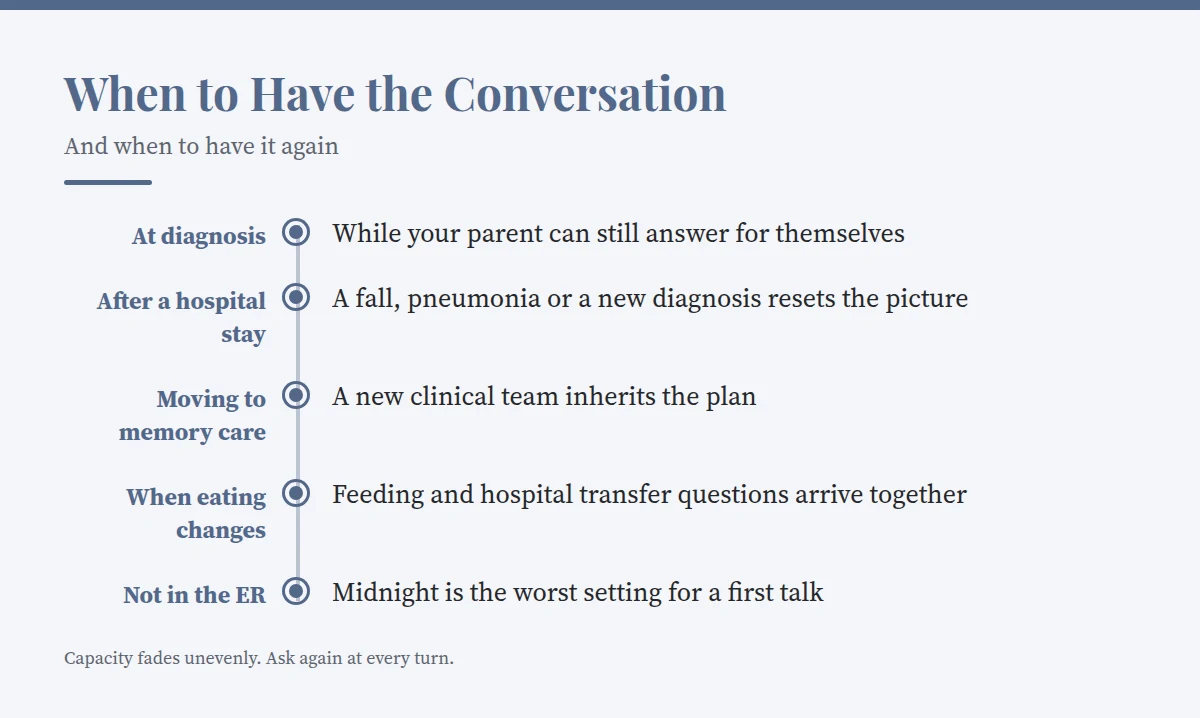
Revisit whenever the clinical picture changes, and expect the conversation to shift. Early on it is a conversation with your father about his own wishes. Later it becomes a conversation about him, in which you and the clinical team practice substituted judgment: not what you would choose, and not what would be easiest, but what he would have chosen if he could see himself as he is now. The notes you took in year one are the whole reason that question has an answer.
When the Family Does Not Agree
The 166-caregiver study is honest about this and so should we be. Having the conversation did not reduce disagreements about end-of-life care. It made the directive more useful and more likely to be followed, which are worth a great deal, but it did not settle the argument between the daughter who wants everything tried and the son who wants his father left in peace.

What helps is separating the two things people are actually fighting about. One is a factual question, which is what this disease does and what a given treatment can realistically achieve, and that belongs to the clinician. The other is grief, which belongs to the family and often sounds like a factual disagreement. A palliative care physician or social worker can run a family meeting that keeps those apart, and calling one in is not an escalation. It is the standard tool.
If one sibling does the daily work and the others visit at holidays, expect the conversation to surface that too. The imbalance between siblings rarely stays quiet once end-of-life decisions are on the table, and it is better aired in a conference room with a facilitator than in a hospital hallway.
What to Say to Start
To the clinician, at the next appointment, in one sentence: “I would like to schedule a separate visit to talk about goals of care, not paperwork. We have the documents. We have not had the conversation.”
To your parent, on an ordinary afternoon when nothing is wrong: “If you ever got sick enough that you could not tell the doctors what you wanted, I would be the one deciding. I want to get it right. Can you help me understand what matters most to you?”
Then stop talking. The pause that follows is where the answer lives, and in dementia the pause needs to be longer than feels comfortable.
The folder still matters. Keep it current, keep a copy in the car, and give one to every clinician who touches the case. But the folder is the record of a decision, not the decision. The conversation is the decision, and it is the part nobody schedules until somebody asks.
Sources
- Ma and colleagues on how goals of care conversations changed advance care planning outcomes for 166 families
- Silveira and colleagues for how often surrogates decide and how often capacity is already gone
- Mitchell and colleagues with the CASCADE study on proxy understanding and burdensome interventions
- VitalTalk on the REMAP map for a goals of care conversation
- Ariadne Labs for the Serious Illness Conversation Guide clinicians are trained on
- American Geriatrics Society with its position statement against feeding tubes in advanced dementia
- CMS on how Medicare pays clinicians for advance care planning time
- CMS describing the GUIDE model’s care navigators and support line
- Alzheimer’s Association for expressing end-of-life wishes and talking with your doctor
- National Institute on Aging on weighing comfort against treatment in the last stages
- Get Palliative Care explaining what palliative care offers a family living with dementia
- CaringInfo on how a POLST differs from an advance directive
Further reading
- Advance Directives and Power of Attorney: The Legal Documents Every Family Needs After a Dementia Diagnosis
- Hospice Care for End-Stage Dementia: When and How to Bring It In
- Hospital Stays and ER Visits With Dementia: The Complete Family Survival Guide
- When a Loved One With Dementia Stops Eating: A Home Guide to Appetite, Weight Loss, and Swallowing
- Mild Cognitive Impairment: The Complete Family Guide to the Stage Before Dementia