Who Actually Owns the Memory Care Community: Private Equity, REITs, Chains, and Nonprofits
Published on September 17, 2026
You toured two memory care communities this week, and your notes make them sound like the same building. Both lobbies had a fireplace and a bowl of green apples on the front desk. Both directors were warm, both memory care units opened onto a secured courtyard, and the rates came within a few hundred dollars of each other.
What a lobby cannot show you is who stands behind it. One building may belong to a regional family company that has run it for twenty years. The other may be owned by an investment fund, leased to an operator that took over last spring, and run by a management company two states away. Neither arrangement is automatically good or bad. But the structure decides who sets the staffing budget, who can raise the rates, and how likely everything is to change after your mother moves in.
That last point weighs more in dementia care than almost anywhere else, because familiar faces and steady routines are part of the care itself. This guide covers the ownership models you will meet, what the research does and does not show, how to trace who owns a community, and the tour questions that bring ownership churn to the surface.
One Front Door, Up to Three Companies
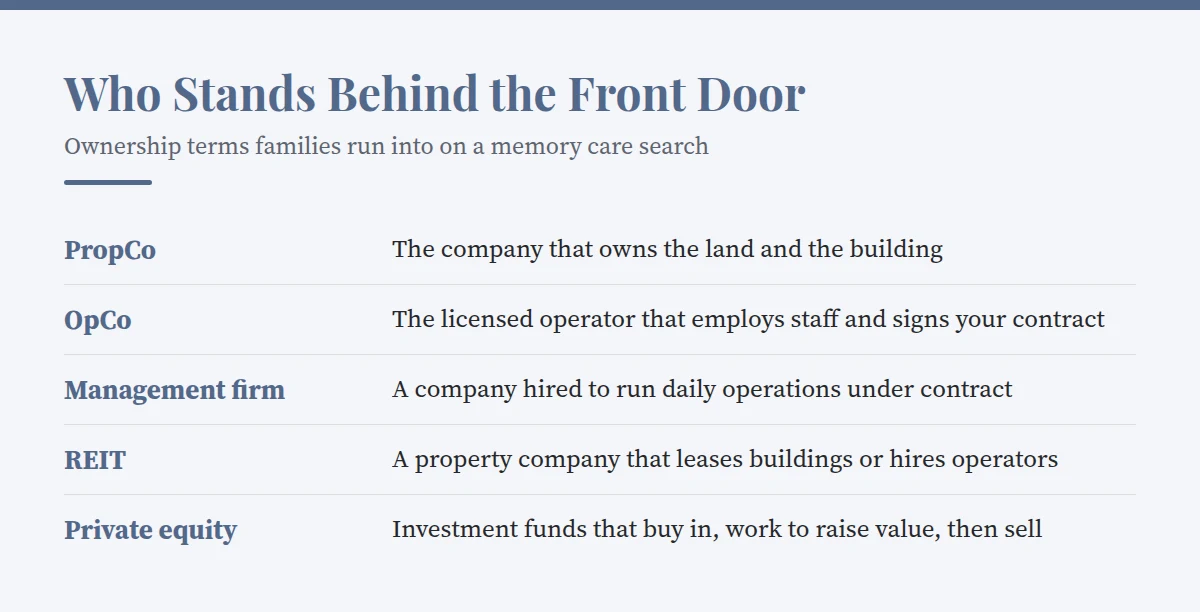
Most families picture one company that owns the building and provides the care. In assisted living, where most memory care is licensed, that is often not how it works. Researchers who built the first national database linking assisted living communities to their parent companies call ownership data complex and fragmented, because different companies often own the property, manage the community, and operate it.
The industry shorthand is PropCo and OpCo. As a real estate attorney put it in interviews published in 2026, “the PropCo owns the dirt and the building.” The operator “is the licensed operator who is charged with caring for the residents.” It typically employs the staff, signs the residency agreement, and holds the state license. Sometimes a third company, a management firm, runs daily operations under contract.
Each of them controls something you will feel:
- The operator answers to state inspectors, hires and schedules the aides on the memory care unit, and is the name on your contract.
- The property owner sets the financial terms the operator works under, starting with the rent.
- The management company, when there is one, can steer daily staffing and purchasing even if it does not hold the license.
Any of the three can change while the sign out front stays the same, and the lobby will look identical the next morning.
The Four Ownership Models You Will Meet
Federal survey data counted about 32,200 residential care communities, the category that includes assisted living, in 2022. Of those, 81.5 percent were for-profit, 17.4 percent nonprofit, and about 1 percent government or other. Just over 57 percent belonged to a chain. The categories overlap: a chain can be backed by private equity, and a building owned by a REIT is still run by an operator that may itself be a chain.
Private equity. A private equity firm pools money from investors, buys companies or properties, works to raise their value, and eventually sells. The first national count of private equity deals in assisted living, published in 2025, found 252 acquisitions involving 912 facilities in 47 states between 2006 and 2023, with more than a third of those facilities in Florida, Texas, California, Washington, and Oregon. Deals peaked in 2021 (36 transactions covering 103 facilities), and 68 percent involved a single community, so this is not only a story about giant portfolios. The authors say their count likely underestimates the total, because these deals are poorly documented and communities built with private equity money were not included.
Interview participants said private equity enters assisted living mainly by owning property, though its reach can extend to choosing the operator, co-owning the operating company, or putting its own management company in charge. In nursing homes, where federal cost reports make the money easier to follow, one study found that management fees, lease payments, and interest payments all rose after private equity buyouts, with interest climbing more than 200 percent.
REITs. A real estate investment trust is a for-profit company, public or private, that invests in income-producing property. In senior housing it typically either leases a building to an operator, which pays rent and runs the business, or uses a federal tax provision to lease the building to its own taxable subsidiary, which hires an independent operator under a management contract. Either way, owner and operator are separate companies, so the operator can change while the landlord stays put. A federal analysis found REIT investment had reached about 9 percent of nursing homes by 2022. No comparable public count exists for assisted living.
Chains. A chain is one company running several communities, from a national brand with hundreds of buildings to a regional operator with six. The label tells you less than you might expect. In the assisted living interview study, participants across groups agreed that local operators provide higher quality care than national firms. That is a perception rather than a measured result, but it came from industry insiders and regulators alike. The useful chain questions are practical: who at the regional office can overrule the local director, and which other memory care communities does this operator run in your state, so you can read their inspection records too?
Nonprofit and faith-based operators. Roughly one in six assisted living communities is nonprofit, some run by religious denominations or their charities and some part of larger campuses with independent living and nursing care. A nonprofit has no shareholders, so any surplus stays in the organization, and it answers to a board. IRS guidance on nonprofit homes for the aged, rooted in a 1972 ruling, also ties charitable status partly to residents’ “financial security,” meaning an established policy of keeping residents who become unable to pay, using reserves, public programs, or fundraising. How far any one organization can stretch that commitment varies, so ask to see the policy in writing.
On average, the nursing home evidence favors nonprofits. A 2009 meta-analysis drawing on 82 studies found that nonprofit homes had more or better staffing and fewer pressure ulcers than for-profit homes, while cautioning that many factors shape how an individual facility performs. In federal data averaged over 2013 to 2020, nonprofit nursing homes had an average overall star rating of 3.84, against 3.19 for homes with REIT investment, 3.04 for for-profit chain homes, and 2.91 for homes with private equity investment. Nonprofit status shifts the odds. It guarantees nothing about the building in front of you.
What the Research Shows, and Where It Runs Out
Here is the uncomfortable part: nearly all the outcome research on ownership comes from nursing homes, not memory care. Nursing homes are a separate, federally regulated level of care that reports to Medicare, so researchers can track staffing, inspections, and hospital use before and after a sale. Assisted living is licensed state by state, and the team behind the national private equity count points out that there is no public national list of assisted living facilities, and a state may not even ask its licensees to report who owns them. They describe private equity’s role in assisted living as an open question, and a project funded by the National Institute on Aging is now studying resident outcomes.
With that caveat, the nursing home findings point in a consistent direction:
- Hospital trips and costs. After private equity firms acquired 302 nursing homes, long-stay residents became 11.1 percent more likely to visit an emergency department, and 8.7 percent more likely to be hospitalized, for conditions that good ongoing care can often prevent. Medicare costs rose 3.9 percent (about $1,081 a year per resident) relative to other for-profit homes.
- Mortality. Among short-stay Medicare patients, going to a nursing home owned by private equity raised the chance of dying during the stay or the following 90 days by 11 percent, partly explained by declines in nurse staffing and in compliance with care standards.
- Registered nurses and inspections. A federal HHS analysis found private equity investment was followed by a 12 percent relative drop in registered nurse hours per resident day and a 14 percent worsening in inspection deficiency scores. REIT investment was followed by a 7 percent drop in registered nurse hours and the same 14 percent worsening.
- Staffing mix. A separate REIT study found small gains in licensed practical nurse and nursing assistant staffing, but registered nurse staffing fell 6.25 percent in years two and three, and smaller deals appeared to swap registered nurses for less expensive staff.
- Sales themselves. Nearly a quarter of nursing homes (23 percent) changed ownership between 2016 and 2022. Homes with a one-star rating were more likely to be sold, and star ratings dipped slightly afterward as staffing and inspection ratings fell.

Inside assisted living, the best evidence so far comes from people close to the deals. In 46 interviews with investors, operators, lenders, state licensing staff, and ombudsman program leaders, state agents described changes after private equity acquisitions in both directions. Some saw new capital pay for nicer buildings, more staff, better food, and dementia training. Others saw reduced staffing and higher monthly rates. One described residents “not getting their medications or laundry,” and a care assessment system that suddenly scored residents differently: “you went from a level one to level four, and that’s another $3000 a month.”
None of this proves that a private equity or REIT owner ruins a building, or that a nonprofit label guarantees good care. It says ownership shifts the odds, especially on registered nurse hours and inspections, and that a change of hands is a moment to watch closely. Treat ownership as a signal about where to look harder, not as a verdict.
How to Find Out Who Owns and Who Runs a Community
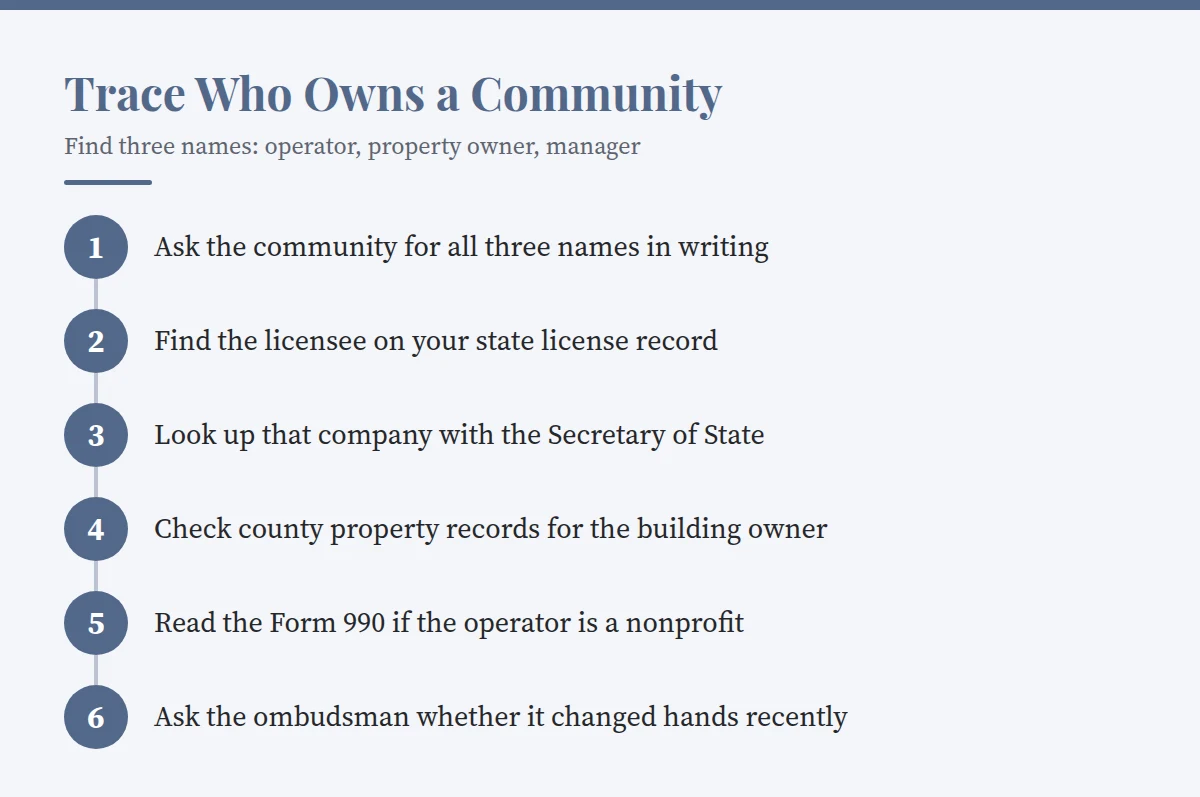
Set aside an hour or two per community and expect a dead end. One state regulator in the 2026 study described searching the state’s own business database and finding “just another shell company that takes me nowhere.” You do not need the whole corporate family tree, just three names (the licensed operator, the property owner, and any management company) and how long each has been in place.
- Ask the community in writing. Request the legal names of all three and the date each took over. An email creates a record, and a vague answer tells you something too.
- Pull the state license record. Your state licensing agency lists the licensee’s legal name, and many states post inspection reports online. Ask when the current licensee took over and whether your state issues a separate memory care license or endorsement.
- Look up the licensee with your Secretary of State. The business registry shows officers or managers and a principal address, which often points toward a parent company.
- Check county property records. The assessor or recorder shows who owns the land and building. If that name differs from the licensee, you have found the landlord.
- Read the Form 990 if the operator is a nonprofit. Nonprofits must make their annual returns available for public inspection. The return shows revenue, leadership pay, and the five highest-paid independent contractors that received more than $100,000, which is where an outside management company would typically appear.
- Use Care Compare if the campus includes a nursing home. Medicare’s Care Compare shows ownership and operator affiliations for certified nursing homes, and CMS publishes combined performance results for groups of homes with shared owners. A 2023 rule also requires nursing homes to tell Medicare whether owners or managers are private equity companies or REITs. None of this covers assisted living, and the public data has had gaps: one analysis found only a third of private equity investments and fewer than a fifth of REIT investments in the public files.
- Call the long-term care ombudsman. An ombudsman will not rank communities but can tell you what kinds of complaints a building draws, and may know whether it has changed hands.
Tour Questions That Bring Ownership Churn to the Surface
Most tour questions test the building. These test the arrangement behind it. Ask them alongside the core questions for any memory care tour, and get anything about rates or contracts in writing.
- Who holds the license, who owns the building, and who manages it day to day?
- When did any of those last change, and is a sale or management change pending?
- How many executive directors and memory care directors have you had in the last three years? Several in a short stretch deserves a follow-up question.
- What happened to rates and care-level fees after the last change? Ask how care levels are scored, how often residents are reassessed, and how much notice you get before an increase.
- If the community is sold, does my residency agreement carry over as written? Ask which part of the contract covers a new owner or operator, and have an elder law attorney review it before you sign.
- Has memory care staffing or dementia training changed in the past two years? Ask for typical staff numbers on the unit for day, evening, and overnight shifts.
- Which other communities does this operator run in the state? Their inspection records show how the company performs somewhere you are not touring.
If the Community Changes Hands After Move-In
The announcement letter may promise that nothing will change for residents, and sometimes that holds. Either way, the months after a transition are when your attention matters most.

- Write down the baseline now. Note the regular aides and nurse on the unit, typical staffing on each shift, the current rate and care level, medication times, and the activity calendar. If something slips, you will have specifics instead of a feeling.
- Ask for a care plan meeting soon after the change. Confirm the plan, care level, and fees in writing with the new operator.
- Question any jump in care level. Ask to see the assessment and the scoring tool behind it. Needs do rise as dementia progresses, but a new pricing grid is not a change in your mother’s condition.
- Watch the dining room and the laundry. Missed laundry and declining food were among the problems one state agent saw after acquisitions, and both are easy to spot, especially if you know what good memory care dining looks like.
- Escalate early and in writing. Start with the director, then the regional office. If nothing changes, call the ombudsman or your state licensing agency.
A sale can also bring money a building badly needed, for more staff, better food, or real dementia training. Judge the new operator by what happens on the unit over the next six months, not by who its investors are.
What the Lobby Cannot Tell You
Ownership should not be the first question you ask. Staffing on the unit, the depth of dementia training, how staff respond when a resident is frightened, and whether your mother seems calmer there still come first. But ownership explains why those things might change, and who has the power to change them.
If the decision is hard, and it usually is, bring in a geriatric care manager or a hospital social worker, someone who knows the local landscape and earns nothing from where your mother lands. Remember that a free placement advisor’s list reflects which communities pay referral fees. For residency contracts, rate increase clauses, and Medicaid planning, an elder law attorney is worth the fee.
Sources
- Carder and colleagues on interviews with investors, operators, and state regulators about how private equity works in assisted living
- Carder and colleagues with an earlier abstract on where industry insiders and regulators agree and disagree about private equity
- Bunker and colleagues for the first national count of private equity acquisitions of assisted living
- Portland State University Institute on Aging on the federally funded study of private equity and dementia care in assisted living
- Smith and colleagues on linking assisted living communities to the companies that own, operate, and manage them
- National Center for Health Statistics with federal survey tables on ownership and chain affiliation of residential care communities
- HHS Office of the Assistant Secretary for Planning and Evaluation on private equity and REIT ownership trends in nursing homes and what followed for nurse staffing and inspections
- Braun, Jung, Casalino and colleagues for hospital use and Medicare costs among long-stay residents after private equity acquisitions
- Gupta, Howell, Yannelis and Gupta on private equity ownership and mortality among short-stay nursing home patients
- Braun, Williams, Stevenson and colleagues with REIT investment and the nurse staffing mix in nursing homes
- Ryskina and colleagues on how often nursing homes change hands and what happens to star ratings afterward
- Comondore and colleagues for the meta-analysis comparing care in nonprofit and for-profit nursing homes
- Chen and colleagues on the gaps between public nursing home ownership data and actual investment deals
- Centers for Medicare & Medicaid Services with the memo adding ownership affiliations to nursing home Care Compare
- Federal Register for the 2023 rule requiring nursing homes to disclose private equity and REIT owners
- Legal Information Institute on the tax code section letting a REIT hire an independent operator for a health care property
- Internal Revenue Service training text on the financial security standard for nonprofit homes for the aged
- IRS with the public’s right to inspect a nonprofit’s annual returns
Further reading
- Choosing the Right Memory Care Facility: Key Questions to Ask
- The Long-Term Care Ombudsman: The Free Advocate Every Memory Care Resident Already Has
- Free Memory Care Placement Services: How Referral Agencies Get Paid and What That Means for Your Search
- 44 Percent of Assisted Living Residents Now Have Dementia: What Families Should Demand When Memory Care Isn’t an Option
- Beyond the Menu: How Memory Care Dining Adapts to Dementia (and What to Ask on a Tour)