Before You Sign: What Is Really in the Memory Care Admission Agreement
Published on September 20, 2026

Move-in day has its own gravity. There is furniture to place and a suitcase of clothes that still need labels sewn into the collars. There is a mother who does not entirely understand why she is here, and a director who is warm and genuinely kind and also has four other things happening. Somewhere in that morning, a folder slides across a desk and someone asks for signatures on eleven or twelve pages.
Nobody reads them. There is no version of that day where anybody reads them.
Those pages go on to decide things that matter a great deal later. They decide whether your family can take the community to court if something goes badly wrong. They decide whether your own bank account sits behind your mother’s monthly bill. They decide how much warning you get on the afternoon somebody announces that her needs have outgrown what the building can offer.
In July 2026, an 83-year-old woman with Alzheimer’s left a memory care community in Charleston, South Carolina through a secured courtyard door that a staff member had allegedly propped open. She was found hours later lying in an ant pile with close to a thousand fire ant bites, hypothermic and with pneumonia. She was moved to hospice and died two weeks later. Her family sued for negligence, wrongful death, and violation of the state law governing Alzheimer’s care. How far a case like that travels depends partly on what was signed the day she arrived.
This is a walk through that folder, clause by clause, written for the family that is about two weeks out from move-in and still has time to ask.
Two Rulebooks, and Yours Is Probably the Thinner One
Before any specific clause makes sense, you need to know which body of law your contract sits under, because families routinely read protections in the news that do not apply to them.
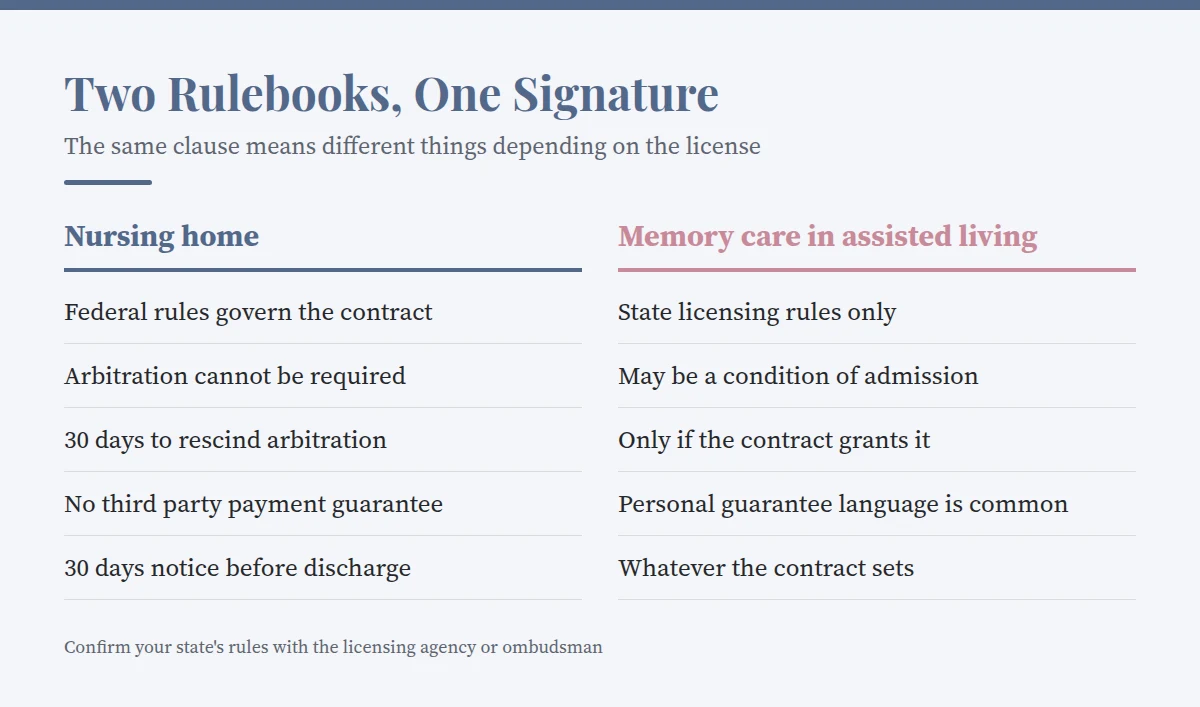
Skilled nursing facilities that take Medicare or Medicaid are governed by federal regulation, built on the Nursing Home Reform Act of 1987 and spelled out in detail at 42 CFR Part 483. That rulebook is long, specific, and enforceable, and it covers admission agreements directly.
Memory care is usually not that. In most states a memory care unit is a licensed wing or floor inside assisted living, and assisted living is regulated by the state, not by CMS. There is no federal residents’ rights regulation standing behind your contract, no federal survey, and no federal star rating. What you get instead is your state’s licensing rules, which range from detailed to almost nothing, plus whatever the contract itself says. Most of this article’s federal protections are therefore a benchmark rather than a guarantee: they tell you what a fair term looks like, and you can ask for it, but outside a nursing home nobody is required to give it to you.
One federal-style protection does show up in most states in another form. Many states have an Alzheimer’s special care disclosure law requiring any facility that advertises memory care to hand you a written statement of how that care actually differs from its regular care. South Carolina’s version, the same statute named in the Charleston lawsuit, requires disclosure of admission, transfer and discharge criteria, care planning, staffing patterns, staff training, the physical environment, activities, the family’s role, and the added costs of the specialized service. That document is separate from the contract, you are entitled to it before placement, and it is frequently the single most useful page in the folder. Ask for it by name.
The Arbitration Clause
Somewhere in the packet, usually near the back and sometimes as its own signature page, is a pre-dispute binding arbitration agreement. Signing it means that if your mother is injured, neglected, or dies because of something the community did, the dispute goes to a private arbitrator that both sides pick rather than to a jury. There is no public record, discovery is narrower, and the decision is generally final with almost no right of appeal.
For nursing homes, federal rules set out exactly what such an agreement has to look like. CMS banned these clauses in 2016, then reversed course in a 2019 final rule that allows them subject to conditions. A Medicare or Medicaid certified nursing home cannot require a resident or their representative to sign one as a condition of admission, and the agreement has to say so explicitly. It must be explained in a form and manner the person understands, the person has to acknowledge they understand it, and the agreement must grant a right to rescind within 30 calendar days of signing. It must provide for a neutral arbitrator agreed on by both parties and a venue convenient to both. It cannot contain language that discourages anyone from talking to state surveyors, health department staff, or the ombudsman. The facility has to keep the signed agreement and the arbitrator’s decision for five years.
Here is the part that catches families out. In assisted living memory care, none of that is automatically true. A community in most states may lawfully treat arbitration as a condition of admission, and some do. A few states regulate these clauses in residential care contracts, and California’s advocates have long argued that an admission agreement cannot make a resident waive rights they hold under state law, but the baseline varies enormously by state.
Federal arbitration law also runs harder in the facility’s favor than most people expect. In Kindred Nursing Centers v. Clark in 2017, the Supreme Court struck down a Kentucky rule that a power of attorney could not bind someone to arbitration unless the document specifically said so, holding that singling out arbitration for that treatment conflicted with the Federal Arbitration Act. The practical upshot is that a broadly worded financial power of attorney may well be enough for an adult child to sign away a parent’s right to a jury trial, whether or not anyone in the room understood that at the time. Researchers looking at nursing home and assisted living resident agreements have tracked the same trend toward enforceability for over a decade.

So treat the arbitration page as a decision rather than a formality.
- Ask for it as a separate document. A clause buried on page nine is a bad sign on its own. Reputable communities hand it over separately because they know it has to be voluntary to hold up.
- You can decline. In a nursing home, refusal cannot cost the bed. In assisted living, ask directly and in writing whether admission depends on it, and write down who told you what.
- You can strike it. Crossing out the clause, initialing the change, and keeping a copy of the version you signed is a normal contract move, not an insult.
- You may be able to rescind. Thirty days is the federal nursing home standard. Many assisted living agreements copy the same language. Read for it, and if it is there, calendar the deadline before you leave the office.
The Signature Line That Can Make You Personally Liable
Look at how the contract names you. Somewhere it will use a phrase like responsible party, financial agent, guarantor, or legally responsible person, and those words carry very different weight.
In nursing homes, the law is clear. A facility that takes Medicare or Medicaid may not request or require a third party guarantee of payment as a condition of admission or continued stay. In September 2022, the CFPB and CMS sent a joint letter to nursing homes and debt collectors saying exactly that, adding that contract terms conflicting with the Nursing Home Reform Act are unlawful and debts arising from them are invalid and unenforceable, and that a collector chasing such a debt may also be violating the Fair Debt Collection Practices Act. That letter exists because families had been garnished and, in some cases, had lost homes over a parent’s unpaid bill.
Assisted living contracts sit outside that protection, and personal guarantee language is common in them. What you agree to should be that you will use your mother’s money, as her agent, to pay her bill. What you must not agree to, unless you genuinely mean it, is that you will pay it yourself if her money runs out.
Practical steps, in order of how much they matter:
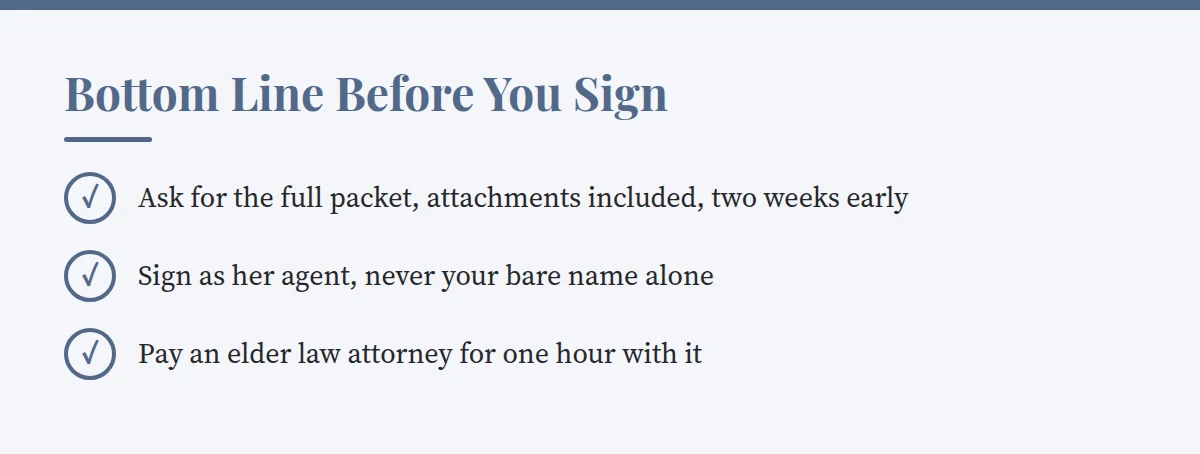
- Sign in your representative capacity. Write her name, then your own, then your role: “Jane Smith, by John Smith, Attorney-in-Fact.” Never sign your bare name on a line that does not say what you are.
- Search the document for the words guarantee, personally, individually, and jointly and severally. Any of them near your signature line deserves an explanation in writing.
- Read the incorporated documents. Most agreements pull in house rules, a fee schedule, and a resident handbook by reference. Those attachments are part of the contract even though nobody hands them to you.
- Have the packet reviewed. An elder law attorney will read a memory care admission agreement for a modest flat fee, and this is one of the highest-return hours a family will spend. If a certified financial planner is already involved in the Medicaid picture, loop them in on the payment terms too. Having the power of attorney properly drafted and in place beforehand is what makes signing as an agent possible at all.
Discharge: The Clause Families Never Read Until It Is Urgent
Discharge or eviction has been the single most common complaint to long-term care ombudsmen for more than a decade. In fiscal year 2023 it topped the list in both nursing homes and assisted living. It is not a rare event, and it very often lands on families who believed a placement was permanent.
Nursing homes again have the firmer floor. Federal rules permit transfer or discharge for only six reasons: the resident’s welfare and needs cannot be met there, their health has improved enough that they no longer need the services, the safety of others is endangered, the health of others is endangered, non-payment after reasonable notice, or the facility closing. Thirty days’ written notice is the standard, with narrow exceptions, and the notice has to explain the right to appeal.
Assisted living memory care runs on the contract and on state law, so read the termination section as carefully as the money section. Look for how many days of notice you get and whether that number changes for behavior versus non-payment. Look for language like “needs exceed the level of care the community is licensed to provide,” which is broad enough to cover almost any decline and is the clause most often used. Look for whether specific behaviors, including the wandering, resistance to care, and occasional aggression that are ordinary features of mid-stage dementia, are listed as grounds for removal. Look for what happens when private funds run out and whether the community accepts Medicaid at all, because Medicaid does not pay room and board in assisted living in most states and plenty of communities take no Medicaid residents. And ask a blunt question on the tour: how many residents were asked to leave in the past year, and why.
If a notice does arrive, you are not without recourse. The long-term care ombudsman helps families respond to discharge notices, and that is free and confidential. Knowing which door to knock on before you need it is worth an afternoon.
What the Contract Actually Promises About Care
This is where an admission agreement is usually at its vaguest, and where the Charleston case lives.
Most agreements describe care in terms of a level assigned by an assessment, with a price attached to each level and a right for the community to reassess and re-price. What they rarely contain is a number. Staffing ratios are seldom written into the contract, and where state rules set minimums they are often expressed as a general sufficiency standard rather than a count. Supervision is promised in adjectives.

So the useful work is turning adjectives into specifics before you sign, and keeping what you are told.
- Ask what the door and courtyard policy is, in writing. Who checks exterior doors, how often, and what happens when an alarm sounds. The Charleston suit turns on a propped-open door to a secured courtyard.
- Ask how often residents are physically checked overnight, and how that check is documented. Then ask to see a blank version of the form.
- Ask who looks at skin, how often, and who is told what they find. Bruises, pressure areas, bites and rashes on someone who cannot report pain are found only if somebody is looking.
- Ask what triggers a call to you, and confirm it in an email afterward. A written confirmation of a verbal promise is not a contract, but it is evidence.
- Ask for the special care disclosure statement described earlier, which in many states must already contain the staffing and training answers.
Watch also for a negotiated risk or shared responsibility agreement, a separate document in which a family accepts the risk of something the resident wants to keep doing. These can be entirely reasonable. They can also function as a liability waiver signed on behalf of somebody who cannot weigh the risk themselves, which is a different thing, and worth an attorney’s eye.
One more thing worth knowing before you sign: the entity on the signature page may not be the one you toured. Buildings are frequently owned by one company, leased to an operator, and managed by a third, and the name on the contract is the one you would be suing. Tracing who actually stands behind the front door takes about twenty minutes and belongs in the same week as the contract review. If a dedicated memory care unit is not available and the plan is general assisted living, the written promises matter even more, because what you should demand of that setting is not what the brochure covers.
Buying Yourself the Time to Read
The single most effective thing a family can do costs nothing: ask for the full admission packet, including every attachment, a week or two before move-in day.

Communities give it to you when asked. Almost nobody asks, which is why the folder appears for the first time on the morning when reading it is impossible. With the packet at your kitchen table you can mark the arbitration clause, find your own name in the liability language, read the termination section twice, and spend an hour with an attorney who does this for a living.
None of this is an argument against placement, and none of it says the community across town is out to harm your mother. Most people working in memory care are doing careful work for modest pay in a building that is short a few staff. But the agreement is written by the operator’s lawyers to protect the operator, which is what agreements are for, and the only person at that desk on move-in day whose job is to protect your mother is you. Read it in a week when you still can, and ask the questions that turn adjectives into answers. It is a small, unglamorous act of advocacy, and it lasts as long as she lives there.
Sources
- Legal Information Institute for the federal rule on binding arbitration agreements in long-term care facilities
- Legal Information Institute on admission, transfer and discharge rights, including the six permissible discharge reasons
- GovInfo with the 2019 CMS final rule that reinstated arbitration agreements under conditions
- Consumer Financial Protection Bureau and CMS in their joint letter on third party payment guarantees and nursing home debt
- South Carolina Legislature for the Alzheimer’s Special Care Disclosure Act and what it requires facilities to hand over
- Justia covering the Supreme Court decision on powers of attorney and arbitration
- CANHR on what belongs in a residential care admission agreement and what does not
- CANHR with the case against signing a pre-dispute arbitration agreement
- Administration for Community Living for the ombudsman complaint categories that rank discharge first
- National Consumer Voice for Quality Long-Term Care in its consumer guide on reading admission paperwork
- Hylak-Reinholtz in Health Care Law Monthly on how arbitration clauses in nursing home and assisted living resident agreements became enforceable
- WCBD News 2 reporting the Charleston lawsuit over a resident found with nearly 1,000 ant bites
Further reading
- Choosing the Right Memory Care Facility: Key Questions to Ask
- The Long-Term Care Ombudsman: The Free Advocate Every Memory Care Resident Already Has
- Advance Directives and Power of Attorney: The Legal Documents Every Family Needs After a Dementia Diagnosis
- Who Actually Owns the Memory Care Community: Private Equity, REITs, Chains, and Nonprofits
- 44 Percent of Assisted Living Residents Now Have Dementia: What Families Should Demand When Memory Care Isn’t an Option