The Sandwich Generation and Dementia: Caring for a Parent While Raising Your Own Kids
Published on September 16, 2026

It is 5:30 on a school night. Your nine-year-old needs help with fractions, nothing is started for dinner, and your father has called three times asking when someone will come and take him home. He is calling from the house he has lived in for forty years. Somewhere in the middle of all that is a job, maybe a partner, and a version of you that used to sleep through the night.
If that evening sounds familiar, you belong to what is often called the sandwich generation: adults caring for an aging parent while still raising children of their own. The group is large. The Alzheimer’s Association estimates that about a quarter of dementia caregivers are in exactly this position. A Pew Research Center survey from September 2025 found that 54 percent of Americans in their 40s have a parent 65 or older along with a child under 18 or a grown child they help financially. Among people in their 50s, that share rose from 36 percent in 2021 to 45 percent.
The first national profile of these caregivers, built by University of Michigan and Wayne State researchers from the 2015 National Study of Caregiving, found something worth sitting with. Adult children who were also raising a minor child gave their older parent about as much care as other adult child caregivers did, roughly 77 hours a month, and they were more likely to hold a paying job (69 percent versus 54 percent). They reported substantial financial difficulty at nearly twice the rate of their peers, and emotional difficulty more often too (44 percent versus 32 percent). If this feels harder than what your friends without kids at home describe, the data agrees with you. So this guide is not about becoming more efficient at an impossible load. It is about shrinking the load, sharing it, and protecting what cannot be traded away.
Triage: Deciding Who Gets You First
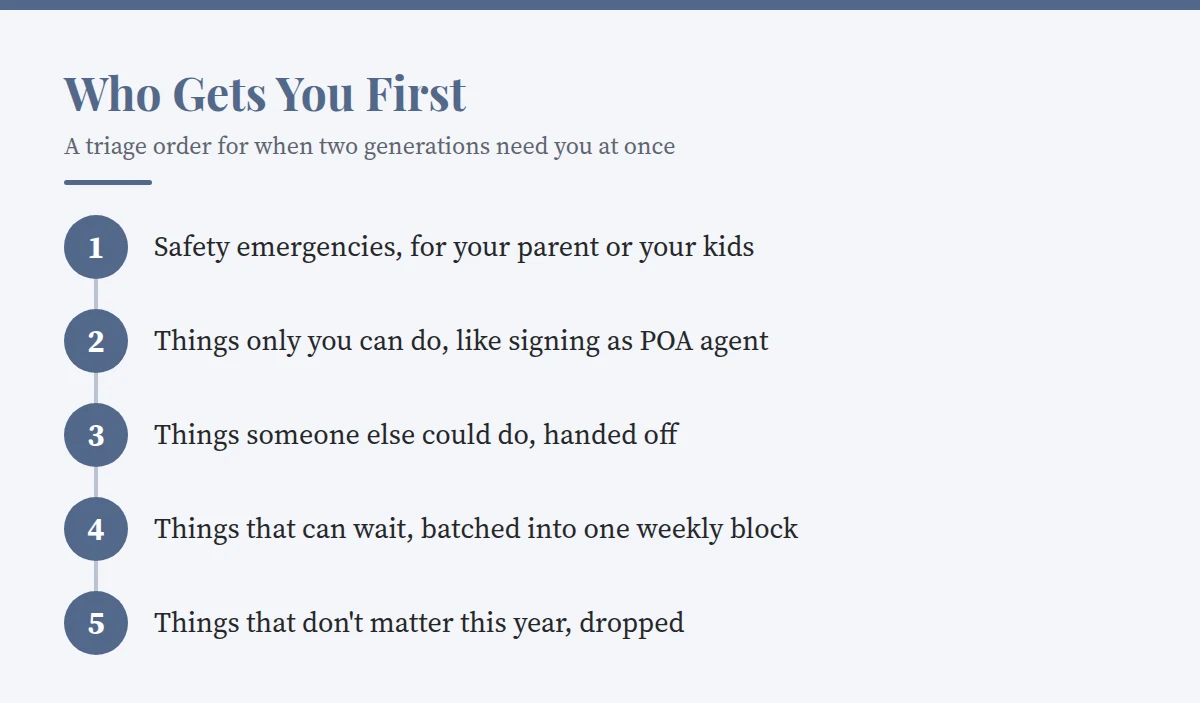
When two generations need you in the same hour, guilt tends to make the call, and guilt usually sides with whoever is loudest. A fixed order of priorities works better, and it applies the same way whether the need belongs to your mother or your son:
- Safety first, for either generation. A fall, a wandering episode, a child who has to be collected from school sick. Nothing else competes with these.
- Then the things only you can do. Signing as your parent’s agent under a power of attorney, the parent-teacher conference, being the familiar face when your father is frightened somewhere new. This list is shorter than it feels at 10 p.m.
- Then the things someone else could do if you let them. Rides to appointments, laundry, grocery runs, an afternoon of company for your parent, a carpool slot. This is where siblings, friends, neighbors, and paid help belong.
- Batch what can wait. Prescription refills, routine checkups, insurance paperwork. Give them one block a week instead of letting them leak into every day.
- Drop what doesn’t matter this year. The spotless house, homemade everything, the volunteer sign-up sheet.
A few habits make the order easier to keep:
- Plan around the late-afternoon slump. The National Institute on Aging describes sundowning as agitation that starts or worsens in the late afternoon or early evening. That is precisely when pickup, homework, and dinner land. If you pay for any help at all, those are the first hours worth buying, and in-home care can be scheduled around exactly that window.
- Stack your parent’s appointments in the morning. Keep them clear of those difficult late-day hours, and bundle visits into as few mornings as you can.
- Keep one family calendar. Your children’s schedules and your parent’s care belong in the same place, visible to your partner and siblings, so nobody discovers a collision at 7 a.m.
- Re-triage every season. Dementia progresses, and a plan that holds in the early stage tends to fail quietly in the middle stage. Put a review on the calendar every three months, the way you would a school conference.
Boundaries You Can Say Out Loud
Many families carry an unspoken assumption that the adult child who lives closest will simply absorb a parent’s care. The Alzheimer’s Association suggests trading that assumption for a direct conversation, and its guidance boils down to four questions you can answer tonight:
- How many hours a week can go to your parent without shortchanging your kids or your own health?
- What does your parent need financially, and what can your household actually carry?
- Which commitments in your life are off the table?
- Who else could share the work?
Write the answers down before a crisis writes them for you, then say them to the people they affect. A boundary nobody knows about is just resentment waiting for an outlet.
Good boundaries are specific. “I’ll help when I can” invites a phone call every day. “I take Dad to appointments on Tuesday mornings and I’m with him Saturdays until two, and weeknights belong to my kids” is something a family can build a schedule around. Task boundaries count too. Plenty of adult children decide they will handle the money and the medical calls but not intimate care like bathing, and arrange for a sibling or an aide to take that on. That is a legitimate line, not a failure of love.
Pick at least one anchor per child that does not move: bedtime reading, the Saturday game, dinner together three nights a week. A few fixed points give a disrupted household something to count on, and they protect you as much as the kids. As for involving the children themselves, keep explanations honest and suited to their age, and be careful about turning an older child into the default sitter. Setting the table with Grandma is connection. Watching Grandpa every afternoon so you can work is a job, and a teenager should get a real chance to say no to it.
Bring your partner into the boundary conversation rather than reporting its results afterward. A 2025 scoping review of research on sandwiched caregivers linked partner support, flexibility at work, and working hours to how well people held work and family life together, with flexible arrangements and staying socially connected standing out as the coping strategies that helped. An arrangement that is quietly costing your relationship is not sustainable, however well it looks from outside.
Guilt will show up anyway. It is not proof that the boundary is wrong. Much of it is grief for a parent who is changing in front of you, a loss that has a name and a shape of its own. The Alzheimer’s Association frames the practical side plainly: a caregiver worn down to total exhaustion is not much use to the person with dementia.
Negotiating With Siblings When You Are the One With Kids
For a sandwiched caregiver, sibling talks tend to go wrong in one of two directions. You get volunteered as the primary caregiver because you live nearest, or you get quietly excused because “you have enough on your plate,” which sounds considerate and often means you are left out of decisions. Name whichever one is happening in your family.
The National Institute on Aging recommends starting with a meeting or conference call that includes your parent where possible, held while things are calm rather than in the middle of an emergency. Settle what care is needed now, what is likely later, who serves as the primary caregiver, and who takes which jobs. NIA’s advice is to match jobs to strengths: whoever is best at research keeps the family updated, whoever stays calm with medical staff handles the doctors, whoever is good with numbers takes the bills and insurance statements, and someone commits to covering so the primary caregiver can actually take a break.

The most useful move for someone with kids at home is to treat time and money as interchangeable. A sibling without children at home might cover one weekend a month, or the first nights after a hospital discharge. A sibling across the country can own the insurance appeals, the pharmacy calls, and the benefits paperwork, work that is real and can be done from anywhere, as our guide to long-distance caregiving explains. A sibling with more income than free time can pay for respite hours. What fails is one person contributing everything while everyone else contributes sympathy.
Write the agreement down and set a date to revisit it, since NIA points out that both a parent’s needs and each family member’s availability will shift over time. If you end up giving substantial hands-on care, a written personal care agreement drafted by an elder law attorney can let your parent pay you fairly without creating a Medicaid problem later, one of the options in our guide to holding a job while caring for a parent. And if old family patterns make a productive meeting impossible, a geriatric care manager or social worker can run it as a neutral party.
The Money Fork: Your Retirement, Their College, Your Parent’s Care
The financial squeeze in the middle has a recognizable shape. Your parent’s care costs climb, your children’s college years get closer, and your own retirement is the one bill no one else will ever pay. The order in which you fund those three matters more than the exact amounts.
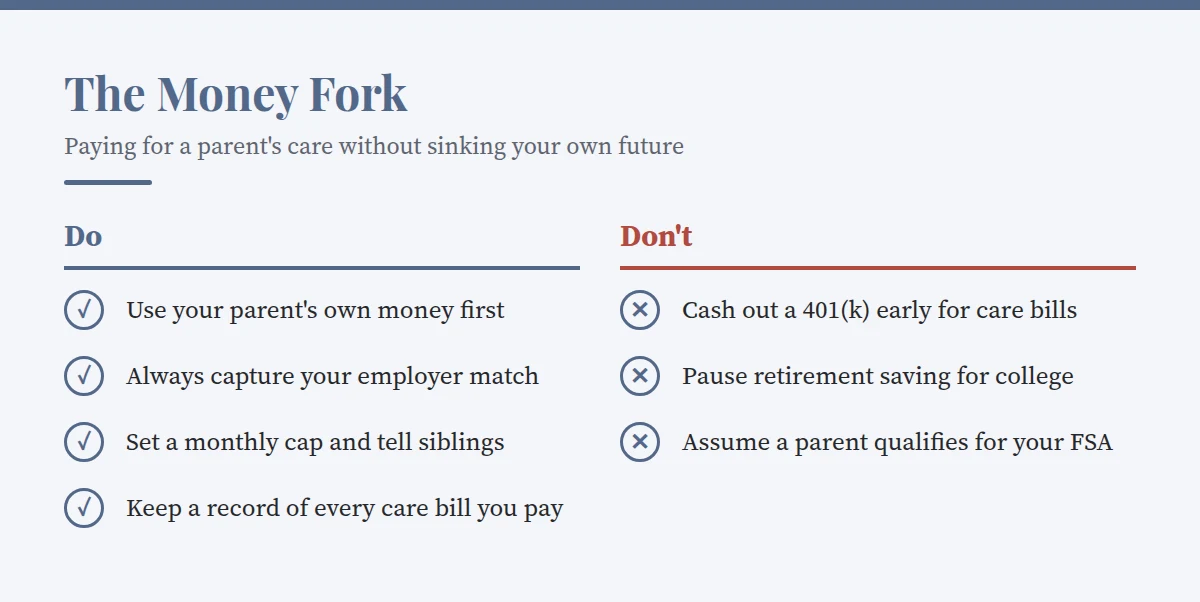
Your parent’s money pays for your parent’s care first. Before you contribute anything, find out what your parent has: income, savings, a long-term care insurance policy, veterans’ benefits, and whether Medicaid may come into play. Whoever holds the durable financial power of attorney should manage those resources, ideally with an elder law attorney’s advice, because spending decisions made now can affect Medicaid eligibility later.
Retirement comes before college. The familiar rule still holds: your kids can borrow for school, and nobody lends you money to retire. Federal aid rules reinforce it. The value of 401(k)s, pensions, and IRAs is not counted as an asset on the FAFSA, while cash in ordinary savings and checking accounts is. The catch is that withdrawals from retirement accounts do count as income, which is one more reason to leave them alone.
Don’t cash out retirement accounts to cover a care bill. According to the IRS, taking money from a 401(k) or similar plan before age 59½ generally triggers a 10 percent additional tax on the taxable portion, with limited exceptions, and that portion is also taxed as ordinary income. The money shrinks badly before it pays a single invoice.
Set a ceiling and keep receipts. Agree with your partner on a monthly amount your household can put toward your parent’s care without cutting retirement saving, and at minimum keep contributing enough to earn any employer match, which is part of your pay. Share that number with your siblings and keep a simple record of what you pay. A number on paper turns an open-ended obligation into a plan.
Look for tax tools that serve both generations. A dependent care FSA can pay for child care for kids under 13 and, under much stricter conditions, adult day care for a parent who lives with you and cannot care for themselves. Both draw on the same annual limit, which rose from $5,000 to $7,500 for 2026. Check your plan’s rules before counting on it for your parent.
A fee-only certified financial planner, paid by you rather than by commissions, can model how these pieces fit your household. For anything involving Medicaid, trusts, or paying a family caregiver, bring in an elder law attorney.
Support That Fits Between Drop-Off and Pickup
Much of the support available to caregivers seems designed for someone with free weekday afternoons. You need help that fits around a school schedule. It exists, but you usually have to go looking.
Adult day centers are the nearest thing to a school day for your parent. The Alzheimer’s Association reports that some stay open seven to 10 hours a day, some add evening or weekend hours, and many provide meals and transportation. Fees are often on a sliding scale, and in some states Medicaid covers the cost for people with very low income and few assets. The Association suggests attending at least twice a week for a month before deciding, since many people resist at first and settle in after several weeks.

Support groups that meet online. One caregiver quoted by the Alzheimer’s Association joins a Zoom support group during the kids’ music lessons and tutoring sessions. Online communities, including the Association’s ALZConnected, are there at 11 p.m. after bedtime.
The 24/7 Helpline. The Alzheimer’s Association line at 800.272.3900 puts you through to a live person at any hour for information, local referrals, crisis help, and emotional support.
Caregiver services your state already funds. The federal National Family Caregiver Support Program gives states grants for counseling, support groups, caregiver training, and respite care for family caregivers. The Eldercare Locator (800-677-1116) can connect you with the local aging agency that serves your parent.
Your employer. Check whether your employee assistance program includes eldercare referral, and ask about flexible hours before assuming the answer is no.
The Michigan study found that sandwich caregivers used support services as rarely as other caregivers did, with one exception: they were more likely to seek financial help. Low use is not the same as low need. Make one call this week.
When the Current Arrangement Stops Working
Some families keep a parent at home, theirs or the parent’s own, for years. Others reach a point where the setup quietly fails, and the signs usually appear well before anyone says them out loud:
- Your parent is no longer safe during the hours nobody is with them, or needs supervision overnight.
- Agitation or aggression is frightening your children.
- Your kids’ needs are going unmet week after week.
- Your own health is sliding: skipped checkups, constant exhaustion, signs of depression.
When those show up, look at the next level of care, and know that the levels are genuinely different. Assisted living offers housing, meals, and help with daily tasks, but not necessarily a secured building or dementia-trained staff. Memory care adds a secured environment, staff trained in dementia, and activities designed for people with cognitive decline. A skilled nursing facility provides round-the-clock nursing for significant medical needs. In-home care and adult day programs can extend the time at home before any move. A geriatric care manager or social worker can assess your parent and match the need to the setting, and that assessment is worth having before you tour anywhere.
A move doesn’t end your role. It changes it from doing the care to overseeing it, which fits far better alongside raising children. You also stop being the only safeguard: residents of nursing homes and assisted living, including most memory care units, can call on a free long-term care ombudsman when a problem goes unfixed.
What This Comes Down To
You will not get the balance right every week, and nobody who has lived this expects you to. What you can do is set the priority order before the next crisis, say your limits out loud, make siblings carry real weight, keep your retirement off the table, and use the help that fits between drop-off and pickup. Then revisit all of it every few months, because the disease will keep rewriting the terms. And when the numbers stop making sense at midnight, the helpline is open. Call it.
Sources
- Alzheimer’s Association on what sandwich generation caregiving looks like in dementia
- Pew Research Center with the share of Americans in each age group who are sandwiched
- Lei, Leggett and Maust for a national profile of caregivers looking after a parent and a minor child
- Honda and colleagues reviewing how sandwiched caregivers balance work and family life
- National Institute on Aging on dividing caregiving tasks among family members
- National Institute on Aging explaining why agitation can worsen in the late afternoon
- Federal Student Aid for the handbook rule that retirement accounts are not FAFSA assets
- IRS on the additional tax on early retirement plan withdrawals
- IRS covering the 2026 increase in the dependent care FSA limit
- Administration for Community Living detailing the services funded by the National Family Caregiver Support Program
- Alzheimer’s Association with adult day center hours, costs, and how to try one
Further reading
- In-Home Memory Care: When to Consider It and How to Get Started
- Ambiguous Loss: Grieving Someone With Dementia Who Is Still Here
- Long-Distance Caregiving for a Parent With Dementia: A Complete Coordination Guide
- Holding a Job While Caring for a Parent With Dementia: The Employment and Income Guide
- The Long-Term Care Ombudsman: The Free Advocate Every Memory Care Resident Already Has