How Dementia Changes the Senses: Why Perception Explains So Much Behavior
Published on September 13, 2026
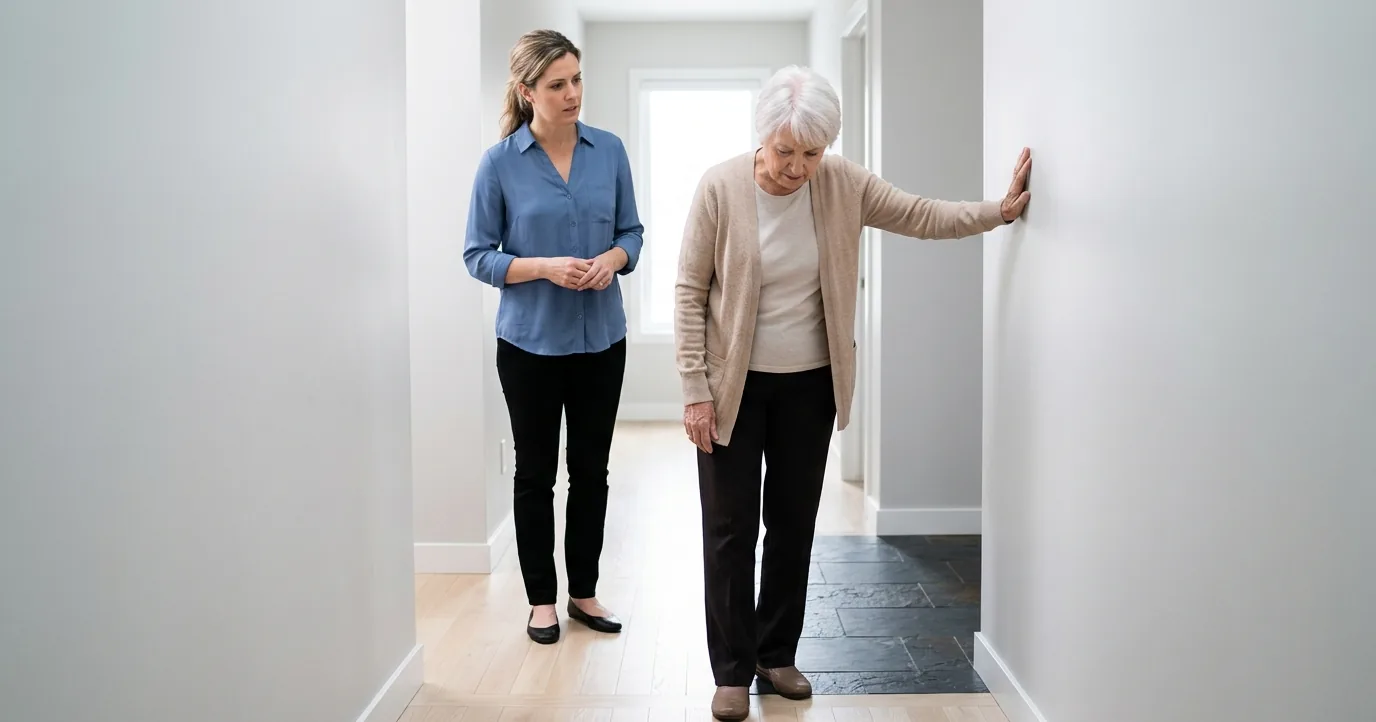
Your mother stops at the bathroom door. The bath mat is charcoal on cream tile, and she will not cross it. You tell her it is just a mat. You have told her this before. She plants her feet and says no, and by the third round you are both upset and nobody has had a bath.
She is not being difficult. To a brain that has lost the ability to judge depth and contrast, that mat is not a mat. It is a hole in the floor, roughly two feet across, and you are asking her to step into it. Take the mat away and she walks in.
A great deal of what families read as stubbornness, paranoia, or a sudden change in personality is none of those things. It is a perception problem. Alzheimer’s and the other dementias do not stop at memory. They damage the parts of the brain that assemble sight, sound, and sensation into a usable picture of the world, and the person is responding sensibly to the world they can actually perceive. Once you see it that way, a surprising number of daily standoffs become things you can fix with a lamp, a roll of colored tape, or a dose of acetaminophen.
The Eyes Are Usually Fine. The Brain Is Not.
Alzheimer’s damage spreads backward through the brain over time, and the regions it reaches in the middle stage (the parietal and occipital lobes) are the ones that interpret what the eyes send. Vision itself can test as 20/20 while the interpretation of it falls apart. That gap is exactly why families and even clinicians miss it: the eye exam comes back normal, so nobody looks further.
Four specific things break down, and each one produces predictable behavior.
Contrast sensitivity goes early. The ability to tell a pale object from a pale background fades, which is why food disappears on a white plate and why a white toilet seat against a white bowl in a white bathroom can be genuinely invisible.
Depth perception follows. Judging where a surface actually sits in space becomes unreliable, so a person lowers themselves toward a chair that is further away than they thought, or freezes at a curb.
The visual field narrows. Attention contracts toward the center, and in later stages the useful field can shrink to something close to what you would see through a paper towel tube. Food on the left half of the plate is not refused; it is not seen. Approaching from behind or from the side becomes startling rather than reassuring.
Color discrimination shifts. The aging lens yellows and filters blue light, and cortical changes compound it. Blues, greens, and violets blur together first. Reds and yellows hold up longest, which is why they work so well for marking things that matter.
There is also a rarer variant worth knowing about. In posterior cortical atrophy, sometimes called Benson’s syndrome, the damage starts in the visual areas instead of the memory areas. These patients often spend years being sent between optometrists before anyone names it, because memory is intact and the complaint is that they cannot read a page or find their car in a lot. If the visual symptoms came first and dominate, that possibility belongs in front of a neurologist.
Translating Behavior Back Into Perception
Here is the same list from the other direction, starting with what you are actually seeing at home.
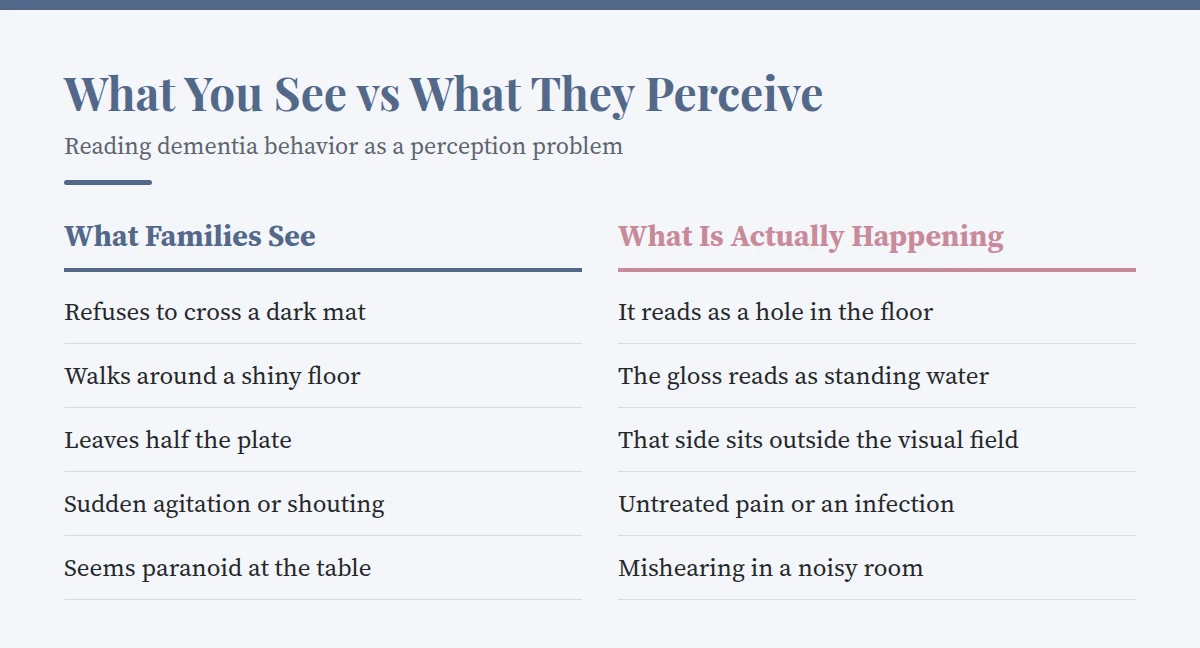
- Refuses to step onto dark flooring, mats, or thresholds. Dark patches read as holes or drops. Remove dark mats. Keep flooring one continuous matte tone from room to room.
- Walks around a shiny floor, or tiptoes across it. Polished vinyl and wet-look tile read as standing water. Matte finishes solve it.
- Picks at the carpet, or swats at the bedspread. Busy patterns can appear to swarm or move. Solid colors throughout.
- Sits down before the chair is there. Depth loss. Guide a hand to the armrest and let touch confirm what sight cannot.
- Becomes agitated in the bathroom. Often the mirror. A person who no longer recognizes their reflection sees a stranger watching them undress. Cover it or take it down.
- Stops eating a meal that is half full. Check the neglected side of the plate before assuming appetite loss. The home guide to appetite and weight loss in dementia covers the rest of the causes.
- Accuses people of hiding things or talking about them. Frequently mishearing rather than delusion, especially in a noisy room.

Detailed hallucinations are a different matter and point toward a specific diagnosis. Well formed, recurring visions of people or animals, often accompanied by movement changes and dramatic day-to-day fluctuation, are a hallmark of Lewy body dementia rather than Alzheimer’s, and they change the medication plan substantially. Our guide to telling the dementia types apart walks through the distinctions.
Contrast and Light Are the Cheapest Interventions You Have
Two rules do most of the work.
First, make anything the person needs to find a different tone from whatever sits behind it. A colored toilet seat on a white bowl. A dark plate under light food. A grab bar that is not the same white as the tile. Colored tape along the leading edge of each stair. A brightly painted bathroom door in a hallway of pale doors. Red and yellow survive longest, so use them where it counts.

Second, give them roughly twice the light you would need yourself, with no glare. A 75-year-old eye needs about double the illumination of a 25-year-old one, and dementia raises the bar further. Shadows in a dim hallway become obstacles; pooled light and dark patches become a floor that looks uneven. Even, diffused light beats bright overhead fixtures. Sheer blinds and matte surfaces kill the glare that turns a sunny window into a wall of white. Motion-sensor night lights along the bed-to-bathroom path prevent a large share of nighttime falls. The room design guide goes deeper on layout, color, and furnishings.
Hearing: The Sense Most Often Left Untreated
Untreated hearing loss looks like worsening dementia. The person answers the wrong question, withdraws from the table, or decides the conversation across the room is about them. Families read confusion and suspicion; the actual problem is a hearing aid in a drawer with a dead battery.
It is worth treating on its own terms. In the ACHIEVE trial, published in 2023, hearing intervention did not slow cognitive decline across the whole study population, but among participants already at elevated risk it cut the rate of decline by roughly half over three years. Whatever that means for prevention, the daily payoff is immediate: a person who can hear you participates.
Practical steps are small. Get a hearing test. Check that aids are in, charged, and correctly fitted, and check it daily, because someone with dementia will not report that they stopped working. When aids are refused or lost repeatedly, a pocket amplifier with headphones costs a fraction as much and is far harder to misplace. Then cut the competing noise: turn the television off during conversation and meals rather than down, and seat the person away from the clatter in restaurants and dining rooms. Sound techniques for the conversation itself are in the communication guide.
Pain Does Not Disappear. It Changes Address.
This is the one that causes real harm. People with dementia consistently receive less pain medication than cognitively intact patients with the identical condition, for one reason: they stop reporting it in words. The pain does not go anywhere. It comes out as behavior.
Agitation, resisting personal care, pacing, calling out, refusing to eat, sleeping badly, striking out during a transfer. Every one of those gets logged as a dementia behavior, and the underlying arthritis, pressure sore, impacted bowel, abscessed tooth, or bladder infection goes untreated for months.
Watch the face and body instead of waiting for a sentence. Clinicians use the PAINAD scale for exactly this, scoring five observable things: breathing, negative vocalizations, facial expression, body language, and whether the person can be consoled. You can use the same five at home. Grimacing, a furrowed brow, guarding a limb, rigid posture, and moaning during a transfer are data.
Then ask for a scheduled analgesic trial. A landmark trial published in the BMJ in 2011 found that a stepwise pain treatment protocol, mostly plain acetaminophen on a schedule, produced a significant drop in agitation over eight weeks compared with usual care. If regular acetaminophen for a week calms someone, it was pain. That is a far better first move than an antipsychotic, which carries a boxed warning for increased mortality in dementia.
One timing rule matters above all: a change that arrives over days rather than months is delirium until proven otherwise, and it demands a same-week medical workup for infection, constipation, dehydration, and new medications. Dementia declines gradually. A person who was fine on Tuesday and is hallucinating by Friday has something else going on, and that something is usually treatable. Hospitalization makes it worse, which is why the hospital and ER survival guide leads with delirium prevention.
Smell, Taste, and Temperature
Loss of smell is one of the earliest changes in Alzheimer’s, often preceding diagnosis by years. Since most of what we call flavor is actually smell, food turns bland, and lifelong favorites get pushed away. Sweet taste holds up longest, which is why dessert still works when dinner does not.
The safety consequence is larger than the culinary one. A person who cannot smell gas, smoke, or spoiled food has lost an alarm system. Stove shutoff devices, working smoke alarms, and someone checking the refrigerator weekly fill that gap.
Temperature sensitivity dulls too, and the scald risk is real. Set the water heater to 120°F. Test bath water yourself every time, without exception. Expect the person to feel cold when you do not, and layer accordingly.
Touch changes as well. Water hitting the skin, a cold washcloth, or hands appearing from behind can register as an assault rather than care, which is the source of a lot of bathing resistance that gets blamed on modesty. Warm the room first, approach from the front, narrate before you touch, and use a handheld sprayer aimed low. More of these techniques are in the daily personal care guide.

Screen the Senses Before You Treat the Behavior
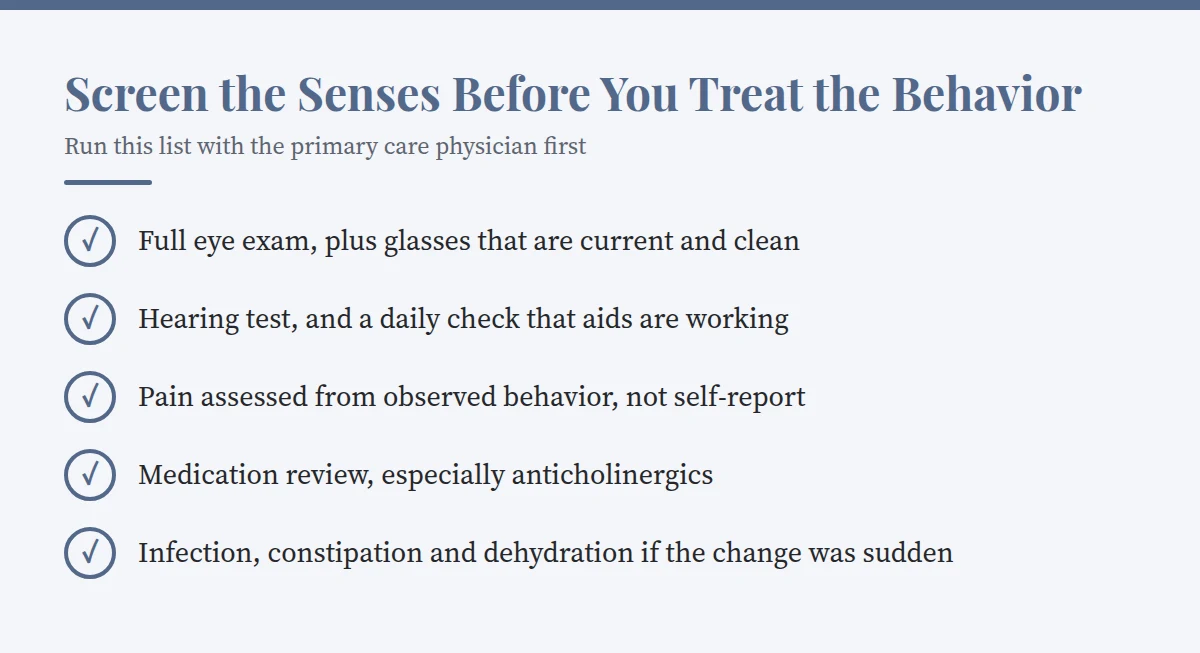
Before any new behavior gets a psychiatric label or a prescription, run this list with the primary care physician:
- A full eye exam, plus confirmation that the glasses on their face are the current prescription and are clean. Wrong or missing glasses are extraordinarily common in care settings.
- A hearing test, and a daily check that aids are working.
- A pain assessment using observed behavior, not self-report, and a trial of scheduled acetaminophen if anything is suspicious.
- A medication review. Anticholinergics blur vision and worsen confusion, and older adults are often on several without anyone tallying the total.
- A check for infection, constipation, and dehydration whenever the change was sudden.
Cataract surgery is worth considering in the early and middle stages. Restoring real vision to someone whose interpretation is already struggling can change their function noticeably, and the decision is worth a frank conversation with an ophthalmologist who has worked with dementia patients.
Behavior in dementia is communication. When someone cannot say “that floor frightens me” or “my tooth is killing me,” they say it by refusing, shouting, or walking away. The question is never how to stop the behavior. It is what the person is perceiving that would make this response reasonable, and what in the room or the body you can change so they no longer need to.
Further reading (sources)
- Alzheimer’s Association on how abilities shift across the stages of the disease
- Alzheimer’s Association for the home safety measures that matter most as dementia advances
- Alzheimer’s Society on how dementia changes a person’s perception
- Peer-reviewed research for making homes more dementia-friendly through aids and adaptations
- The BMJ with the trial showing scheduled pain treatment reduces agitation
- Peer-reviewed research with the design and findings of the ACHIEVE randomised trial
- Dementia Services Development Centre on light reflectance values and why flooring contrast matters