Best Programs for Caregiving: How to Find a Proven Dementia Caregiver Program by ZIP Code
Published on October 7, 2026
Somebody has told you to “get some support.” Maybe it was the neurologist on the way out of the appointment, maybe a friend who means well. So you searched, and the results were a blur of support groups, webinars, blog posts, and a class at the library that may or may not still meet. Nothing told you whether any of it actually helps.
You are far from alone in that. In a 2024 Alzheimer’s Association survey, two in three dementia caregivers (66 percent) said they had trouble finding resources and support for their needs. The strange part is that the help exists. Programs tested in published studies, and shown to ease caregiver depression and stress, are running through hundreds of organizations right now, most of them free and many of them by phone. When researchers surveyed the organizations delivering them, the two problems those organizations reported most were marketing their program (69.8 percent) and getting caregivers to engage with it (66.3 percent). Families cannot find the programs, and the programs cannot find the families.
A free national directory called Best Programs for Caregiving was built to close that gap, and as of August 2026 it has a powerful new partner. Here is what it is, how to search it, and how to choose a program you will actually finish.
What Changed in August 2026
On August 17, 2026, the Alzheimer’s Association announced a three-year partnership, running through 2028, with Benjamin Rose Institute on Aging and Family Caregiver Alliance to support and expand Best Programs for Caregiving, usually shortened to BPC. Benjamin Rose developed the directory with Family Caregiver Alliance and The Gerontological Society of America and launched it in 2020 as a tool for health systems and community agencies deciding which programs to offer. In 2024 a public version opened so families could search it directly.
The partners say they want to raise awareness of proven programs, connect families with support earlier in the disease, and persuade more health care and community organizations to adopt the programs that work. The Association will also submit three of its own programs for possible listing: The Empowered Caregiver, Managing Money: A Caregiver’s Guide to Finances, and the care consultation it provides through its 24/7 Helpline. Those are under consideration, not yet in the directory.
For families, the practical news is simpler. The directory works today, it costs nothing to use, and you do not need a referral to search it.
What “Evidence-Based” Actually Means
Most caregiver support is built on good intentions. A hospital hosts a monthly talk, a congregation starts a group, a local agency runs a class on understanding dementia. Many of these genuinely help, and time with other caregivers has value on its own. But almost none of them have been tested, so nobody can tell you whether they work or for whom.
A program earns a place in BPC in three ways. It has been studied in published research, usually by comparing caregivers who took it with caregivers who did not, or by measuring the same caregivers before and after. It produced measurable improvement in something that matters, such as depression, stress, or confidence in handling care. And it is ready to run outside the original study, typically with a manual and leader training, so the version offered near you follows the same plan that was tested.
The best-known example shows what that testing looks like. The REACH II trial enrolled 642 family caregivers in five U.S. cities, in roughly equal numbers of Hispanic or Latino, white, and Black caregivers, and randomly assigned them either to the program or to two brief check-in calls. Over six months, the program delivered 12 sessions at home and by telephone, working on the caregiver’s mood, stress, self-care, and support network, plus the behaviors that made daily care hardest. At the end, 12.6 percent of the program group met the threshold for clinical depression, against 22.7 percent of the comparison group. Quality of life improved significantly more for Hispanic or Latino and white caregivers, and for Black caregivers looking after a spouse.
The same trial is just as instructive for what it did not find. It made no significant difference in how many people with dementia moved into a care facility within six months. Evidence-based programs are good at easing the caregiver’s load. They do not slow the disease.
A 2025 analysis of the research behind the directory’s programs makes the same point at scale. Across 128 published studies of its 45 programs, the outcomes measured most often were caregiver depression (in 63.3 percent of studies) and stress, strain, or burden (58.6 percent). Far fewer studies checked whether caregivers ended up with more help from family and friends (13.3 percent) or used more community services (10.2 percent). So “proven” mostly means proven to lift distress. Programs that promise more practical help may well deliver it, but the evidence there is thinner.
How to Search the Directory, Step by Step
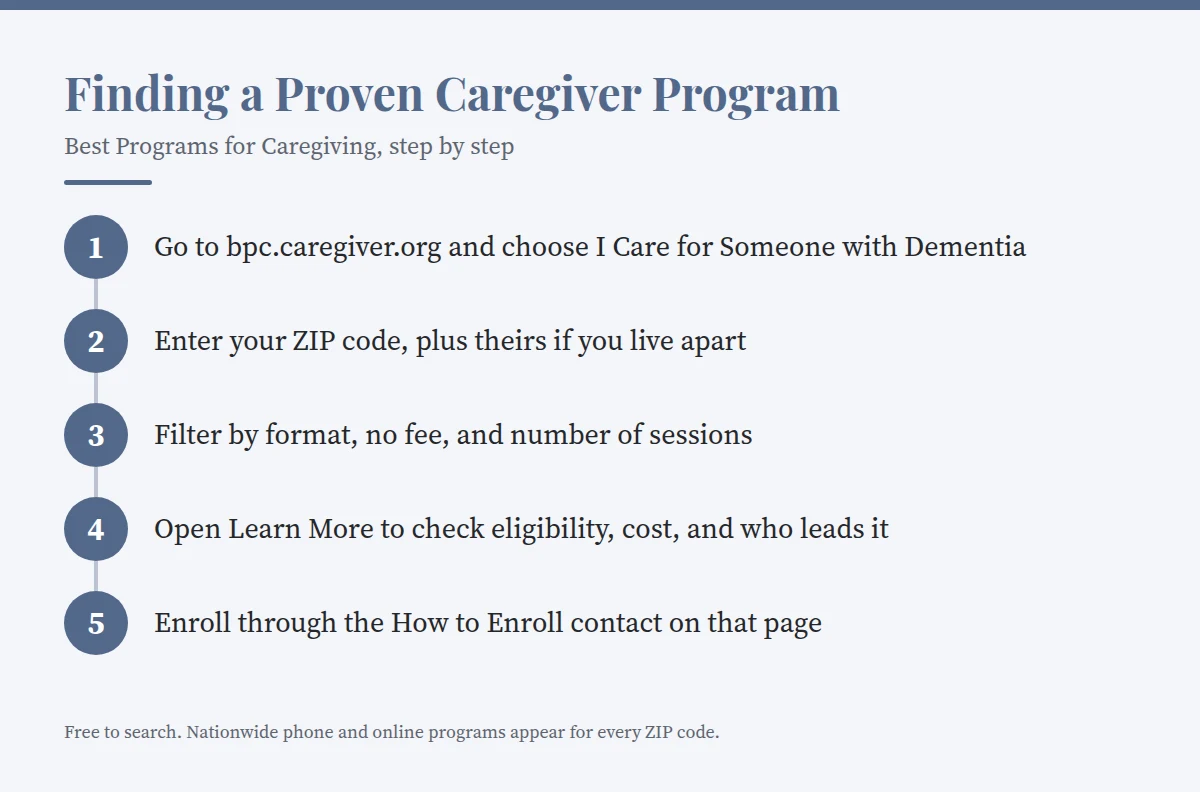
The family version lives at bpc.caregiver.org, and a first search takes about five minutes.
- On the home page, choose the button that says I Care for Someone with Dementia. The other path, for program providers, holds the same programs with much more technical detail, including the research studies behind each one.
- Enter your ZIP code. The results combine programs run by organizations near you with programs offered nationally by phone or online, which caregivers anywhere in the country can join.
- Search twice if you care from a distance. The directory itself suggests entering both your own ZIP code and the ZIP code of the person you care for. A phone program might suit you while an in-person class suits the sibling who lives nearby.
- Narrow the list with filters for delivery type (in person, live online, recorded or self-guided, telephone), programs with no fee, number of sessions, and programs adapted for diverse communities.
- Click Learn More on anything promising. Each program page lists the kinds of help it gives, who is eligible, what it costs, how many sessions it runs and how long each lasts, who leads it, and which languages it comes in.
- Enroll through the contact listed under “How to Enroll,” not the organization’s details in the box at the top of the page. The directory’s own FAQ specifically warns about this.
How much shows up depends on where you live, though less than you might expect. When we searched a downtown Chicago ZIP code in early October 2026, the directory returned 46 listings covering 25 different programs. Thirty-one of those listings were open to caregivers anywhere in the country, and 34 of the 46 carried no fee. A search for Miles City, in eastern Montana, returned 32 listings across 18 programs, and only one of them came from a local organization. Rural caregivers are not shut out. They mostly get their help through a phone or a screen.

That fits what the providers themselves report. Even before the public version existed, about 350 organizations were delivering these programs, reaching an estimated 40,000 caregivers and people living with dementia in 2018 and 2019. Nearly 13 million Americans now provide unpaid dementia care. The organizations delivering programs were most often health care systems and Area Agencies on Aging (23.8 percent each), followed by Alzheimer’s and dementia associations (12 percent). The most common funding source was Title III-E of the Older Americans Act, the National Family Caregiver Support Program, which helps explain why so many listings cost nothing.
Reading the Results: What to Compare
Once you have a list, compare programs on five things before you pick one.
The kind of help. Benjamin Rose sorts the programs into three broad types: skills training, care navigation, and support for the caregiver’s own well-being. Skills programs teach you how to handle a refused shower or late-afternoon agitation. Navigation programs connect you to services and help you plan. Well-being programs work on your stress and mood. Pick the one aimed at your biggest problem right now.
Group or one-on-one. Group classes such as Savvy Caregiver or Powerful Tools for Caregivers give you peers who understand. One-on-one coaching such as REACH suits a caregiver whose situation is complicated, private, or hard to schedule around.
The commitment. Many group programs run six sessions, some stress and mindfulness programs run nine, and coaching or navigation programs are often ongoing. Count the weeks against your real calendar, not your hopeful one.
Cost and eligibility. Most listings are free. Some charge a fee, and the program page says whether financial help is offered. Some are limited to particular groups, such as caregivers of veterans.
Language and fit. Each program page notes translations and any adaptations made for particular racial, ethnic, or LGBTQ+ communities. One listed program, Telenovela Mirela, is a telenovela-style video made for Hispanic and Latino family caregivers.
Matching a Program to the Stage You Are In
No program is locked to one stage, and the directory does not sort them that way. But the programs were built for different moments, and knowing which is which keeps you from signing up for the wrong one.
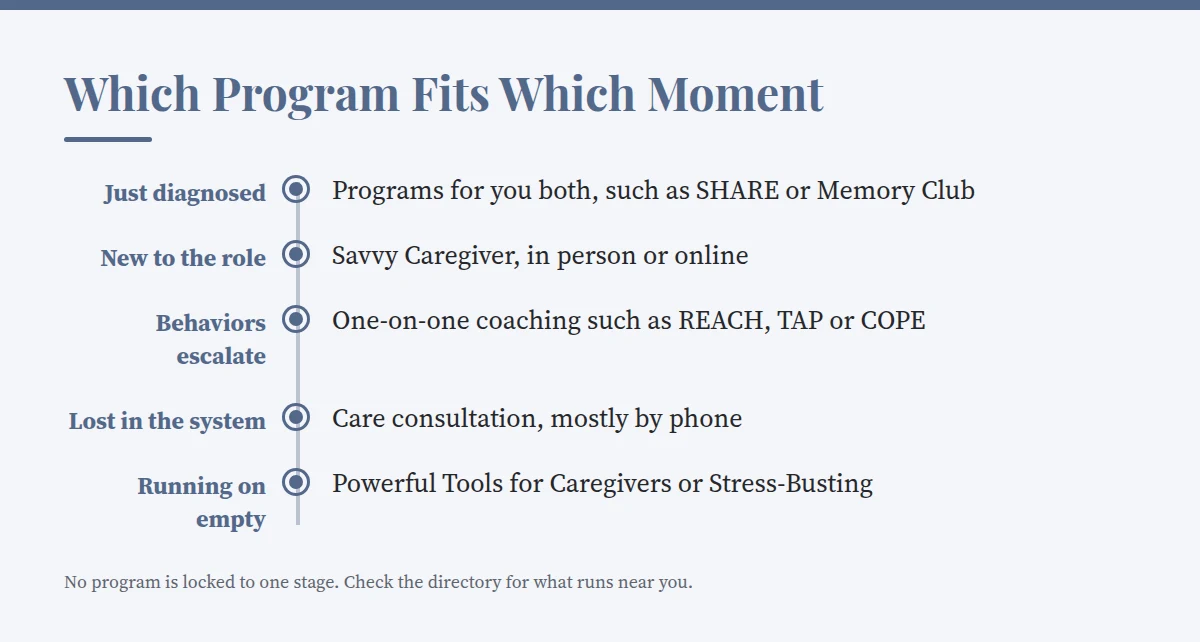
Soon after the diagnosis. If the person with dementia can still take part, look for programs built for both of you. SHARE helps a person in the early stage and their caregiver talk through care values and preferences and plan together. Memory Club brings people with early-stage dementia and their care partners into an eight-session group about coping with memory loss. This is also the stage when well-meant habits like correcting and quizzing do the most damage, which our guide to the caregiving reflexes that backfire walks through.
When you are new to the role. Savvy Caregiver was designed to introduce family members to caregiving, give them the knowledge, skills, and outlook the role demands, and alert them to their own self-care. It now runs in person and online. A randomized trial of the online version, Tele-Savvy, followed 261 caregivers through seven weekly live video sessions and 36 short recorded lessons over about six weeks. Compared with the control groups, participants reported less depression and perceived stress, reacted less strongly to their person’s behaviors, and felt more in command of their role. The trial did not find the expected drop in burden or anxiety, a reminder that feeling more capable and carrying less are not the same thing.
When behaviors and safety take over. In the middle stage, the hardest days often involve agitation, refusals, wandering, and a caregiver running on fumes. REACH is a one-on-one program built for that mix, covering safety, problem behaviors, the caregiver’s mood and health, and support from others. Its VA version was delivered by clinical staff in 24 VA medical centers across 15 states, and from the start of the program to six months later, caregivers reported significantly less burden, depression, and frustration, along with fewer troubling dementia-related behaviors. Ninety-six percent said the VA should offer it to caregivers. If the person you care for is a veteran, ask the VA about REACH VA, and see our guide to VA benefits for veterans with dementia for the rest of what the system offers. Other one-on-one programs in the directory, such as TAP and COPE, focus on activities matched to what the person can still do and on adapting the home. The Association’s own Empowered Caregiver series, which it describes as designed for caregivers in the middle and late stages to build skills, manage stress, and find community, is not in the directory yet; call the 24/7 Helpline (800.272.3900) to ask whether it runs near you.
At any stage, when the system is the problem. Sometimes the hardest part is not the disease but the phone calls. Care consultation is a coaching model in which a trained consultant works with the family, mostly by telephone, to find strengths and resources within the family, the health plan, and the community. It is one of the longest-studied approaches. In a randomized trial run with the Alzheimer’s Association’s Cleveland chapter inside a large managed care system, care consultation reduced caregiver depression and some measures of health care use over 12 months. A companion analysis found that people with more severe memory problems had fewer physician visits and were less likely to land in the emergency department or the hospital. In our test searches, BRI Care Consultation, a version of this model from Benjamin Rose, appeared as a free national option by phone, online, text, or email. Navigation programs such as Care Ecosystem work along similar lines.
When you are the one running out. If your own health is slipping, programs aimed squarely at the caregiver may need to come first: Powerful Tools for Caregivers (six sessions on stress and self-care), the Stress-Busting Program for Family Caregivers (nine sessions), and Mindfulness-Based Dementia Care (nine sessions). Grief is a separate weight, and our guide to ambiguous loss covers the particular grief of losing someone who is still here.
When the Directory Comes Up Short
BPC is deliberately incomplete. It lists only programs with research behind them, which leaves out plenty of good help: local support groups, adult day programs, respite, and classes that simply have not been studied. If your search turns up little that fits, the directory’s FAQ points to Family Caregiver Alliance’s state-by-state list of services. The Alzheimer’s Association’s 24/7 Helpline can point you to local programs and support groups, and your Area Agency on Aging, reachable through the Eldercare Locator at 800-677-1116, may run some of these programs itself.
Before you enroll anywhere, ask a few questions:
- Is this the full program as it was tested, or a shortened or adapted version?
- Who leads it, and were they trained in this specific program?
- What happens if I miss a session, and can I join the next round?
- Is there help caring for my person while I attend?
- What does it cost, and is financial help available?
If you work, a phone or recorded program you can fit around your job beats an in-person class at 2 p.m. on a Tuesday that you will never reach. Our guide to working while caring for a parent with dementia covers the leave and scheduling side of that problem. And if you are coordinating from another city, our long-distance caregiving guide shows how to build a local team around whatever program the hands-on caregiver chooses.
The Honest Limits
These programs are not a cure, and they are not respite. A six-week class will not give you a full night’s sleep if your person is up at 3 a.m. The evidence describes averages: the typical caregiver in a study felt less depressed or less stressed, which does not guarantee that you will. And the field has measured distress far more often than it has measured whether caregivers ended up with more real help.
The biggest limit is the one the providers named themselves. Programs only work for caregivers who start them and stay with them, and the organizations running them say engagement is among their hardest problems. So choose the format you will finish. A phone program you complete will do more for you than a perfect class you drop after the second week.
Bring in professionals for the decisions that go beyond any class. A social worker or geriatric care manager can help you weigh a program against respite, in-home help, or a move to memory care, and the person’s neurologist or geriatrician is the right person for questions about symptoms and treatment. Signing up is not an admission that you are failing. It is one of the few steps in this disease that research says will make the road easier on you.
Further reading (sources)
- Alzheimer’s Association on its three-year partnership to expand Best Programs for Caregiving
- Alzheimer’s Association with its 2025 caregiver resources, including The Empowered Caregiver
- Best Programs for Caregiving for the caregiver FAQ on searching and enrolling
- Best Programs for Caregiving on the ZIP code search and its tip for long-distance caregivers
- Benjamin Rose Institute on Aging describing the three kinds of help the directory covers
- Cannon and colleagues on the organizations delivering these programs and their biggest hurdles
- Minyo and colleagues with which caregiver outcomes the directory’s programs have been tested on
- Belle and colleagues for the REACH II randomized trial across three racial and ethnic groups
- Nichols and colleagues on how REACH performed once the VA adopted it
- Hepburn and colleagues with the development and field testing of Savvy Caregiver
- Hepburn and colleagues for the randomized trial of the online Tele-Savvy program
- Bass and colleagues on care consultation in the Cleveland managed care demonstration
- Clark and colleagues with outcomes for the people living with dementia in that demonstration