Can a Speech Sample Detect Dementia? What Voice-Based Cognitive Screening Can and Cannot Do Yet
Published on September 29, 2026

Your mother is telling a story about the neighbor’s new puppy, and halfway through she stalls. “The thing. You know, the thing you walk it with.” She gets to “leash” eventually, and the story carries on. It happened twice at dinner last month and once on the phone this week, and you have started listening to her the way you listen to a car that has begun making a new noise.
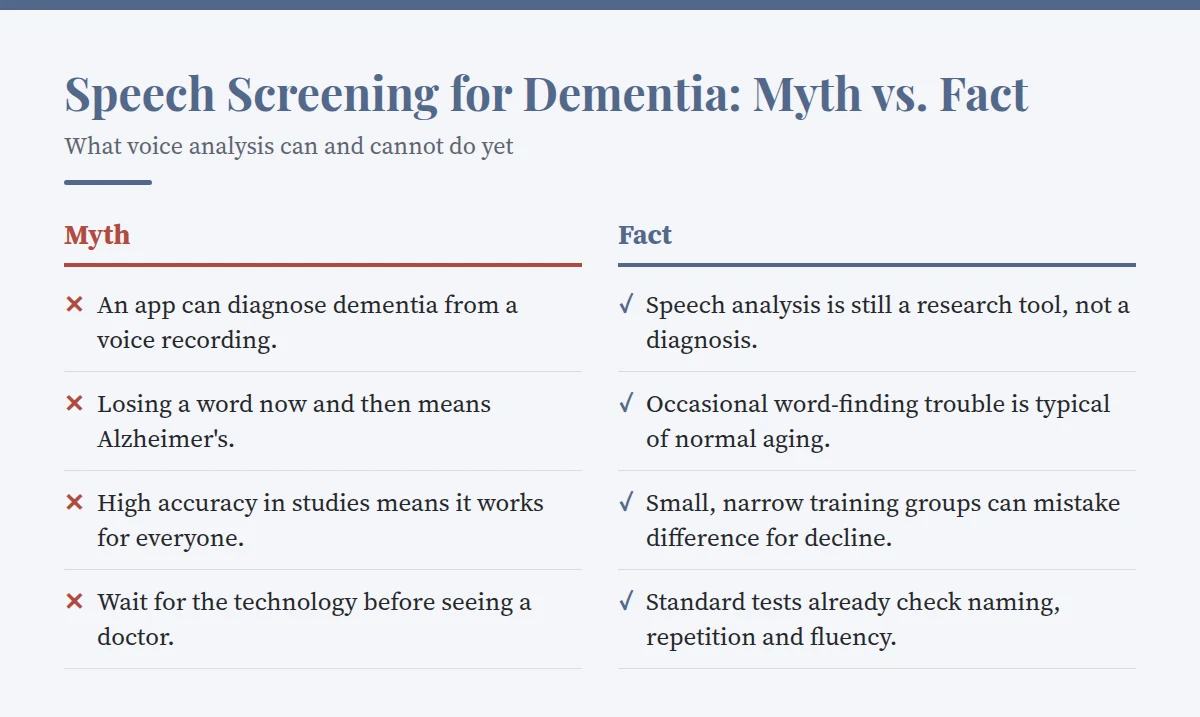
Meanwhile, the headlines keep promising that artificial intelligence can pick up Alzheimer’s from a minute or two of talking. There is serious science underneath those headlines, and some of it is striking. But no speech test is waiting at your mother’s next appointment, and the distance between the research and the exam room is what this guide is about: what these systems actually listen for, why language can shift years before a diagnosis, how accurate the tools really are, who they are most likely to get wrong, and what you can do about word-finding trouble today.
Why Language Can Change Years Before a Diagnosis
Talking looks effortless, but it is one of the most demanding things a brain does. To describe even a simple scene, a person has to pull up the right words, build sentences around them, keep track of what they have already said and hold the point in mind until they get there. Trouble in any of those systems can leak into speech, and language difficulties are often among the early signs of dementia.
The evidence that those changes can surface early comes from some unusual places. In the Nun Study, researchers scored autobiographies that young sisters had written around age 22 for “idea density,” a measure of how many distinct ideas a writer packs into a given number of words. About 58 years later, the women whose youthful writing was low in idea density tended to score lower on cognitive tests. Among the 14 sisters who later died, Alzheimer’s was confirmed at autopsy in every one whose early writing was low in idea density and in none whose writing was high. Fourteen is a tiny number, but the finding has shaped the field for three decades.
Researchers at Arizona State University later analyzed Ronald Reagan’s unscripted press conferences across his presidency. Over time he used fewer unique words and more conversational fillers and vague, non-specific nouns, a trend that did not appear in George H. W. Bush’s press conferences. Reagan was diagnosed with Alzheimer’s in 1994, five years after leaving office. It is a single, very public case, but it shows the kind of slow drift that no one conversation would ever reveal.
The strongest evidence comes from the long-running Framingham Heart Study in Massachusetts. Researchers analyzed written descriptions of a picture that participants had produced while their thinking still tested normal. In a test group of 80 people, language features predicted who would develop Alzheimer’s before age 85 with about 70 percent accuracy, and the diagnosis came an average of about seven and a half years after the writing sample.
None of this means every lost word is a warning. The Alzheimer’s Association draws the line clearly: sometimes having trouble finding the right word is a typical age-related change. New problems with words are the warning sign, such as stopping mid-conversation with no idea how to continue, struggling to name a familiar object, or calling a watch a “hand-clock.” A study from Baycrest and the University of Toronto of 125 healthy adults aged 18 to 85 found that the best predictor of everyday word-finding blanks was simply how quickly a person retrieved words in general, which suggests much of the normal-aging version comes down to speed. So the question is not whether your mother ever loses a word. It is whether the pattern is new, getting more frequent and starting to get in the way.
What the Software Actually Listens For
Much of this research starts with the same task. A person looks at the “Cookie Theft” picture from the Boston Diagnostic Aphasia Examination, a line drawing of a kitchen in which a boy on a stool reaches into a cookie jar with a girl nearby, and their mother dries dishes while the sink runs over, and describes everything they see. Software then works through the recording and the transcript at four levels.
Sound. How long the pauses are and where they fall, how fast the person talks, and the rhythm and melody of the voice.
Words. How varied the vocabulary is, and whether precise nouns are giving way to pronouns, fillers and vague stand-ins. A team at Massachusetts General Hospital has reported that in both English and Persian, people with Alzheimer’s used more pronouns, more common words and shorter sentences when describing a picture.
Sentences. Whether sentences are getting shorter and simpler, with fewer clauses hanging off them.
Meaning. Whether each sentence adds information and connects to what came before. In a 2024 analysis of Cookie Theft descriptions, people with probable Alzheimer’s used fewer of the picture’s core words and took longer to reach them. Half of the participants without dementia or with mild cognitive impairment mentioned the overflowing water within about 30 seconds. By about 100 seconds, only 30 percent of the Alzheimer’s group had.
One recent study shows where the meaning layer is heading. Two researchers in India, publishing in 2024 in the International Journal of Language & Communication Disorders, fed transcripts of picture descriptions into transformer language models, the same basic architecture behind today’s AI chatbots, and measured how closely each sentence related to the ones around it. Their premise is that relevance, whether each new sentence actually belongs with the last, reflects how well memory is holding the thread. Tested on the Pitt Corpus, a collection of recorded descriptions from people with and without dementia, their chosen model captured that context better than comparable models did.
How Accurate Are These Tools, Really?
Impressive in the lab. Unproven in your kitchen.
Boston University researchers took recordings of neuropsychological test sessions from 166 Framingham participants with mild cognitive impairment, converted them to text with automatic speech recognition, and analyzed the text with language models alongside age, sex and education. The best model predicted who would progress to Alzheimer’s within six years with 78.5 percent accuracy. It caught 81 percent of the people who did progress, which also means it missed nearly one in five.
A 2026 study of 1,003 older adults at the University of Zurich trained a model to flag people whose scores fell below normal on standard cognitive tests. Its best result was an AUC of 0.81, on a scale where 0.5 is a coin flip and 1.0 is perfect. The authors see it as useful for screening large groups and choosing volunteers for clinical trials, but that leaves real room for error with any single person.
The most telling comparison comes from the Massachusetts General group, working with people with early-onset cognitive impairment. On people its model had never seen, the speech analysis scored 0.945. A model built on nothing but each person’s score on the Montreal Cognitive Assessment (MoCA), the 10-minute paper screening test many doctors already use, scored 0.920. The AI edged ahead, but the test that already exists came remarkably close.
Two more cautions sit behind every number. First, most studies compare people who already have a diagnosis with healthy volunteers, which is far easier than catching the first faint change in one person. Second, much of the field has been built on the same aging recordings. The Pitt Corpus comes from a University of Pittsburgh study that enrolled a few hundred people between 1983 and 1988, and it has been used in more than 300 scientific publications. A 2020 systematic review of 51 studies found promising results in nearly all of them but very few tools in clinical research or practice. Even the 2024 study above notes that these algorithms still need validating on larger, more diverse datasets, with their potential biases addressed.
Who These Tools Are Most Likely to Get Wrong
A speech model learns what normal sounds like from the people in its training data. When your loved one does not sound like those people, the model can mistake difference for decline. The Massachusetts General team wrote that its own markers still need testing in larger groups with wider age ranges and socioeconomic backgrounds, and in languages other than English.
The trouble can start before any analysis happens. Many speech tools begin by turning audio into text with automatic speech recognition, the same kind of technology inside phone assistants. A 2020 study of five leading commercial systems found they made nearly twice as many errors transcribing Black speakers as white speakers, an average word error rate of 35 percent against 19 percent. A transcript that is wrong before the analysis begins passes its mistakes straight into the result.
Then there are all the ordinary reasons a person can sound different:
- Hearing loss. Someone who mishears a question gives an odd answer. Hearing impairment is common in older adults and distorts cognitive tests that depend on good hearing, which is why researchers built a version of the MoCA that gives its instructions in writing.
- Other conditions. A 2025 study in the Czech Republic found that mild cognitive impairment from Alzheimer’s, from Lewy body disease and from Parkinson’s each left its own speech pattern. The Parkinson’s group used shorter sentences and longer pauses, and the Lewy body group repeated words more than the Alzheimer’s group did.
- Depression. It can leave a person feeling slowed down and struggling to concentrate or remember, which is much of what a speech algorithm measures.
- A second language or a lifelong style. Someone speaking English as a second language, or someone who has always talked plainly and briefly, may fall outside a model’s idea of normal for reasons that have nothing to do with disease.
The one thing never to wait on: sudden change. Sudden trouble speaking or understanding speech, with or without a drooping face or a weak arm, is a stroke warning sign. Call 911 right away and note the time the symptoms started.
Researchers know about these gaps. A study called SpeechDx, run by the Alzheimer’s Drug Discovery Foundation’s Diagnostics Accelerator, follows 2,650 participants who speak English, Spanish or Catalan. Each gets neuropsychological testing, an MRI and a blood test for amyloid, so that speech can be matched against confirmed biology in a large and varied group.
What Is Available at a Doctor’s Office Today
Automated speech analysis is, for now, a research tool. Its most likely near-term uses are in studies and in choosing volunteers for drug trials, not in a standard dementia workup, and no family should put off an evaluation waiting for it.
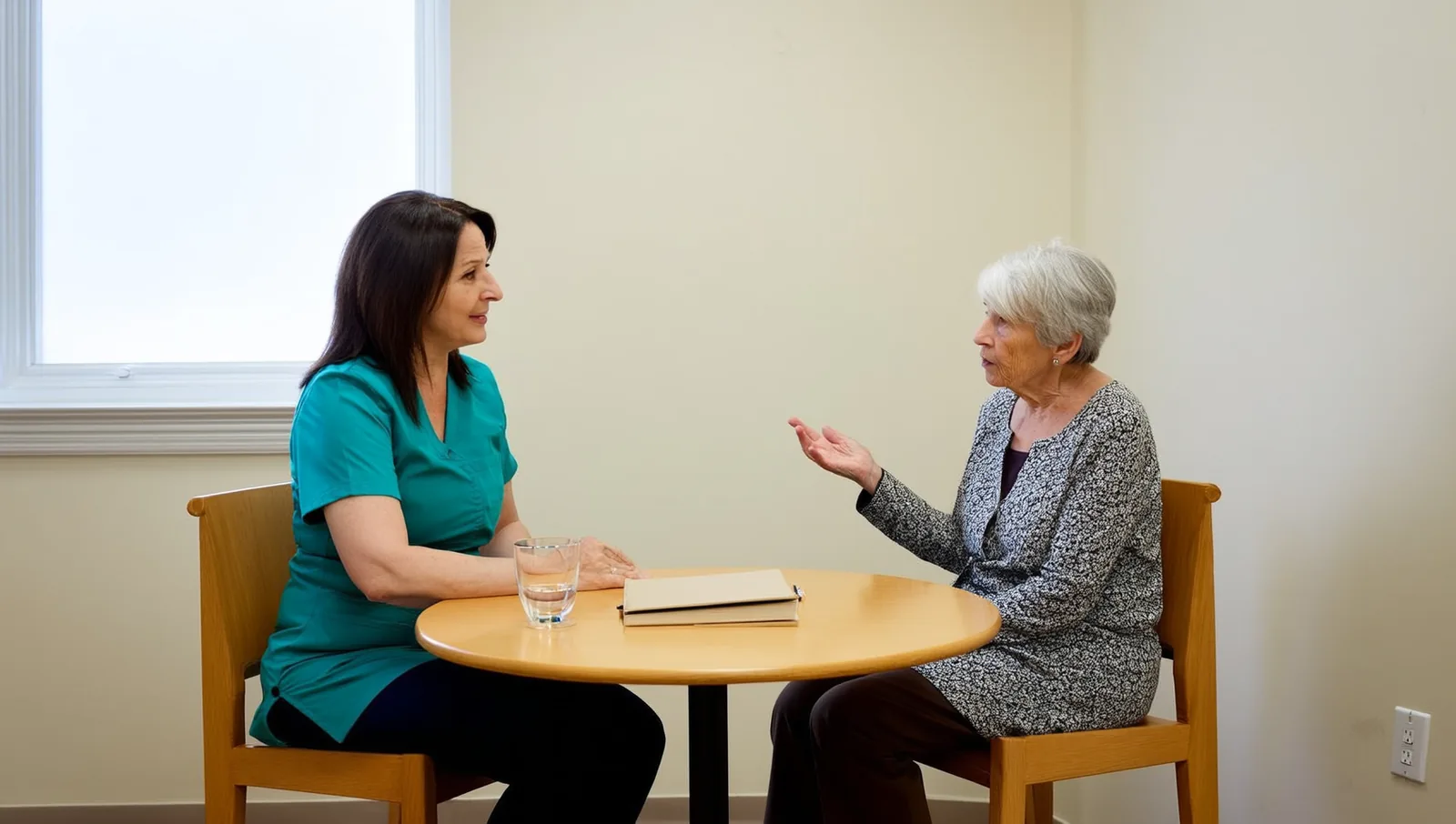
What your loved one can get today is language testing scored by trained people. The MoCA already asks for speech: naming animals from drawings, repeating sentences back and producing as many words as possible in response to a prompt. A full neuropsychological evaluation goes much deeper. A speech-language pathologist can assess communication specifically, and the American Speech-Language-Hearing Association describes that assessment as culturally and linguistically relevant, an adjustment a model trained on other people’s speech cannot easily make. Speech-language pathologists also treat the communication problems that come with dementia, so the visit can leave a family with strategies as well as scores.
If language is the first and biggest change, especially in someone under 65, ask directly about primary progressive aphasia. The National Institute on Aging describes it as a change in the ability to speak, read, write and understand what others are saying, while problems with memory, reasoning and judgment are not apparent at first. It belongs to the frontotemporal family of disorders, which tend to start younger than other dementias, although people with one form, logopenic PPA, may also have the amyloid plaques associated with Alzheimer’s. Our guide to the types of dementia explains how frontotemporal dementia differs from Alzheimer’s, and a neurologist is the right specialist to sort it out.
Blood tests, AI-read brain scans and tablet-based memory tests are further along than speech analysis, and several are in clinics now. Our overview of how AI is changing dementia diagnosis covers which of those you can ask for this year.
How to Bring Language Changes to the Doctor
You do not need an app to make word-finding trouble visible. You need specifics.
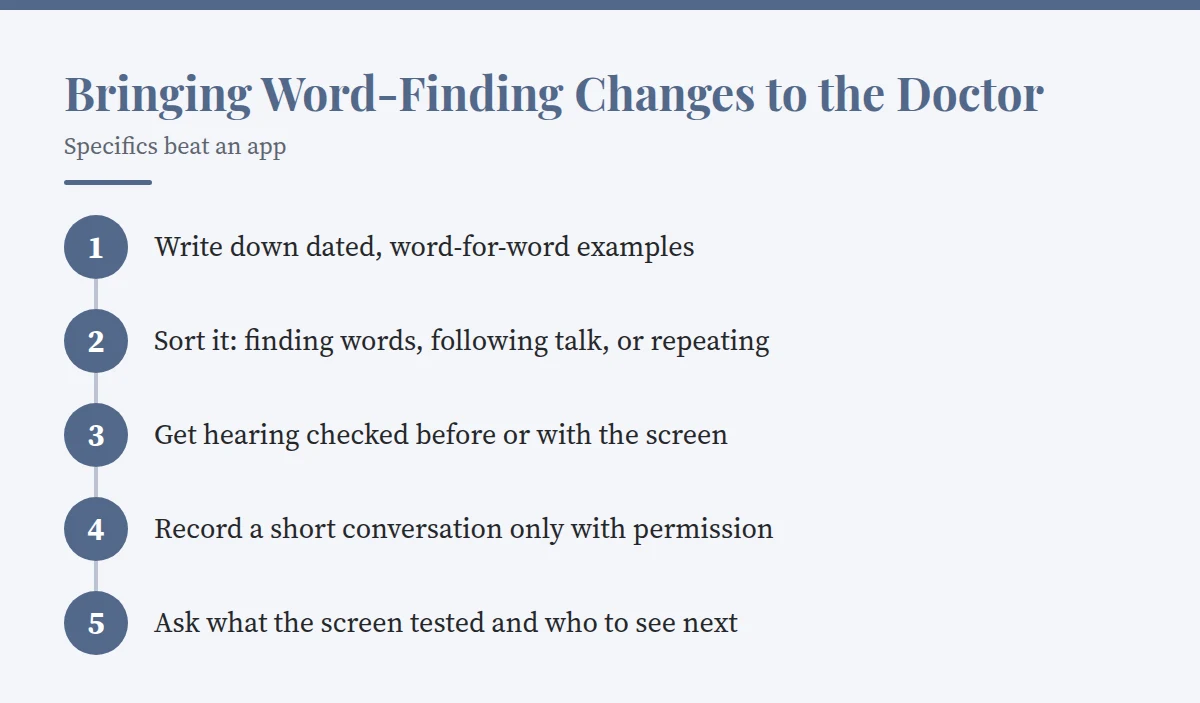
Write down the actual words. Not “she’s having trouble with words,” but “Called the remote ‘the TV changer thing,’ May 3” or “Lost the thread of her own story three times at Sunday dinner.” Dated, word-for-word examples are much harder to wave off as normal aging. If you have not yet raised your concerns with your loved one, our guide to starting the conversation about memory loss walks through how.
Sort what you are seeing. Reaching for a word she clearly knows is different from not following what others say, which is different again from telling the same story twice in an hour. Each points a clinician in a different direction, and trouble following a conversation sometimes turns out to be trouble hearing it.
Get hearing checked. A hearing test before or alongside a cognitive screen keeps hearing loss from being scored as memory loss. Our piece on how dementia changes the senses covers why hearing and vision matter so much.
Consider a short recording, with permission. Two minutes of ordinary conversation on a phone can show a clinician what a list cannot. Ask first, explain why, and keep it private. A secret recording spends trust you will need later.
Ask pointed questions at the appointment.
- Did today’s screening include language tasks, and how did she do on them?
- Could hearing, mood, sleep or a medication explain this?
- Would a neuropsychological evaluation or a speech-language pathologist help?
- If language is the main change, could this be primary progressive aphasia, and should we see a neurologist?
If the answer turns out to be mild cognitive impairment, our family guide to MCI explains what that label does and does not mean.
Be wary of any app that promises a verdict. Before uploading a parent’s voice anywhere, ask who analyzes it, who keeps the recording, whether the tool was tested on people who talk like your parent, and who will explain a worrying result. A risk score with no clinician attached is not a diagnosis.
The Alzheimer’s Association’s free 24/7 Helpline (800.272.3900) can help you find a memory clinic or specialist near you. And if a diagnosis leads to decisions about care, bring in a geriatric care manager or social worker who knows the local options.
What This Comes Down To
Speech may well become a routine vital sign for the brain. It is cheap, it needs no needle or scanner, and it can be sampled as often as a person talks. The Massachusetts General team imagines screening in primary care that works much like a routine vital sign check. The research is real, and the next few years will probably bring tools an ordinary clinic can use.
For now, though, the most sensitive speech detector available is the person who knows how your mother used to talk: the family member who noticed the stalls, wrote them down and asked for a proper evaluation. Nothing in this article is a diagnosis, and no speech tool is one either. Only a neurologist or geriatrician can tell you what is happening to a specific person. Your part is to get them good evidence, sooner.
Further reading (sources)
- Rini and Gayathri on scoring sentence relevance in speech with transformer models
- Snowdon and colleagues for the Nun Study’s link between early writing and late-life Alzheimer’s
- Berisha and colleagues with the press conference analysis of Presidents Reagan and Bush
- Eyigoz and colleagues on predicting Alzheimer’s onset from written picture descriptions
- Alzheimer’s Association for the 10 warning signs and what counts as typical aging
- Wei and colleagues on why word-finding blanks become more common with age
- Fromm and colleagues with how people with and without dementia describe the Cookie Theft picture
- Rezaii and colleagues for voice analysis in early-onset cognitive impairment, measured against the MoCA
- Amini and colleagues on predicting progression from mild cognitive impairment with Framingham recordings
- Heitz and colleagues with speech as a stand-in for cognitive testing in 1,003 older adults
- Becker and colleagues for the Pittsburgh study cohort behind the Pitt Corpus
- de la Fuente Garcia and colleagues on a systematic review of AI and speech approaches to Alzheimer’s
- Koenecke and colleagues with racial disparities in automated speech recognition
- Dawes and colleagues for adapting the MoCA for people with hearing loss
- Kovac and colleagues on how speech differs across Alzheimer’s, Lewy body and Parkinson’s MCI
- National Institute of Mental Health for the symptoms of depression
- CDC with the signs of stroke and when to call 911
- Alzheimer’s Drug Discovery Foundation on the SpeechDx study and its multilingual dataset
- Nasreddine and colleagues for the original validation of the MoCA
- Cecato and colleagues with which MoCA subtests separate normal aging from MCI
- American Speech-Language-Hearing Association on the speech-language pathologist’s role in dementia
- National Institute on Aging for primary progressive aphasia and other frontotemporal disorders