44 Percent of Assisted Living Residents Now Have Dementia: What Families Should Demand When Memory Care Isn't an Option
Published on June 10, 2026
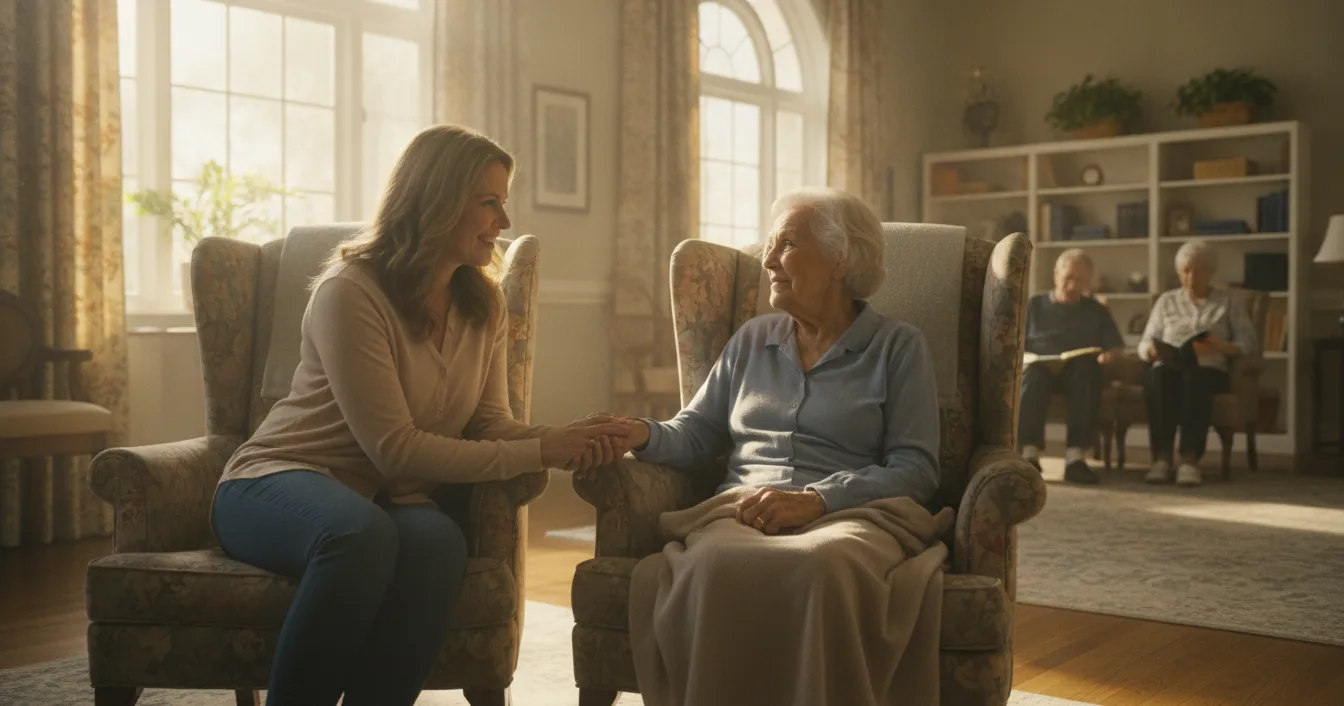
If you have just learned that your mother’s assisted living community is not a memory care unit, yet she is showing clear signs of dementia, you are facing one of the most confusing situations in senior care. You want her to be safe and well cared for, but the building she lives in was not designed around her memory loss, and a dedicated memory care unit may be full, unaffordable, or simply more than she needs right now. You are not alone in this. The numbers show that families across the country are quietly navigating the same gap.
What the 44 Percent Number Really Means
In May 2026, a wave of industry reporting put a striking figure in front of families: 44 percent of assisted living residents now live with Alzheimer’s or another form of dementia. The number comes from an AARP analysis of federal long-term care data, and it slightly exceeds the 41 percent of nursing home residents who carry the same diagnoses.
What makes this notable is the direction of the trend. A decade earlier, nursing homes were where most people with dementia lived. Between 2012 and 2022, the share of nursing home residents with dementia fell from 49 percent to 41 percent, while assisted living climbed from 40 percent to 44 percent. At the same time, the population of adults aged 85 and older living in assisted living jumped from roughly 408,000 in 2020 to 522,000 in 2022, a 28 percent rise in just two years.
As one widely shared industry headline put it, dementia care is no longer a memory care problem. Standard assisted living staff are increasingly caring for residents with significant cognitive decline, often without the specialized training that a licensed memory care unit would require. For families, that means the label on the building tells you far less than you might assume about whether your loved one will actually be safe.
Why a Dedicated Memory Care Unit Is Not Always an Option
It would be easy to say that anyone with dementia belongs in memory care. In practice, that door is not always open. Cost is the most common barrier. The median price of assisted living reached about $70,800 per year in 2024, and a dedicated memory care unit typically runs higher, often $7,000 to $8,000 a month. Set that against the reality that the average household income for adults aged 75 and up is around $47,790, and the math collapses for a great many families.
Beyond cost, memory care beds are genuinely scarce in many regions, with waiting lists that stretch for months. Sometimes the obstacle is more human than logistical: a parent is settled, has friends, and is in the early stages where a full secured unit would feel like a loss of freedom rather than a gain in safety. For all of these reasons, dementia care frequently happens inside general assisted living, whether the family planned it that way or not. Because the financial stakes are so high, this is a good moment to involve a certified financial planner or an elder law attorney who can map out long-term care insurance, Medicaid eligibility, and asset protection before you commit.
The Licensing Gap Between Assisted Living and Memory Care
Here is the part most families never hear on a tour. In most states, “memory care” is not a separate kind of building. It is a special license, endorsement, or designation layered on top of an assisted living license, and it carries extra obligations: a minimum number of dementia training hours for staff, a secured physical environment, and sometimes higher staffing requirements. General assisted living, which was built around the idea of independent residents who need only light help, often carries none of those dementia-specific mandates.
The result is a regulatory patchwork that varies enormously from one state to the next. Two communities can both call themselves assisted living while offering wildly different levels of dementia competence. The author of the AARP report warned that until federal action makes assisted living more reliable and transparent, states must step up as regulators “or face the reality of substandard care for older adults.” Until that oversight catches up, the burden of asking hard questions falls on you. It helps to understand the distinctions between assisted living, memory care, and skilled nursing, and to know the specific type of dementia your loved one has, because the answers change what a community needs to provide.
What to Demand: Dementia-Trained Staff and Honest Ratios
The single most important question is not about the chandelier in the lobby. It is about who will be in the room with your loved one at 3 a.m. Ask whether every direct-care worker, not only the nurses, receives ongoing dementia-specific training, and ask for the number of hours and how often it is refreshed. Strong programs name the frameworks they use, such as Teepa Snow’s Positive Approach to Care or Montessori-based methods for dementia, and they can describe how staff are taught to de-escalate agitation and read nonverbal cues.
Then press on staffing ratios, and ask for them shift by shift. A community may sound well staffed at 10 a.m. and be dangerously thin overnight, which is exactly when wandering and sundowning peak. Ask how many residents each caregiver covers on nights and weekends, and whether the same caregivers are assigned to the same residents. Consistency matters more than almost anything in dementia care, because a familiar face lowers fear. These are the same standards you would apply when touring a dedicated memory care community, and there is no reason to hold a general assisted living setting to a lower bar.
What to Demand: Safety, Supervision, and Restraint-Free Care
General assisted living buildings are usually open-access by design, which is the opposite of what a person prone to wandering needs. Ask directly how the community prevents and responds to elopement, whether any wing can be secured, what monitoring or wearable technology is used, and what the protocol is when a resident is found at an exit. If the honest answer is that nothing stops a resident from walking out the front door, that is critical information for your decision, not a detail to gloss over.
Behavior is the other safety frontier. When staff lack dementia training, the temptation is to manage distress with medication. Federal data has long shown that close to 40 percent of nursing home residents with dementia were given antipsychotic drugs, a figure regulators have worked to bring down because these medications carry serious risks for older adults. Ask how the community handles agitation, aggression, and resistance to care without reaching first for a sedative. The best answer involves trained redirection and calm communication rather than a prescription. If you want to recognize good practice when you see it, our guide to communicating with a loved one who has dementia describes the techniques skilled staff should already be using.
What to Demand: Engagement and a Plan for Rising Needs
A person with dementia who sits in front of a television all day will decline faster and suffer more. Ask to see a real activity calendar and look for programming matched to cognitive ability, not one-size-fits-all bingo. Music, art, gentle movement, and reminiscence are not frills; they are clinical-grade tools for protecting mood and reducing difficult behavior. Our overview of meaningful activities for people living with dementia gives you a concrete sense of what genuine engagement looks like so you can tell substance from a brochure.

Finally, ask what happens as the disease progresses. Get a clear answer, in writing, about the point at which the community can no longer meet your loved one’s needs and what the transition would look like. A reputable operator will tell you honestly where its limits are rather than promising to handle anything. Knowing the exit ramp in advance spares you a crisis transfer later.
How to Judge Whether the Setting Can Truly Keep Your Loved One Safe
Match the community’s real capacity to your loved one’s real needs. Someone in early-stage dementia who is socially engaged and not exit-seeking may thrive in a supportive general assisted living community with strong training. Someone who wanders, leaves the stove on, or becomes frightened in open spaces likely needs the secured environment and tighter supervision that only a memory care unit reliably provides. This is not a judgment you should make alone or under pressure from an admissions director.
Bring in a geriatric care manager or a hospital or community social worker to assess the fit objectively. These professionals know the local landscape, can read a community’s track record and inspection history, and have no financial stake in where your loved one lands. For any clinical question about staging or symptoms, lean on a geriatrician or neurologist rather than guessing. The placement decision is yours, but it should rest on expert eyes.
You Are the Advocate
The 44 percent figure is, at bottom, a warning and a call to action. Dementia has moved into general assisted living faster than training, staffing, and regulation have kept up, and the gap is real. You cannot fix the system, but you can refuse to accept vague reassurances about your own family member. Ask the hard questions, demand specifics, write down the answers, and lean on professionals who work for you rather than the building. When memory care is not an option, informed advocacy is the next best protection your loved one has.
Further reading (sources)
- Senior Housing News reporting that 44 percent of assisted living residents now live with Alzheimer’s or dementia
- McKnight’s Long-Term Care News on why dementia care is no longer only a memory care problem
- LUXUO with why Alzheimer’s care calls for a specialized assisted living setting
- AARP Public Policy Institute for its analysis of assisted living’s growing care role
- Genworth on the latest national cost of long-term care
- Alzheimer’s Association covering the scale of Alzheimer’s in America