Recognizing and Reporting Abuse of a Loved One With Dementia
Published on September 23, 2026
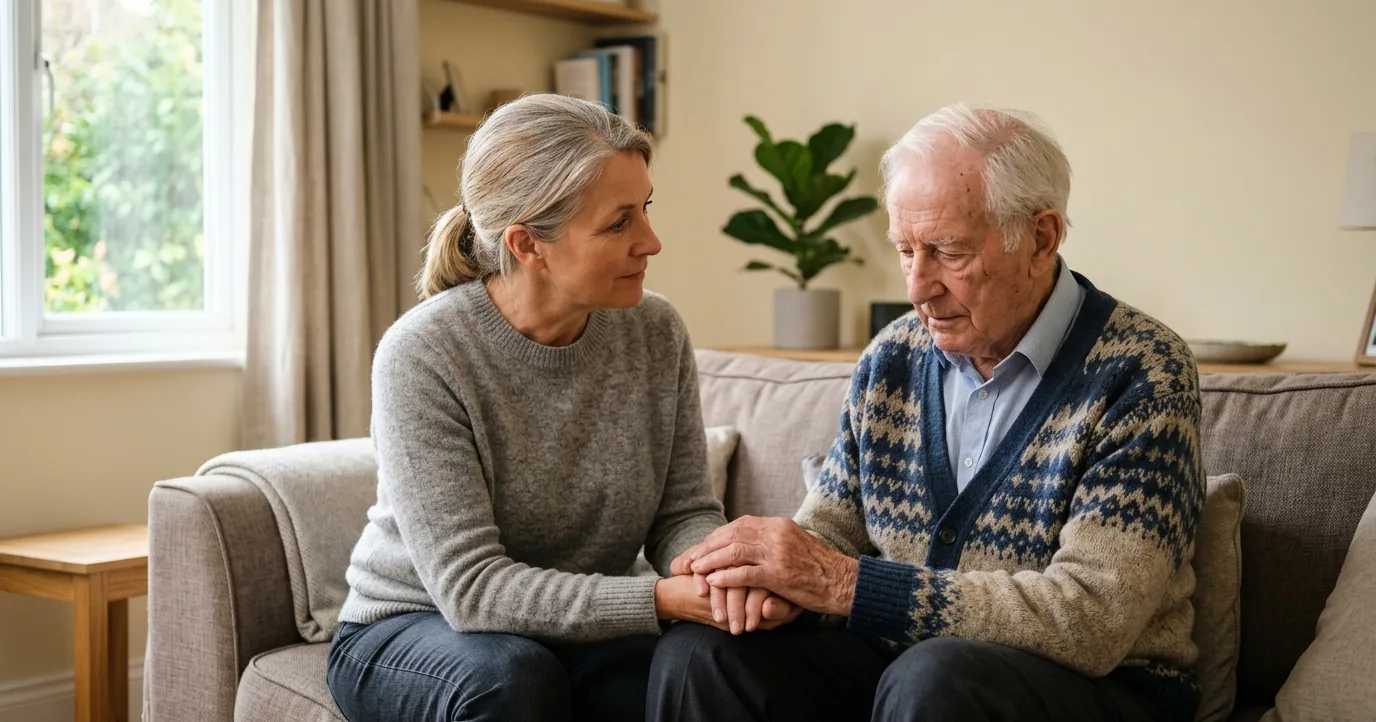
The bruise is on the outside of your father’s upper arm, dark and roughly the size of a palm. He cannot tell you how it got there. The aide says he caught the doorframe on the way to lunch, and maybe he did. People with dementia fall, bruise easily and forget. That is exactly the problem. The disease that makes a person vulnerable to abuse also takes away the ability to report it, and sometimes to recognize it at all, which leaves the noticing to you.
This guide covers abuse and neglect by the people trusted with care, at home and in care communities: what it looks like when the victim cannot describe it, how to tell it apart from the disease, and exactly who to call. Financial exploitation has a guide of its own, so here it gets only a paragraph.
Why Dementia Hides Abuse So Well
Abuse can happen anywhere, at home or in a care setting, and the Alzheimer’s Association is plain about why dementia raises the stakes: the disease may keep a person from reporting abuse, or even from recognizing it. The National Center on Elder Abuse fills in the rest. People with dementia may fear the caregivers they depend on for everything, may be too embarrassed to disclose harm inside the family, and in later stages may simply have no words for what happened.
The research numbers are hard to read. In one California study of 129 people with dementia living at home with their caregivers, an expert panel found psychological abuse, physical abuse or neglect in 47.3 percent of them. In a British survey of 220 family carers of people newly referred for dementia care, 52 percent admitted some abusive behavior and 34 percent admitted what the researchers counted as important levels of it, mostly verbal. Only three admitted physical abuse, though the authors suspected the most abusive carers were the least likely to say so.
Most of these caregivers are not villains. They are worn out, doing a job that grows heavier every month, and the research points to a specific trigger: less the memory loss itself than the behavior that can come with it, like resisting a bath, agitation and aggression. That explains abuse. It does not excuse it, and it does not make it any less your business.
What Each Kind of Abuse Looks Like
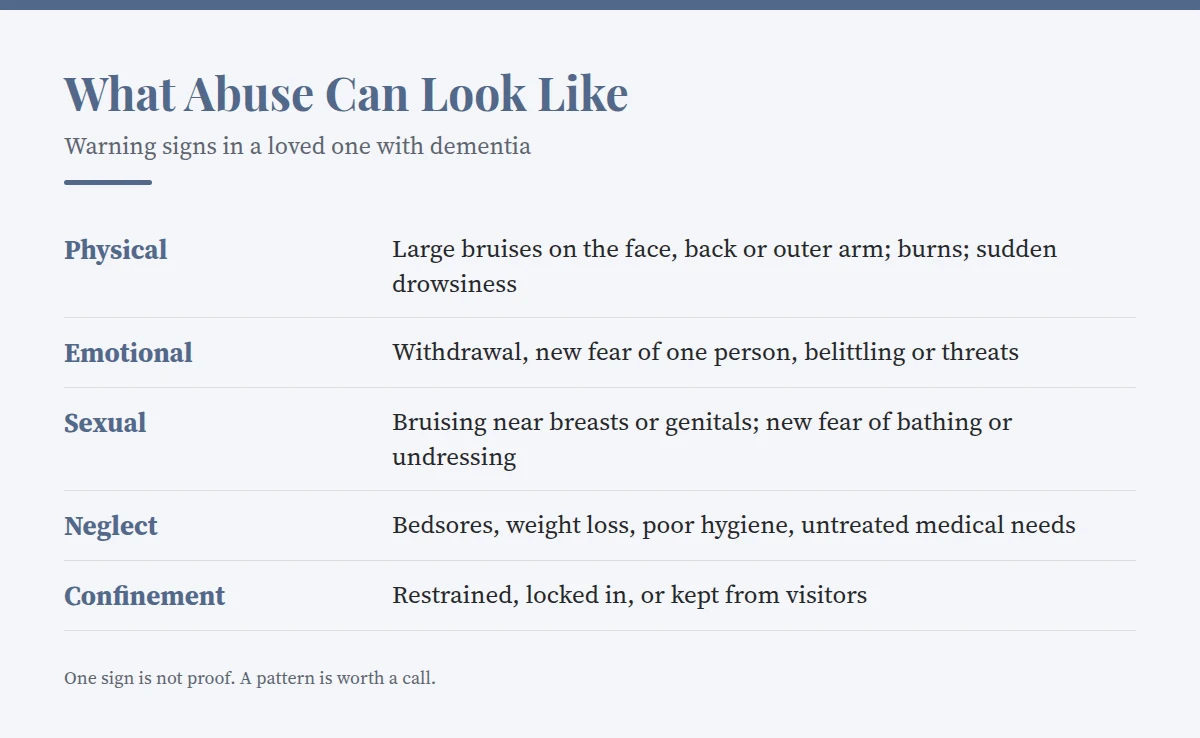
No single sign proves abuse, and the Alzheimer’s Association says so directly. What you are looking for is a pattern, a sudden change, or an explanation that does not fit the injury.
Physical abuse. Bruises, pressure marks, abrasions, burns and broken bones. Where a bruise sits matters more than most families realize. In a study of older adults referred to Adult Protective Services, bruises from abuse were often large, more than 5 centimeters (about 2 inches) across, and abused adults were significantly more likely than older adults who bruised accidentally to have them on the face, the outer side of the right arm, or the back and torso. A bruised shin on someone who shuffles into furniture is ordinary. A hand-sized bruise on the back is a question someone needs to answer.
Watch the medication, too. Withholding needed medicine is abuse, and so is sedating someone to keep them quiet, a practice known as chemical restraint. A person who is suddenly drowsy, glassy-eyed or far more confused may be getting something they do not need, or may have an infection brewing. Either way, they need a doctor that day.
Emotional abuse. Belittling, threats, harassment and intimidation. Because a person with dementia may not remember the words, watch for what they leave behind: withdrawal from things the person used to enjoy, a sudden change in alertness, unexpected depression, or fear that shows up around one particular person. The National Center on Elder Abuse also names a quieter form, communication neglect, which means failing to talk with or relate to a person, sometimes as punishment for being “difficult.” In a care setting it can look like an aide who talks over your mother, or about her, as if she were not in the room.
Sexual abuse. The hardest to imagine and among the least likely to be disclosed. The Alzheimer’s Association defines it as any sexual contact when the person cannot understand, is unwilling, or is threatened or forced, and lists bruising around the breasts or genital area as a warning sign. Research summarized by the National Center on Elder Abuse found that offenders against people with dementia were most often people they knew (family, paid caregivers, fellow residents), and that victims tended to show distress through behavior rather than telling anyone. A new terror of bathing or undressing, or sudden fear of one person, deserves a careful look before anyone files it under sundowning.
Neglect. The failure to provide food, clothing, shelter, medical care or a safe environment. The textbook signs are bedsores, untreated medical problems, poor hygiene and unusual weight loss. In a care community they can look more ordinary: the same soiled clothes two visits running, missing glasses, hearing aids or dentures, a water cup left out of reach, a call light nobody answers.
Confinement. Restraining or isolating the person, whether that means strapping someone into a chair, locking them in a room, or keeping visitors away. Federal nursing home rules forbid physical or chemical restraints used for discipline or staff convenience rather than medical need.
Financial exploitation. Sudden changes in the person’s finances, missing valuables, or a new helper with access to the accounts.
Clinicians have also noticed that the kind of abuse tends to track the stage of the disease. Financial abuse clusters early, while the person still handles money but judgment is slipping. Physical abuse clusters in the middle stage, when resistance to care and behavioral changes are often hardest to manage. Neglect clusters late, when the person can no longer walk, ask or complain. The National Center on Elder Abuse is careful to present this as an observation from practice rather than a proven rule, but it tells you where to aim your attention now.
Is It the Disease, or Is It Abuse?
This is the question that stops families from acting, and it is a fair one. People with dementia do fall. Thin skin and blood thinners bruise at a touch. Weight drops as the disease advances, and a mother who insists that staff stole her purse may have hidden it herself. Pain and perception problems produce agitation that can look a lot like fear.
Four questions help separate the two.
Does the explanation fit the injury? A fall onto a hip explains a bruised hip. It does not explain a large bruise on the back with no fall on record. An injury that nobody can account for at all is a red flag in its own right, and federal auditors count these “injuries of unknown source” among incidents of potential abuse or neglect.
Was the change sudden? Dementia usually moves over months. A sharp change in mood, alertness, weight or behavior over a few days points to something new, whether an infection, a medication or a person.
Is there a pattern? Fear that appears only with one aide, only on one shift, or only after visits from one relative is information. So is a caregiver who will not let you speak with your loved one alone.
What does your loved one say? Take it seriously. In one emergency department study, trained assessors were confident that 81 percent of older patients with cognitive impairment could report abuse, including 7 of 11 with severe impairment. An accusation from someone with dementia is not proof, but it is not noise either.
Then stop trying to settle the question yourself. Deciding whether abuse occurred is the investigator’s job. Yours is to notice, write it down and report it.
At Home: When the Harm Comes From Family
At home, harm most often comes from the person closest to the care, and sometimes that is someone you love. Occasionally it is you.
In a 2020 study, 50 family caregivers who lived with a person with dementia kept a daily diary for three weeks. Abusive or neglectful behavior was most likely on days when the routine fell apart and when the person’s behavioral symptoms drove the caregiver’s stress up. Sharing a meaningful activity twice in a day, something enjoyable rather than a care task, went with much lower odds of neglect that day. Risk rose and fell with the day, which means it can be lowered.

If you have shouted, gripped an arm too hard, or left someone alone longer than was safe, you are not the first caregiver to do it. Treat it as the signal to get help now, not as proof that you are a bad person. Call the Alzheimer’s Association’s 24/7 Helpline at 800-272-3900, line up respite or an adult day program, and look seriously at bringing in paid help before a bad day turns into a dangerous one. Harm can also run the other way. Aggression from the person with dementia can grow as the disease progresses, and a caregiver who is being hit needs help, not silence.
If you suspect another relative, watch for the habits that keep abuse hidden: isolating the person, controlling visits and phone calls, insisting on being present for every conversation, and money moving without explanation. Strained relationships and frequent arguments between a caregiver and the person with dementia are warning signs on their own. You do not need a confession or a photograph to call Adult Protective Services.
In Memory Care or a Nursing Home
Moving into care changes who is involved, not whether abuse can happen. More than half of nursing home residents live with dementia, all of them depend on staff, and residents whose disease brings aggression face higher risk still. Two in three staff in nursing homes and other long-term care facilities report having committed abuse in the past year, according to the World Health Organization, most often psychological abuse. Harm from another resident counts too.
Do not assume the building will report it for you. When federal auditors combed 2016 Medicare emergency room claims for skilled nursing facility residents, they estimated that one in five high-risk ER visits resulted from potential abuse or neglect, and that the facilities failed to tell state survey agencies about 84 percent of those incidents. Most of the facilities that explained themselves said they did not think the incidents qualified.
The rules are strict on paper. A nursing home must report an allegation of abuse, or any incident that causes serious bodily injury, to its administrator and the state survey agency within 2 hours, and other allegations, including injuries of unknown source, within 24 hours. It must investigate, report the results within five working days, and protect the resident from further harm while the investigation runs. Memory care inside assisted living answers to state rules instead, and those vary. In either setting you can ask what the community’s investigation found and whether and when it reported the incident to the state, and you can file your own report whatever the answer.
Visit at different times of day, including evenings and weekends. Learn the names of the aides who do the hands-on work, and notice whether your loved one brightens or tenses when a particular person walks in. If you are thinking about a camera in the room, talk to the ombudsman first, because some states have laws on in-room cameras while others leave it to facility policy, and a roommate’s privacy is part of the question. How openly a community answers all of this tells you a great deal about it.
How to Report It
If anyone is in immediate danger, call 911. A serious injury, an assault or a sexual assault is a police matter first.
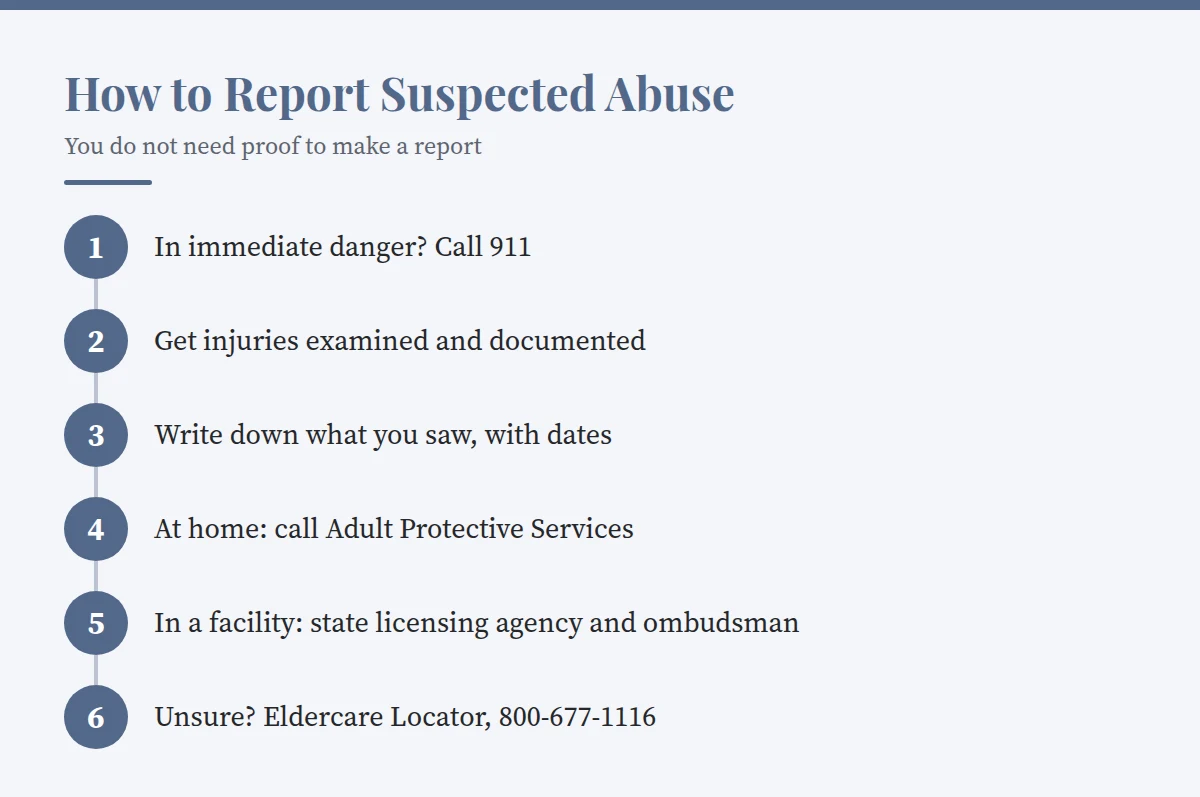
Get the injury examined and documented. Ask the doctor, nurse or emergency department to look at it and record what they find, and take your own dated photos.
Write it down while it is fresh. Note the dates and times, what you saw, and what you were told and by whom, in their words. A written log turns a worry into something an investigator can use.
Call the agency that covers the setting. For someone living at home, that is Adult Protective Services in their state or county, and the National Adult Protective Services Association keeps a state-by-state list of reporting lines and online forms. For someone in a nursing home, assisted living or memory care community, report to the state licensing or survey agency, and to APS in states where it covers facilities. Tell the long-term care ombudsman as well: the ombudsman advocates for your loved one, while the licensing agency and APS investigate. If you are not sure who covers what, the Eldercare Locator (800-677-1116) or the Alzheimer’s Association Helpline (800-272-3900) will route you.
Report what you saw, not what you have concluded. Give the person’s name and where they live, the diagnosis and how it affects their ability to speak for themselves, what you observed and when, who you are worried about, and whether they are in danger right now.
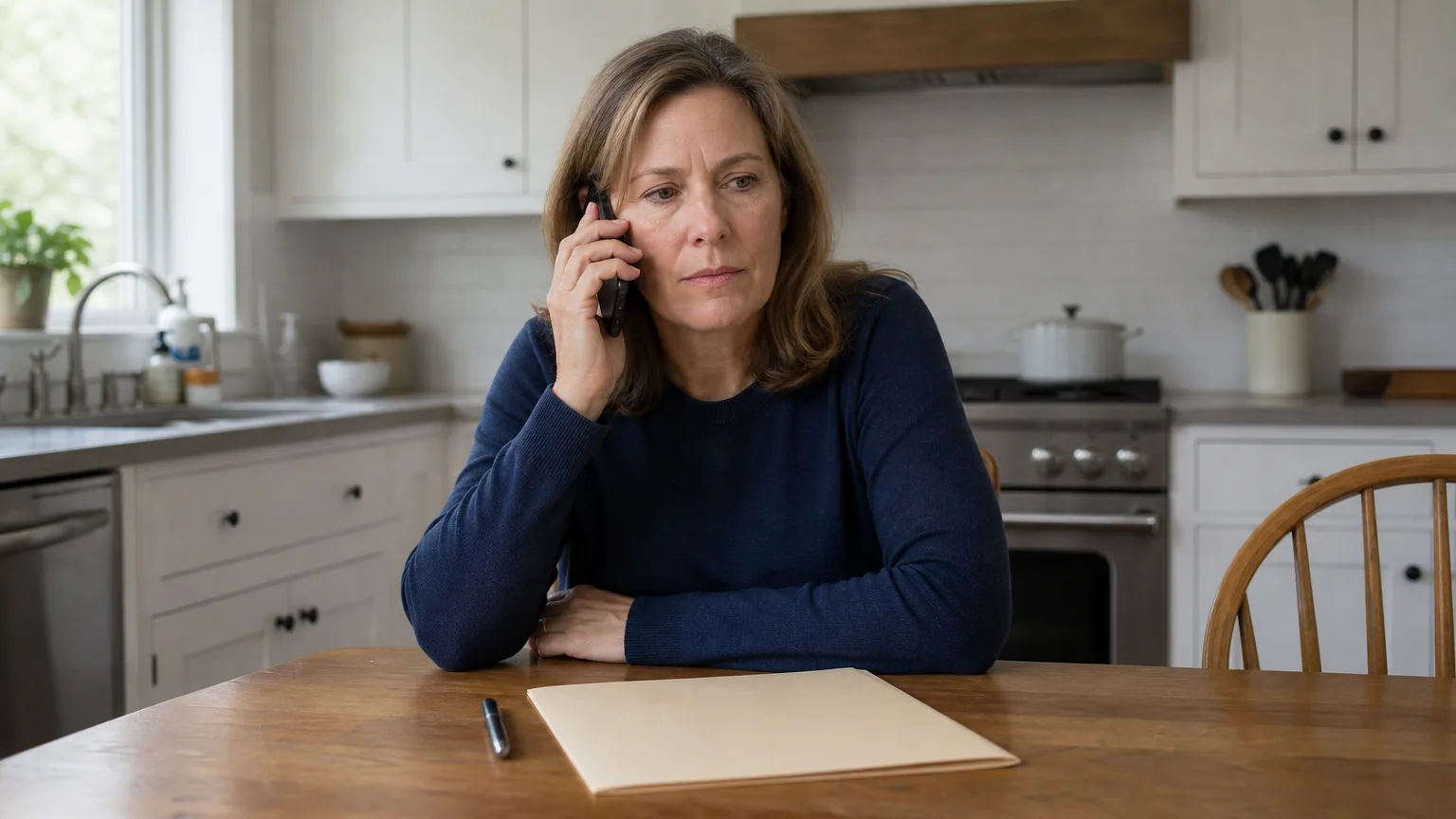
You do not need proof. The Alzheimer’s Association and the National Center on Elder Abuse both say so plainly: investigating is the professionals’ job. Reports to APS are confidential, and federal rules require states to protect the privacy of the adult, the reporter and the report itself. Reporting is also getting easier. A federal rule finalized in 2024 requires every state APS program to accept reports around the clock, by more than one method including at least one online, with full compliance due by May 2028.
After the Call
An investigator will usually visit and talk with your loved one, the caregivers and often you. Two things tend to surprise families. APS practice is person-directed, so an adult who still has decision-making capacity can turn down help, and investigators look for the least restrictive option that keeps the person safe. And because those privacy rules cover the whole case, you may learn less about the outcome than you would like.
Keep the person safe while it runs. At home, that may mean respite care, another relative stepping in, or a short stay somewhere else. In a care community, ask in writing for a care plan meeting and for the staff member involved to be kept away from your loved one while the investigation is open, then keep visiting. If the community stalls or turns cold toward you, that tells you something about whether your loved one should stay. For questions about liability, damages, or an arbitration clause signed at admission, talk to an elder law attorney, and bring in a geriatric care manager or social worker if a move is on the table.
The Call That Costs Little
Families hold back because they are afraid of being wrong, of blowing up a relationship with a sibling or a care team, or of retaliation against the person they are trying to protect. Those fears are real. But weigh what each mistake costs. A report that turns out to be unfounded costs an awkward conversation and an investigator’s afternoon. A report that never gets made can cost months of harm your loved one cannot describe to anyone but you.
Your loved one may not be able to tell anyone what is happening. You can.
Further reading (sources)
- Alzheimer’s Association on the forms of abuse, the warning signs and where to call
- National Center on Elder Abuse with its research brief on mistreatment of people with dementia
- National Center on Elder Abuse for where to report abuse at home and in facilities
- Wiglesworth and colleagues (2010) on how often mistreatment turned up in 129 dementia households
- Cooper and colleagues with a survey of abusive behavior by family carers
- Wiglesworth and colleagues (2009) on where bruises from physical abuse tend to appear
- Pickering and colleagues for the daily diary study of caregiver abuse and neglect
- Richmond and colleagues on whether older adults with cognitive impairment can report abuse
- World Health Organization with its fact sheet on abuse of older people
- HHS Office of Inspector General on unreported abuse and neglect in skilled nursing facilities
- Legal Information Institute for the federal nursing home rule on abuse, restraints and reporting deadlines
- National Adult Protective Services Association with APS reporting contacts for every state
- Administration for Community Living on the 2024 federal rule for Adult Protective Services
- Legal Information Institute for the APS rule on round-the-clock reporting and confidentiality