The Caregiving Reflexes That Backfire: What Not to Do When Someone Has Dementia
Published on October 4, 2026

Your father asks when his mother is coming to take him home. She died in 1987. You tell him gently, and you watch him take in the news as if for the first time, because for him it is. Twenty minutes later he asks again.
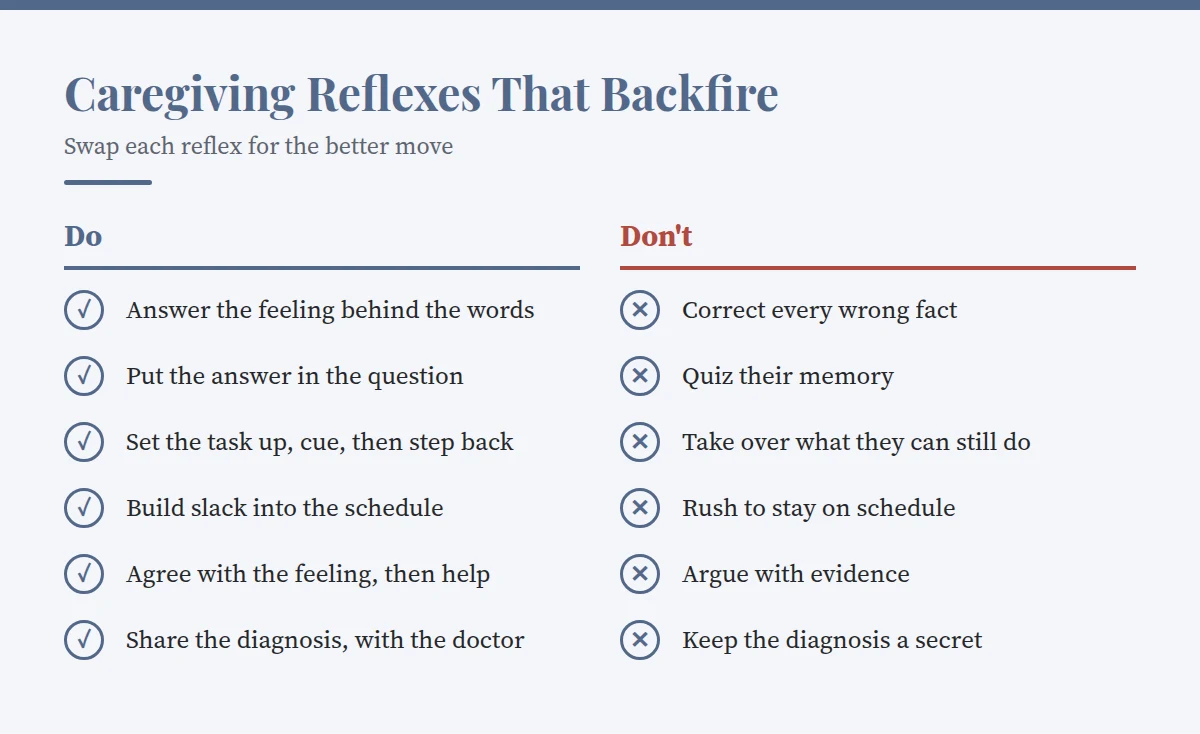
Most of what goes wrong in dementia care starts as something that would be right with anyone else. Correcting a mistake. Testing a memory to keep it sharp. Doing a hard task for someone you love. Hurrying to keep the day on schedule. Settling a disagreement with the facts. Sparing a parent frightening news. Aimed at a healthy brain, every one of those is good care. Dementia changes the brain they land on, and each one starts to do the opposite of what you meant.
This guide takes the six most common of those reflexes one at a time: why each backfires, the brain change behind it, and what to do instead. It is written as a list of things not to do on purpose. In the middle of a hard moment, “don’t argue” comes to mind faster than a five-step technique.
The Finding Behind Every Item on This List
In 2014, researchers at the University of Iowa showed 17 people with Alzheimer’s disease film clips chosen to make them feel sad or happy, alongside 17 healthy people matched for age, sex and education. When tested shortly afterward, the patients’ memory for the films was severely impaired. Their feelings were not. The sadness in particular lasted more than 30 minutes, even in patients with no conscious recollection of what they had watched.
That pattern runs under everything that follows. Alzheimer’s typically damages the hippocampus early, and the hippocampus is what the brain uses to turn experience into lasting memory, so the facts of an exchange fade fast. The feeling it left behind does not. Your correction will not stick, but the sting of it may. The argument will be forgotten while the bad mood stays. As the Iowa team concluded, what caregivers do has consequences even when the person does not appear to remember it.
Most of the research below comes from Alzheimer’s, the most common cause of dementia.
Reflex 1: Correcting Every Wrong Fact
She says it is 1974. He asks for a mother who died decades ago. She insists this is not her house. The reflex is to set the record straight, kindly and clearly, because letting a mistake stand can feel like leaving someone alone in their confusion.
There is a professional version of this instinct. In its classroom form, reality orientation means scheduled group sessions that walk people through the date, the place and the news, and that structured version has some evidence behind it: a review of six small randomized trials found benefits for both thinking and behavior. Its modern relative, cognitive stimulation, offers a range of enjoyable activities for thinking and memory, usually in a small group, and is recommended in guidelines. Neither involves contradicting someone at the kitchen table every time they get something wrong.
That running correction is what backfires. A correction is new information, and new information is exactly what a damaged hippocampus struggles to keep. So you are not teaching your father that his mother died. You are telling him again, for the first time, and handing him the grief along with the fact. The Iowa findings suggest the sadness can outlast the conversation by half an hour or more. The Alzheimer’s Association’s guidance is direct: avoid criticizing or correcting, and listen for the meaning in what the person says instead.

The better move: answer the feeling, not the fact. A man asking for his mother is often asking for comfort or safety. “You miss your mom. Tell me about her” meets that need without a death announcement. Our guide to communicating with a loved one who has dementia covers this approach in depth.
Does that mean you should lie? A UK inquiry into truth and lying in dementia care, run by the Mental Health Foundation with a panel that included people living with dementia, lays the options out along a line: telling the whole truth, looking for the meaning behind what was said, distracting, going along with the person’s reality, and lying. Start as close to the whole truth as you can, and move along the line only when the truth is causing distress that serves no purpose. Outright lies, the panel concluded, belong only in extreme circumstances, to prevent physical or psychological harm. It also cautioned that a rigid “never lie” rule may not help in practice.
Reflex 2: Quizzing Their Memory
“Do you know who I am?” “What did you have for lunch?” “Who’s this in the picture, Mom?” Families quiz for two reasons: to check how bad things are, and in the hope that exercising memory will keep it in shape.
Both backfire. A quiz turns a visit into an exam the person already suspects they are failing, and the embarrassment, like the sadness in the Iowa study, can linger after the question is gone.
There is a subtler cost, too. Memory researchers Alan Baddeley and Barbara Wilson proposed that one of the main jobs of explicit memory, the conscious kind that dementia erodes, is catching and discarding mistakes. In their experiments with people who had amnesia, encouraging guesses made learning worse, while supplying the right answer from the start made it better. Without that error check, wrong answers get in the way. Researchers later applied this errorless learning approach to Alzheimer’s: in one small study of six people at the early stage, each working on a specific everyday memory problem, five improved significantly and kept the gain for up to six months. A pop quiz is the opposite of that method. It invites exactly the guessing that errorless learning is designed to prevent.
The better move: put the answer in the question. “Hi Dad, it’s Sarah, your daughter” instead of “Do you know who I am?” “That’s you and Uncle Joe at the lake” instead of “Who’s in this picture?” If you need to know how memory is changing, keep notes and bring them to the doctor rather than testing the person at the dinner table.
Reflex 3: Taking Over What They Can Still Do
She takes four minutes to button a cardigan you could button in ten seconds. He sets the table with every fork on the wrong side. The instinct is to step in, kindly, and just do it.
Gerontologists have a name for what that can produce over time: excess disability, meaning function lost beyond what the disease itself explains. Some of it is made by helpers. When researchers in Berlin observed older adults at home with family members and home health nurses, the dominant pattern was what they called the dependency-support script. When the older person did something on their own, the helper’s response supported dependence about twice as often as it supported independence. Nobody intends it. Doing it for them is faster, and it feels kind.
The brain change behind this one is good news. Memory for facts and memory for how to do things are not the same system. A review of 23 experiments found that people with Alzheimer’s kept their capacity for implicit motor learning, the hands-on kind, and concluded that with training suited to their abilities they can relearn practical skills well enough to support their independence. What usually breaks down is the sequence, knowing where to start and what comes next, more than the movements themselves. So the fix is to set things up and cue, not to take over. Our daily personal care guide breaks that cueing down task by task.
People living with the disease notice the difference. “I felt that my husband was being overprotective,” one person with Alzheimer’s says on the Alzheimer’s Association’s site, which acknowledges that well-meant help can feel invasive or unnecessary.
The approach holds up in care settings, too. In a randomized trial in four nursing homes, residents whose aides were trained in function-focused care, which engages residents with dementia in physical and functional activity as part of daily care, became more active and physically capable, and fewer of them fell: 28 percent, against 50 percent in the comparison homes. A later trial in assisted living found no difference, but there the approach was poorly delivered, largely because of staff turnover.
Over-helping has a voice as well: the singsong, “are we ready for our bath, sweetie?” register that researchers call elderspeak. In videotaped nursing home care, the estimated chance that a resident with dementia would resist care roughly doubled after elderspeak, from 26 percent following ordinary adult conversation to 55 percent.
The better move: do it with them, not for them. Lay the clothes out in order, hand over one item at a time, start the motion and let them finish it, and let the mismatched outfit go. Step in for safety, not for speed or style.
Reflex 4: Rushing
The appointment is at ten and the car needs to leave at 9:30. The reflex is to hurry: finish their sentence, hand over shoes already loosened, say “come on, Mom” for the third time.
For a brain with dementia, time pressure is stress, and stress is something it handles badly. Nursing researchers Geri Hall and Kathleen Buckwalter described this in 1987 in their progressively lowered stress threshold model: because the disease erodes the ability to cope, people with dementia tolerate less stress, and as stress accumulates through the day it comes out as agitation and other behavioral symptoms. A 2022 study in which 165 family caregivers kept daily diaries for three weeks backed the model, linking stressors to a wider range of behavioral symptoms the same day and the next.
The flip side is measurable. In a randomized trial in 15 nursing homes in Oregon and North Carolina, bathing approaches organized around the resident’s comfort cut aggressive incidents by 53 percent with person-centered showers and 60 percent with towel baths given in bed. The person-centered shower took an average of 3.3 minutes longer. Three extra minutes bought a far calmer bath. Rushing often turns out to be the slower choice, because the meltdown it sets off lasts longer than the patience it skipped.

The better move: put the slack in the schedule, not on the person. Start getting ready earlier. Cut the steps that do not matter. Ask one question, then wait longer than feels comfortable for the answer; the Alzheimer’s Association’s advice is simply to give the person plenty of time to respond. And when a morning has already gone wrong, moving the appointment usually costs less than hauling a frightened person to it.
Reflex 5: Arguing About Facts
“You took my purse.” “I already took my pills.” “I’ve been driving for sixty years, and I don’t need anyone to take me.” When someone you love says something false, especially something false about you, the reflex is to defend yourself with evidence. You produce the pill organizer. You find the purse under the cushion. You explain, logically, why the keys have to go.
But arguing depends on exactly the abilities the disease wears away. Many people with Alzheimer’s lose the ability to recognize their own deficits, a condition called anosognosia. A 2014 review reports it in a large proportion of people even at the mild stage, becoming more common as the disease advances, and linked to dysfunction in frontal and temporal regions of the brain. One proposed explanation is that the brain stops updating the person’s picture of themselves. That is not stubbornness or denial, and evidence does not reach it. Our guide to starting the conversation about memory loss explains how to tell the two apart.
Arguing asks a damaged brain to weigh proof, revise a belief and remember the revision. None of those steps is reliable anymore, so the argument cannot be won. The best case is that you prove your point and it is forgotten within the hour. The worst is that the feeling of being cornered stays and the reason does not. The Alzheimer’s Association’s advice is to avoid arguing: if the person says something you don’t agree with, let it be.
The better move: agree with the feeling, then solve the problem. “That’s frightening, losing your purse. Let’s look together.” Learn the usual hiding places and keep a spare of whatever goes missing most. For the big disputes, such as driving or money, step out of the opponent’s role and let a neutral third party, the doctor or a professional driving evaluation, deliver the message. One exception to letting it be: suspicion or confusion that appears suddenly, over hours or days, deserves a call to the doctor, because infections and medications can cause it.
Reflex 6: Keeping the Diagnosis From Them
Some families never say the word. The neurologist tells the daughter in the hallway, and the daughter decides her mother has enough to carry. It feels like protection, and it is a common instinct. In a 1996 survey at a Dublin memory clinic, 83 of 100 family members said the patient should not be told, mainly because the news would upset or depress them. Yet 71 of the same 100 said they would want to be told if it were them, and most called that their right.
The fear behind the secrecy is mostly misplaced. Researchers at Washington University in St. Louis measured depression and anxiety in 90 people before and after they received the results of a dementia evaluation. They found no significant change in depression, in the patients or in the companions who came with them, and anxiety dropped substantially in most groups. Their conclusion: disclosure does not prompt a catastrophic emotional reaction in most people, and an explanation can bring relief.
The secrecy has real costs. According to the Alzheimer’s Association’s 2015 Facts and Figures report, fewer than half of people diagnosed with Alzheimer’s or another dementia said a health care provider had told them. Someone kept in the dark cannot plan around a diagnosis they do not know they have: choosing who will speak for them, weighing treatments, volunteering for a clinical trial, joining an early-stage support group, or saying what they want while they still can. The Alzheimer’s Association names the result in its guidance for people living with the disease: feeling excluded while family members make plans for the future without their presence or feedback.
The brain change makes the timing urgent. As the anosognosia research shows, insight tends to fade as the disease advances, so the early stage is the window in which a person can understand the diagnosis and help shape what comes next. Hiding the diagnosis spends that window.

The better move: tell them, together, with the doctor. Use plain words, let them set the pace, expect to have the conversation more than once, and move quickly to what can be done. Then put the legal documents in place while they can still take part in choosing who speaks for them.
When You Catch Yourself Doing It Anyway
You will. Every caregiver corrects, quizzes, rushes and argues, usually on the worst day of the week. The research that explains the damage also points to the repair. Feelings outlast their causes, the good ones included, and the Iowa researchers urged caregivers to create positive moments on purpose: visits and conversation, exercise, music, dancing, jokes and favorite foods.
So when an exchange goes wrong, skip the long apology and change the mood. Say sorry simply. Put on a song they love, step outside, offer something good to eat. Then let yourself off the hook, too. These reflexes fire most often where the caregiving never stops, which is one reason the question of whether a parent should move in with you deserves an honest look at your own limits.
You do not have to unlearn all of this alone. A social worker or geriatric care manager can help you build a care plan and a support network around it, and the Alzheimer’s Association’s free 24/7 Helpline (800.272.3900) can connect you with caregiver education and support near you. Nothing here replaces a clinician’s judgment about a specific person, and a neurologist or geriatrician is the right person to ask about symptoms that change.
Further reading (sources)
- Guzmán-Vélez and colleagues on feelings that outlast memory in Alzheimer’s disease
- Spector and colleagues for a review of randomized trials of classroom reality orientation
- Woods and colleagues with the Cochrane review of cognitive stimulation for dementia
- Alzheimer’s Association on communicating at each stage, including why to avoid correcting and arguing
- Mental Health Foundation describing its inquiry into truth and lying in dementia care
- Baddeley and Wilson on amnesia and the problem of eliminating learning errors
- Clare and colleagues for errorless learning with early-stage Alzheimer’s
- Brody and colleagues with the early study of excess disabilities and individualized treatment
- Baltes and Wahl on the dependency-support script in home caregiving
- van Halteren-van Tilborg and colleagues for preserved motor skill learning in Alzheimer’s
- Alzheimer’s Association with guidance for people living with Alzheimer’s on changing roles and relationships
- Galik and colleagues on function-focused care in nursing homes
- Galik and colleagues for the assisted living trial and its staffing problems
- Williams and colleagues with elderspeak and resistance to care
- Hall and Buckwalter on the original progressively lowered stress threshold model
- Pickering and colleagues for a daily diary test of the stress threshold model
- Sloane and colleagues with the person-centered showering and towel bath trial
- Starkstein on anosognosia in Alzheimer’s disease
- Maguire and colleagues for what family members think patients should be told
- Carpenter and colleagues with how people react to a dementia diagnosis
- 2015 Alzheimer’s Disease Facts and Figures on how often a dementia diagnosis goes undisclosed