When a Loved One With Dementia Stops Eating: A Home Guide to Appetite, Weight Loss, and Swallowing
Published on September 11, 2026
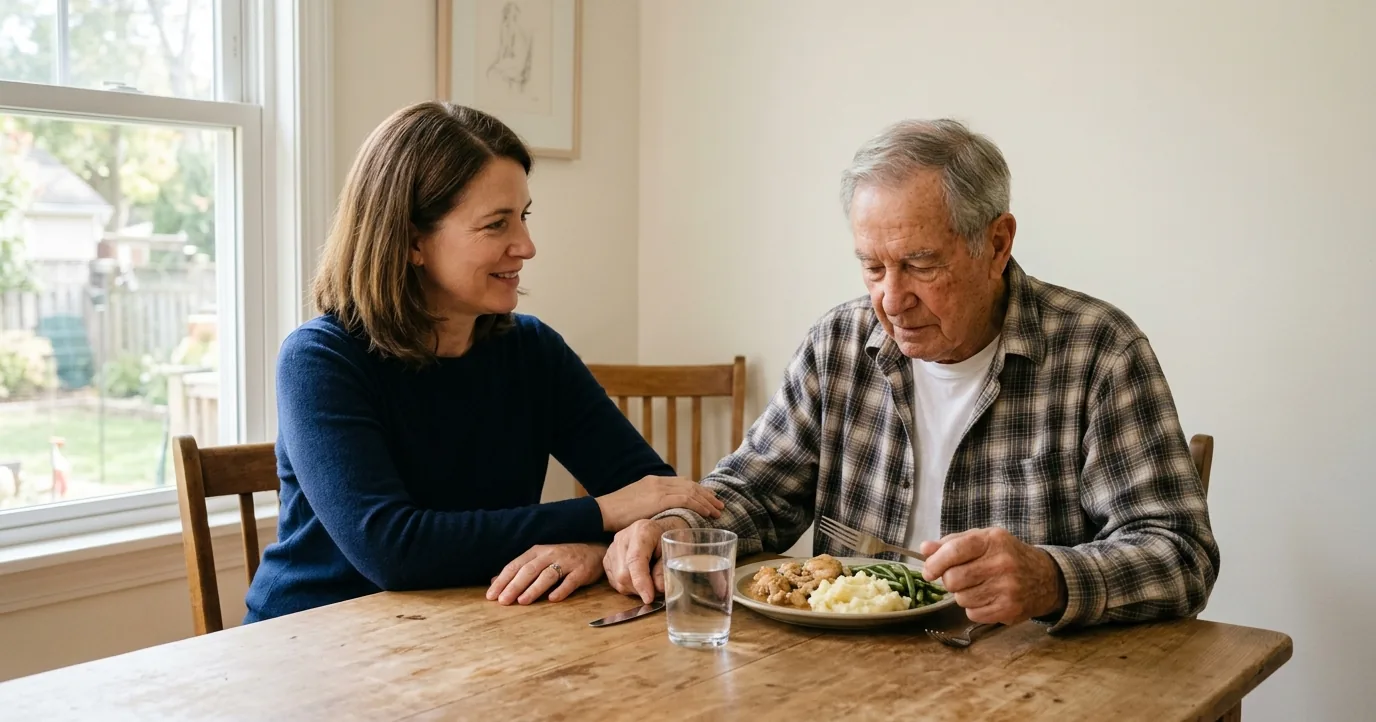
The plate comes back the way it went out. You cooked the thing she has liked for fifty years, and she pushed it around with the fork and then set the fork down. Maybe she says she already ate. Maybe she says she is not hungry, or says nothing at all. A month later her rings turn on her finger, and at the next appointment the scale is down nine pounds.
Weight loss is one of the most reliable signs that dementia is advancing, and that fact quietly does a lot of harm, because it teaches families to read an untouched plate as something to accept. Often it is not. Eating falls apart in dementia for a stack of separate reasons, and a good share of them are fixable in your own kitchen this week: a sore tooth, a new prescription, a plate the food vanishes into, a meal served at the wrong hour. The disease is real, and in the end it does take eating away. Everything before the end is worth working for.
Weight Is a Number, So Track It Like One
“She seems thinner” is not usable information at a doctor’s appointment. A number is.
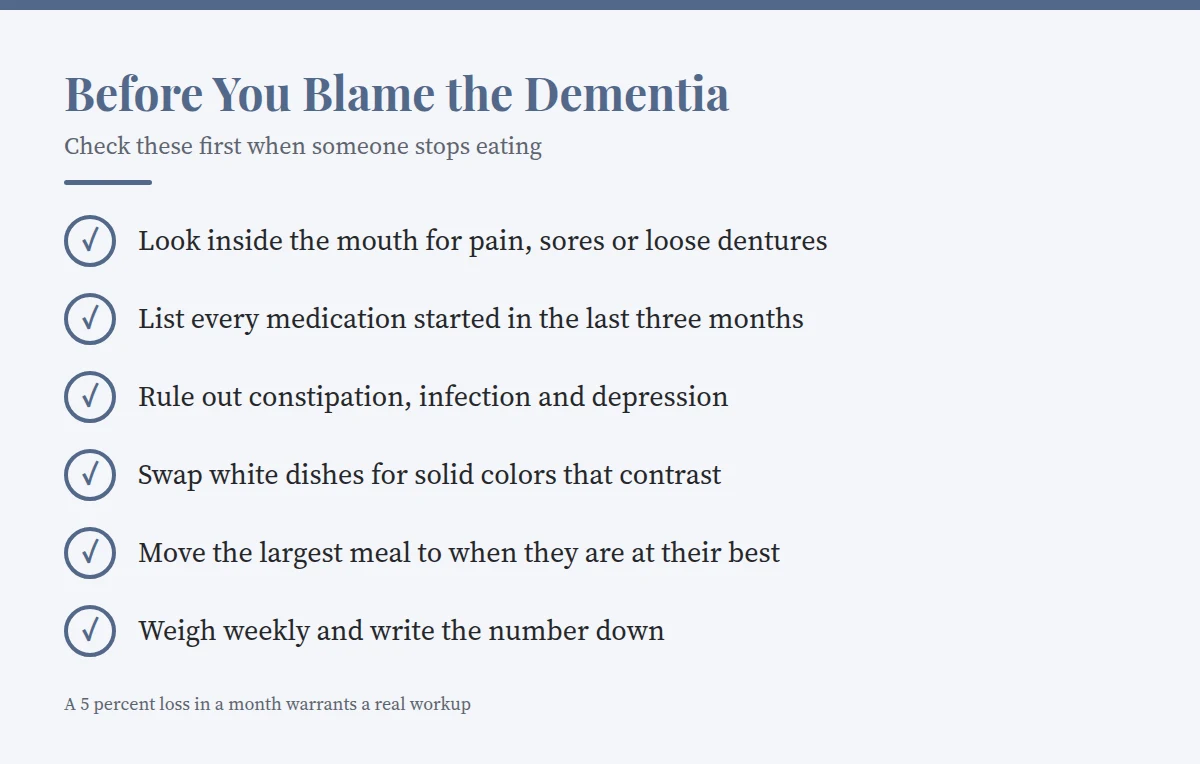
Weigh the person once a week, on the same scale, on the same day, at the same time of day, in similar clothing, and write it in one place. A phone note works. So does the back of a calendar. What you are watching for is the threshold clinicians use: a loss of about 5 percent of body weight in a month, or 10 percent over six months, counts as significant unintended weight loss and warrants a real workup. For a 150-pound person that is seven and a half pounds in a month. It can pass unnoticed by everyone who sees her every day.
This matters beyond the number on the scale. Losing weight in later life costs muscle before it costs fat, and less muscle means more falls, slower healing, thinner skin that breaks down, and weaker resistance to the infections that put people with dementia in the hospital. Weight that comes off at this stage is very hard to put back on. Catching a downward trend at four pounds is a different problem from catching it at twenty.
Bring the log to the appointment. A physician looking at eight weekly weights will act on a pattern that a single reading would never surface.
Nine Reasons the Plate Comes Back Full
Before concluding that the dementia has simply progressed, run the list. Most of these are ordinary, treatable problems that happen to show up as a refused meal.
- A painful mouth. Broken teeth, an abscess, thrush, a mouth ulcer, or dentures that no longer fit a thinner face. The person often cannot tell you it hurts, so they stop eating instead. This is the single most productive thing to check first.
- Medication. Donepezil and the other cholinesterase inhibitors commonly cause nausea and appetite loss. So do many antidepressants, antibiotics, and pain medicines. Any new drug or dose change in the weeks before the appetite dropped is a suspect.
- Constipation. A backed-up bowel kills appetite completely and is easy to miss in someone who cannot report it.
- Depression. Common in dementia, frequently mistaken for the dementia itself, and treatable.
- Not recognizing the food. The brain can lose the link between the object on the plate and the idea of something to eat.
- Lost smell and taste. Olfactory decline is one of the earliest changes in Alzheimer’s. Food that no longer smells of anything stops being tempting, which is why a lifelong favorite can suddenly be rejected.
- Not being able to see it. Damage to visual processing means pale food on a pale plate can genuinely disappear.
- Forgetting, or believing they already ate. Common in the middle stage and not worth arguing about.
- Not enough daytime activity. A person who sits all day does not build an appetite. A walk before lunch does more for intake than most supplements.
Take the results of that list to the primary care physician and ask for three things by name: a medication review, a check for constipation and infection, and a dental appointment. Only when that comes back clean is it fair to call the change progression.
Set the Table So the Food Can Be Seen
The cheapest fixes are environmental, and they work best in the middle stage, when perception is failing but the hands still function.
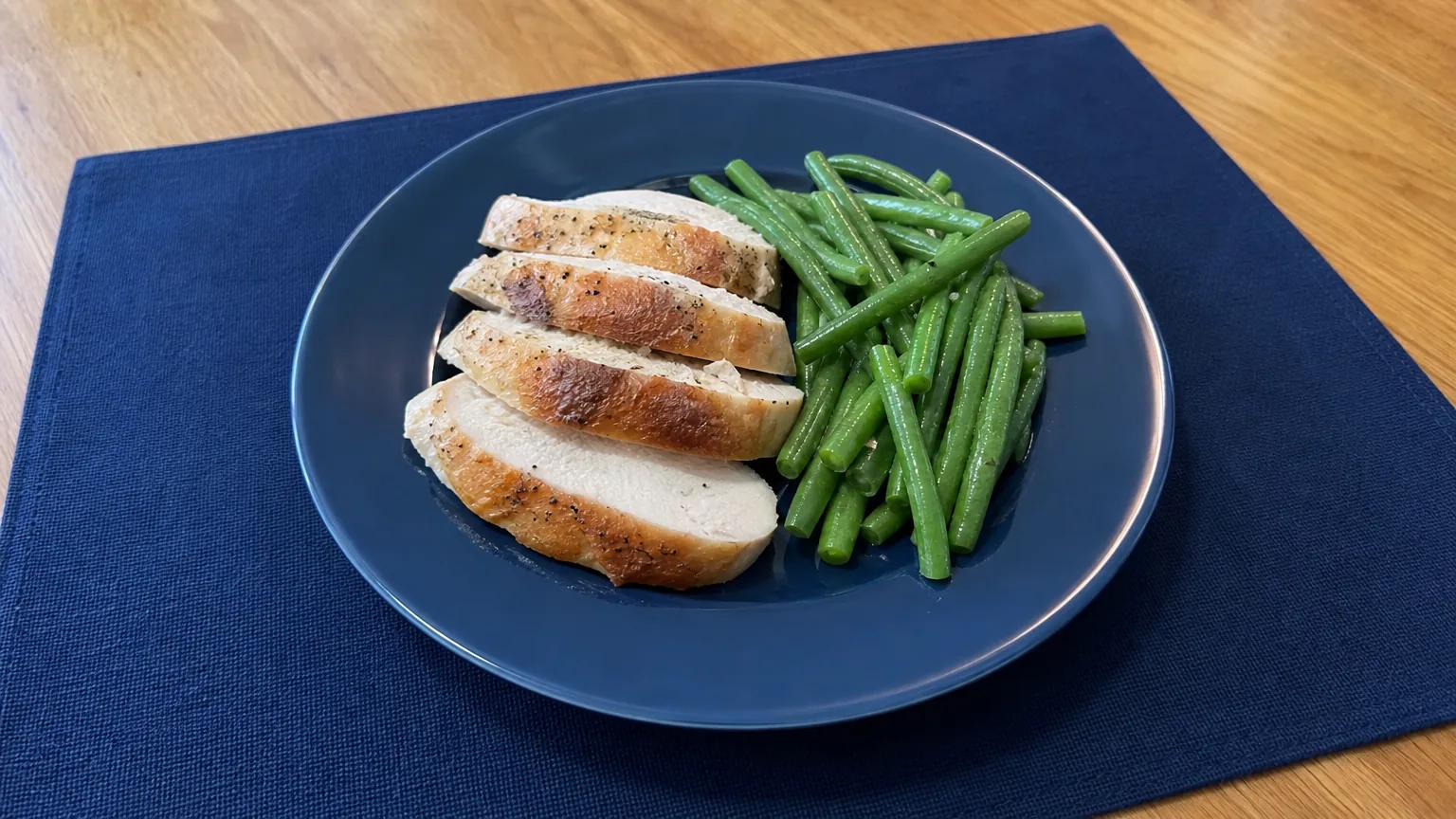
Use plain, solid-colored dishes with no pattern, on a plain placemat, in a color that contrasts sharply with the food. Mashed potatoes and chicken on white china on a white cloth is close to invisible to a brain that has lost contrast sensitivity. The research behind this is surprisingly strong for such a small intervention, and it is covered in more depth in the guide to how memory care dining rooms are engineered for dementia.
Then take everything else away. Turn off the television. Clear the flowers, the mail, the salt and pepper, and every utensil except the one needed for this course. Put one or two foods on the plate rather than a full dinner, and bring the next item when the first is gone, because a crowded plate is a decision problem for someone who can no longer make decisions.
Serve the largest meal when the person is at their best, which for most people is breakfast or lunch rather than the end of the day, when fatigue and sundowning are at their worst. Allow an hour and do not hover. And always test the temperature yourself, because a person with dementia may not register that soup is hot enough to burn. These habits sit alongside the rest of daily personal care in dementia, and they follow the same rule: change the environment before you try to change the person.
Cook for the Appetite You Have, Not the One You Wish For
Standard nutrition advice inverts once weight loss is the main threat. Calorie density becomes the goal, and a low-salt or low-fat or diabetic diet that is costing an underweight person their last interest in food is usually the wrong trade. Ask the physician directly whether the diet can be loosened. That conversation, called diet liberalization, is a normal one in geriatrics.
Fortify the food she already eats rather than replacing it. Stir cream, butter, whole milk, or powdered milk into mashed potatoes, soups, oatmeal, and scrambled eggs. Add cheese, nut butters, avocado, olive oil, and full-fat yogurt. A milkshake made at home with ice cream and whole milk beats a pharmacy supplement on both calories and willingness. Keep supplements for between meals if the doctor suggests them, not in place of a meal.
Lean into the sweet tooth. Sweet taste tends to survive longest in dementia, and this is one of the rare situations where adding sugar to savory food is legitimate clinical advice rather than a lapse. If the only thing she will finish is dessert, start with dessert.
Six small offerings beat three formal meals. Keep a plate of something visible and reachable on the counter all day. And cook what she grew up with, not what she ate last year: the foods that carry the deepest memory are often the ones that still register.
Finger Foods Buy You Years
When the fork stops working, the assumption is that being fed comes next. It should not, and usually it does not have to for a long time.
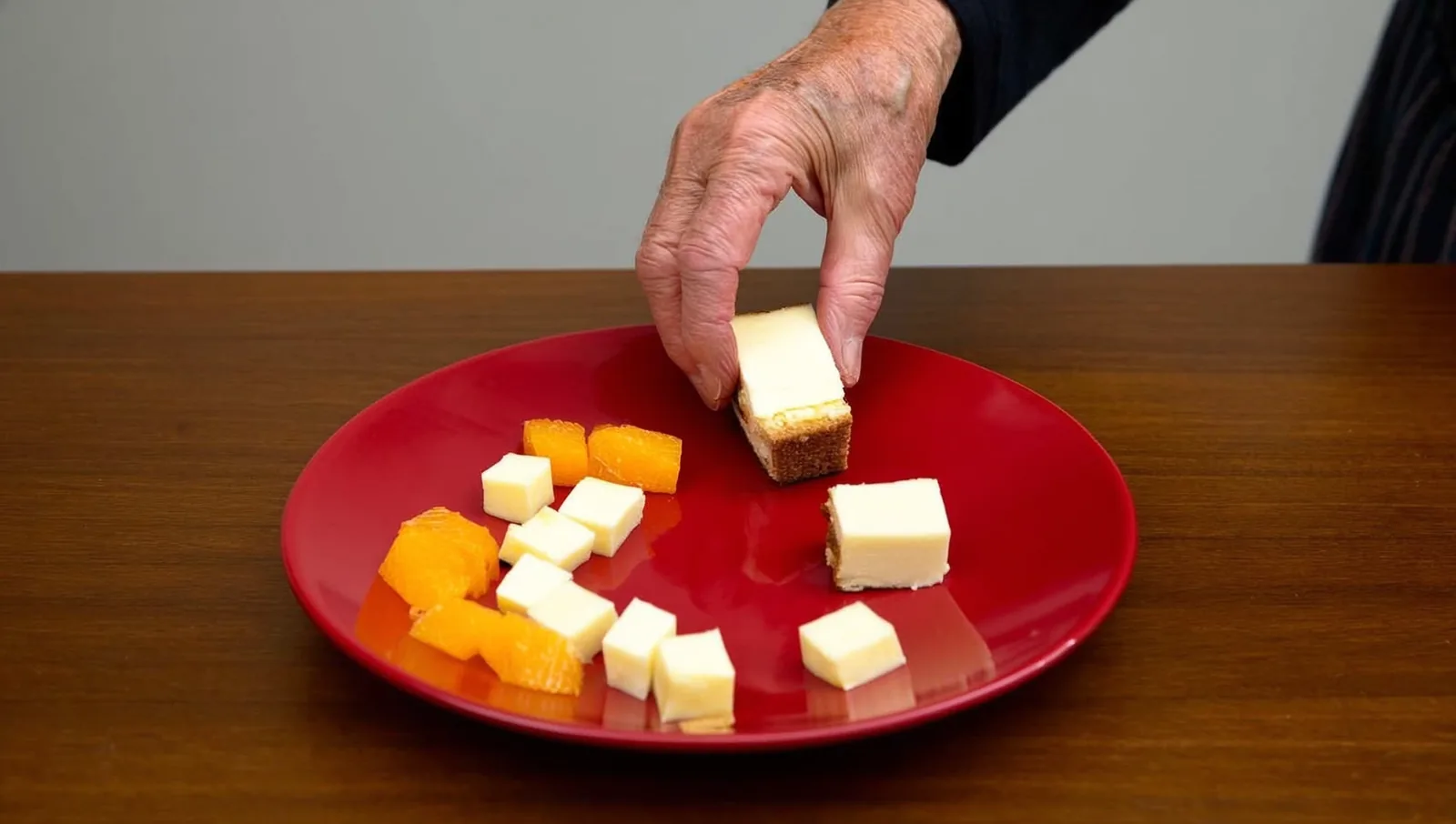
Almost any meal can be rebuilt into something a hand can manage: sandwich quarters, chicken tenders, meatballs, cheese cubes, hard-boiled eggs, roasted potato wedges, steamed broccoli florets, orange segments, banana pieces, breakfast bars. A person who can no longer aim a utensil can often keep feeding themselves for another year or two this way, and self-feeding protects both intake and dignity in a way that being spoon-fed does not.
Where help is needed, try cueing before feeding. Put the spoon in her hand, place your hand over hers, and start the motion toward the mouth. Very often the sequence takes over from there. Sitting down beside her and eating the same food at the same time does more than any instruction, because eating is imitative and people with dementia read the room long after they stop reading words.
Hydration Is the Problem You Notice Last
Dehydration rarely announces itself. It shows up as sudden confusion, a urinary tract infection, a fall, or a level of agitation that looks like the disease taking a step down. Families often discover it only after an emergency room visit that could have been avoided.
Thirst perception fades in dementia, so the person will not ask. Offer small amounts often instead: a few ounces every hour, attached to something that already happens (the morning pills, the walk, the television program) rather than left in a pitcher across the room. Use whatever she will actually drink, including juice, milk, decaf tea, and broth. Water-heavy foods count too, so soups, melon, yogurt, ice pops, and smoothies all move the needle.
One thing not to do: never restrict fluids to reduce incontinence. It trades a laundry problem for a delirium problem, and it makes urinary infections more likely, not less.
When Swallowing Starts to Change
Swallowing trouble, called dysphagia, arrives in the later stages for most people with dementia, and it is the point where mealtimes stop being only about nutrition and start being about safety. Aspiration pneumonia, caused by food or liquid going into the lungs, is among the most common causes of death in advanced dementia.
Watch for these signs at the table:
- Coughing, choking, or throat clearing during or just after meals
- A wet or gurgly voice after swallowing
- Food held in the cheek, or a mouth still full long after the bite
- Chewing for a very long time, or refusing to swallow at all
- Watering eyes or a red face while eating
- Repeated chest infections, or a low-grade fever with no obvious source
Any of these earns a call to the physician and a request for a swallowing evaluation by a speech-language pathologist. Medicare Part B covers it with a physician order, it can often be done at home, and the therapist will recommend a specific food texture and liquid consistency rather than leaving you to guess.
In the meantime, the basics matter more than any product. Have her sit fully upright, never propped in bed or reclining, and keep her upright for thirty minutes afterward. A slight chin tuck toward the chest as she swallows narrows the airway and helps. One small bite at a time, no talking with food in the mouth, and no rushing. Check that the mouth is empty before the next bite and again at the end of the meal. Never feed anyone who is drowsy, agitated, or lying down.
Brush her teeth and gums after meals even if she eats almost nothing. Aspiration pneumonia is driven as much by the bacteria in the mouth as by the food going the wrong way, and good oral care is one of the few measures shown to reduce it.
Two cautions. Thickened liquids are frequently recommended, but the evidence that they improve survival is weak, and they often make people drink less and become dehydrated, so treat them as a therapist’s specific recommendation rather than a default. And blending a whole dinner together makes it unrecognizable and unappetizing; puree each food separately and keep the colors apart.
The Feeding Tube Question
At some point a hospital may raise a feeding tube, often during an admission for pneumonia, often at the worst possible hour.
The American Geriatrics Society recommends against it, and the reasoning is worth understanding rather than simply accepting. On every outcome anyone has managed to measure (how long people live, how often they get pneumonia, what they can still do, how comfortable they are), being fed by hand does at least as well. A Cochrane review found no evidence that tube feeding lengthens life in severe dementia. What a tube does reliably add is harm: agitation, restraints of one kind or another to stop the person pulling at it, and new pressure ulcers. The recommended alternative is everything the sections above describe, done patiently.
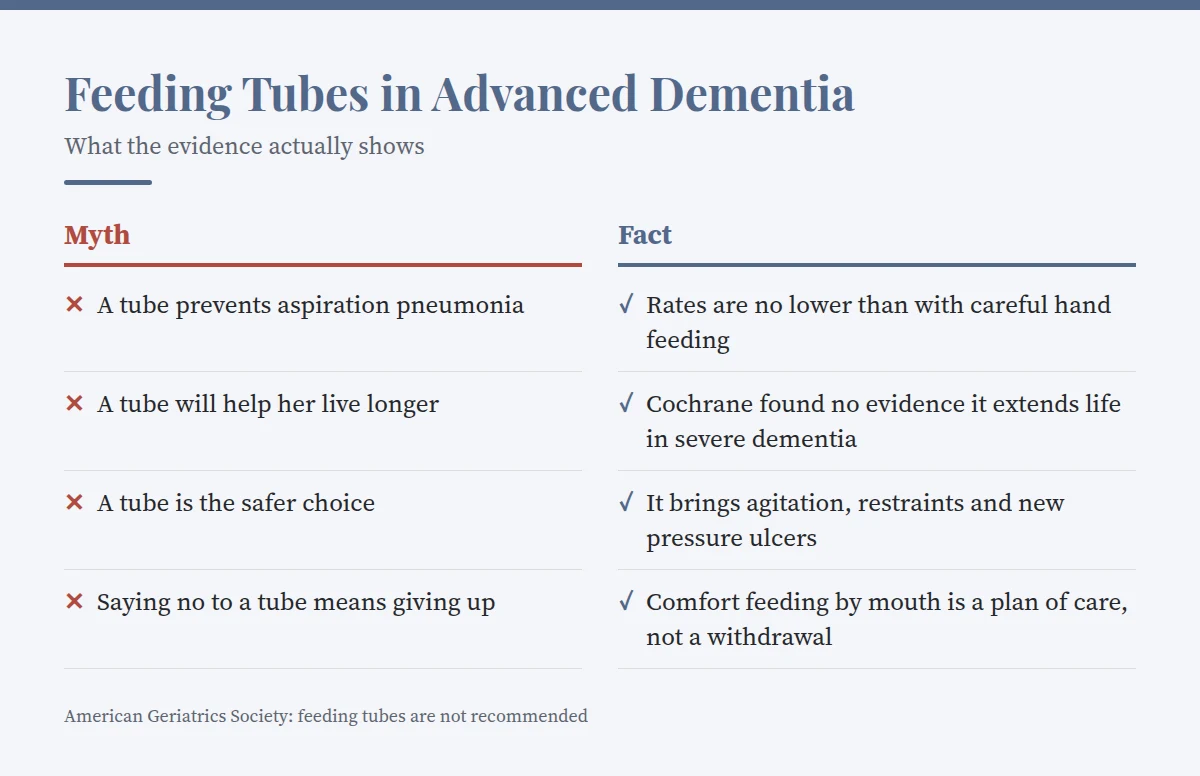
There is a formal alternative worth knowing by name. A “comfort feeding only” order directs staff to offer food and fluid by mouth for pleasure and comfort, as much as the person wants and tolerates, with no target volume and no obligation to finish. It is a plan of care, not a withdrawal of care, and it can be written into a chart.
This decision should never be met for the first time in a hospital corridor at 2 a.m. It belongs in an advance directive written while the person can still say what they want. And a persistent eating problem with ongoing weight loss is itself one of the clinical markers that can support hospice eligibility in end-stage dementia, which brings in a nurse, an aide, and equipment at no cost to the family.
What to Do This Week
Weigh her and start writing it down. Look inside her mouth. List every medication that started in the last three months. Buy four solid-colored plates that are not white. Move the big meal to lunch. Turn the television off at the table.
Then watch one whole meal without helping and simply notice where it breaks down, because the fix depends entirely on which link in the chain is failing. Feeding the people we love is the oldest way we have of saying it, and when they stop eating it can feel like a personal failure, particularly for anyone already stretched thin by holding down a job alongside all of this. It is not. A dietitian, a speech-language pathologist, and a geriatric care manager can each take a piece of this off you, and asking for them early is the difference between managing a decline and being flattened by one.
Sources
- Alzheimer’s Association on the causes of poor appetite and how to set up a calmer meal
- Alzheimer’s Association for food, fluids, and positioning in late-stage caregiving
- National Institute on Aging with practical advice for helping someone with Alzheimer’s eat well
- Alzheimer’s Society covering eating, drinking, and swallowing difficulties in dementia
- American Geriatrics Society on why feeding tubes are not recommended in advanced dementia
- Cochrane for the evidence on enteral tube feeding in severe dementia
- ASHA explaining what a swallowing evaluation involves
Further reading
- Daily Personal Care for a Loved One With Dementia: The Complete ADL Caregiver Guide
- Beyond the Menu: How Memory Care Dining Adapts to Dementia (and What to Ask on a Tour)
- Hospice Care for End-Stage Dementia: When and How to Bring It In
- Hospital Stays and ER Visits With Dementia: The Complete Family Survival Guide
- Advance Directives and Power of Attorney: The Legal Documents Every Family Needs After a Dementia Diagnosis
- In-Home Memory Care: When to Consider It and How to Get Started